
Punk vs. New Wave: Two Rebellions That Sounded Nothing Alike
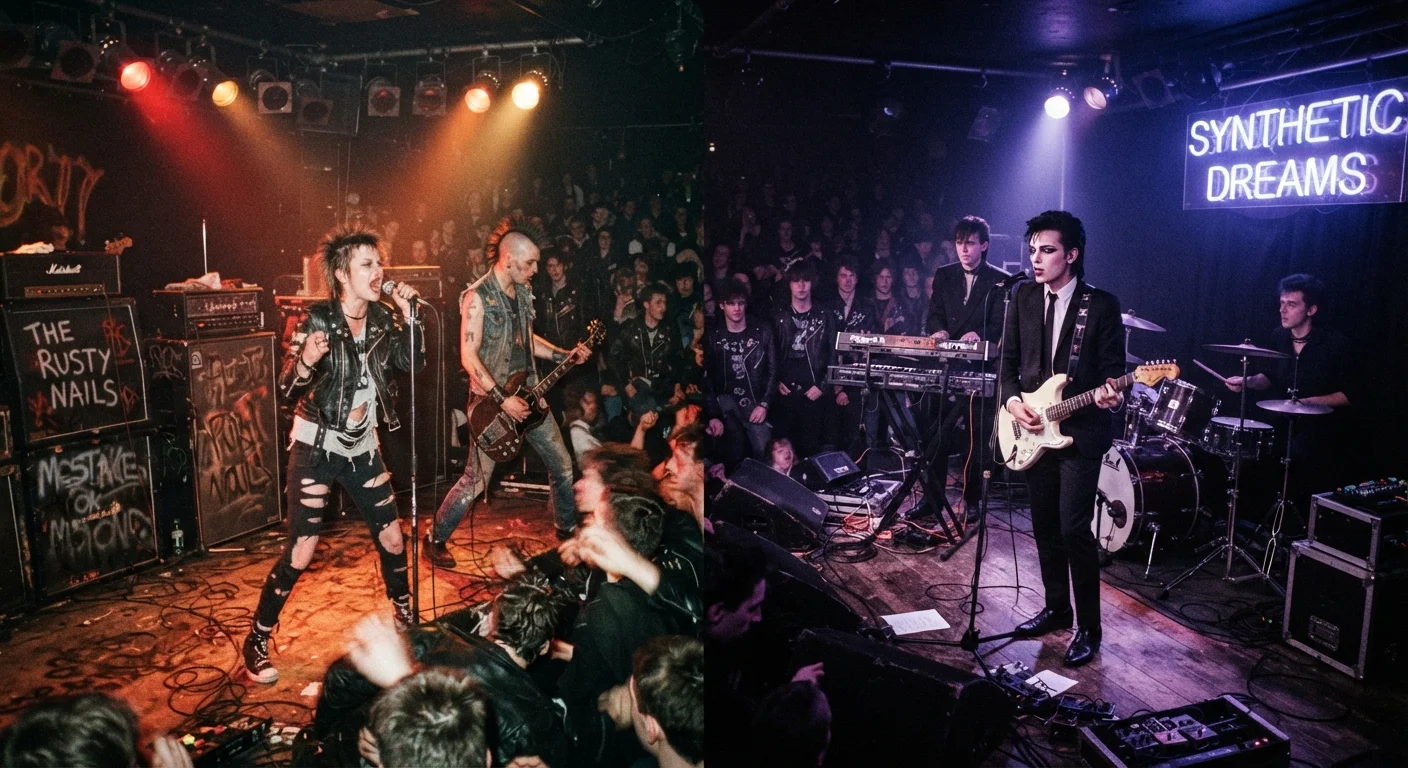
Photo credit: faqsnest.com
In this article
Punk and New Wave both rejected 1970s excess, but their sounds, politics, and legacies diverged sharply. Here's how to tell them apart.
Key Takeaways
- Punk prioritized raw aggression and anti-establishment politics over technical polish or commercial appeal.
- New Wave absorbed punk's rebellious spirit but embraced synthesizers, art influences, and radio-friendly production.
- Both movements emerged in the mid-to-late 1970s as direct rejections of arena rock and disco excess.
- The two genres share a historical moment but diverge sharply in sound, aesthetics, and cultural impact.
- New Wave's commercial success carried it through the 1980s MTV era, while punk splintered into hardcore and post-punk.
- Understanding both genres clarifies decades of rock, indie, and alternative music that followed.
The Same Moment, Two Very Different Responses
By the mid-1970s, mainstream rock had grown enormous — stadium tours, elaborate concept albums, and a growing distance between musicians and their audiences. Two movements emerged almost simultaneously in the UK and US to push back against that bloat, but they did so in strikingly different ways.
Punk, crystallized in the UK by bands like the Sex Pistols and the Clash and in New York by groups like the Ramones and Television, was a deliberate act of subtraction. Three chords, short songs, no solos, and confrontational lyrics targeting the establishment, the monarchy, unemployment, and boredom. The message was that technical virtuosity was a distraction — anyone could and should make music.
New wave grew partly from the same clubs and scenes — CBGB in New York, the 100 Club in London — but it moved in a different direction. Acts like Blondie, Talking Heads, Devo, and the Cars absorbed punk's anti-establishment attitude while layering in art school sensibilities, synthesizers, danceable rhythms, and an enthusiasm for studio craft. Where punk stripped away, new wave added and reconfigured.
Sound, Style, and Instrumentation
The sonic difference between punk and new wave is immediate and unmistakable. Punk recordings — especially early British releases — are often deliberately lo-fi: distorted guitars, pounding drums, and vocals delivered at maximum intensity. Production choices were partly ideological; a polished record implied commercial compromise.
New wave, by contrast, embraced the recording studio as a creative tool. Synthesizers and drum machines moved from novelty to central instrument. Devo's robotic precision, Gary Numan's icy electronics, and the Police's reggae-inflected arrangements all reflected a genre comfortable with eclecticism. Hooks mattered. Melody was not a betrayal.
| Criterion | Punk | New Wave |
|---|---|---|
| Core instrumentation | Distorted guitar, bass, drums | Synthesizers, guitar, drum machines |
| Production approach | Lo-fi, raw, minimal overdubs | Studio-crafted, layered, polished |
| Political tone | Explicit, confrontational | Ironic, abstract, ambiguous |
| Relationship to commerce | Actively anti-commercial | Compatible with mainstream success |
| MTV/visual culture | Minimal engagement | Central to identity and reach |
| Key descendant genres | Hardcore, post-punk, indie rock | Synth-pop, dance-rock, art-pop |
Visually, punk favored ripped clothing, safety pins, and an aesthetic of controlled destruction — much of it curated by figures like Malcolm McLaren and Vivienne Westwood, though with genuine subcultural roots. New wave's look was more theatrical and varied: the angular geometry of post-punk fashion, bold color, and an eye for irony that translated well to music videos and magazine covers.
Politics and Intent
Punk carried genuine political weight in a way that new wave generally did not. The Clash's London Calling addressed nuclear anxiety, racial tension, and economic collapse. The Sex Pistols attacked the monarchy and the music industry simultaneously. American hardcore acts that grew from punk — Black Flag, Dead Kennedys — pushed the political confrontation even further.
New wave's politics were subtler and more ambiguous. Talking Heads explored alienation and consumer culture through an anthropological lens. Devo satirized conformity and de-evolution as social commentary. The themes were often sharp, but they were filtered through irony and abstraction rather than delivered as direct challenge. That ambiguity made new wave easier to commodify — and ultimately more commercially durable.
This distinction matters when tracing each genre's legacy. Punk's explicit anti-commercialism created an internal tension: bands that achieved mainstream success risked accusations of selling out. New wave faced no such paradox; mainstream success was compatible with its values, which is partly why it dominated early MTV programming throughout the early 1980s.
Legacy and Lasting Influence
Punk fractured quickly. By the early 1980s, it had splintered into post-punk (Joy Division, Wire), hardcore (Minor Threat, Black Flag), and eventually the alternative and indie underground that shaped college radio throughout the decade. The DIY ethic became infrastructure — independent labels, zines, and touring circuits that operated entirely outside major-label systems.
New wave's commercial peak ran roughly from 1979 through 1986, powered by MTV's appetite for visually compelling, radio-ready acts. Its influence flows into synth-pop, dance-rock, and the art-pop that artists continue to produce today. The genre's comfort with image-making and studio experimentation seeded entire production aesthetics still audible in contemporary pop and indie music.
The Overlap Is Real — and Intentional
Many artists defied easy categorization. The Clash incorporated reggae and funk. Blondie moved fluidly between punk clubs and disco. Elvis Costello remains claimed by both camps. The boundary between punk and new wave was always porous — which is part of what made the late 1970s one of the most generative periods in rock history. Scholars and critics continue to debate the boundaries, and that productive ambiguity is itself part of the story.
What unites both movements, despite their differences, is a shared insistence that rock music had grown complacent — and that the response was not nostalgia but invention. Punk and new wave didn't just complain about the mainstream; they built alternatives to it. That instinct to construct something new rather than merely critique something old is perhaps the most enduring lesson both genres left behind.

Author
Entertainment & Media Editorial Team
Entertainment & Media Editorial Team is the collective byline for our editorial team and contributor network. Articles published under this byline or an editorial pen name are researched, written, and reviewed according to our editorial standards for clarity, consistency, and independence before publication.
View all articles →