
Film Noir: Shadow, Cynicism, and the Crime Stories That Defined Postwar Cinema
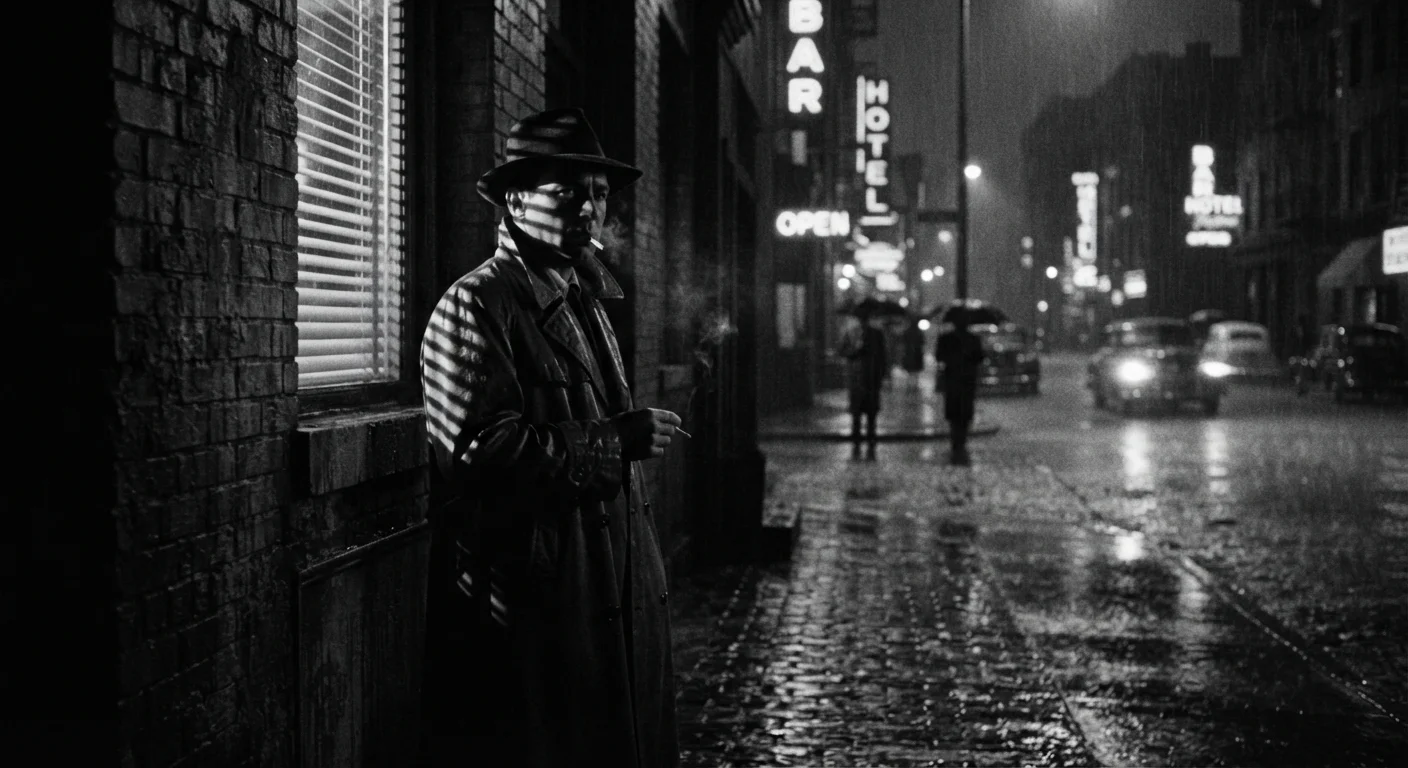
Photo credit: faqsnest.com
In this article
Trace the origins of film noir, its visual grammar of shadow and light, and how it reflected postwar America's anxieties.
Key Takeaways
- Film noir emerged in the 1940s from hardboiled fiction, German Expressionism, and postwar American disillusionment.
- Its signature visual style uses low-key lighting, deep shadows, and canted angles to externalize moral ambiguity.
- Recurring archetypes — the cynical detective, the femme fatale, the ordinary man trapped by fate — carry symbolic cultural weight.
- The genre reflected genuine anxieties about returning veterans, shifting gender roles, and Cold War paranoia.
- Neo-noir adaptations continue to evolve the tradition across film, television, and streaming.
What Is Film Noir?
Film noir is both a stylistic mode and a thematic sensibility that dominated American crime cinema roughly between 1941 and 1958. The term itself — French for dark film — was coined by French critic Nino Frank in 1946, when European audiences, denied Hollywood imports during World War II, encountered a wave of American pictures that felt strikingly different from prewar studio fare. What distinguished them was not simply plot, but a pervasive atmosphere of moral corruption, fatalism, and existential dread rendered through a precise visual vocabulary.
Scholars debate whether noir constitutes a genre, a cycle, or a style. Unlike westerns or musicals, noir is defined less by setting or subject than by tone and technique. A noir film may be a hardboiled detective story, a domestic thriller, or a heist picture — but all share an organizing worldview in which institutions fail, trust collapses, and characters are undone by desire or circumstance. Understanding that worldview is essential to reading noir critically. The framework for critical film viewing that addresses cinematography and mise-en-scène is particularly useful when approaching noir, whose meaning often lives in the frame rather than the dialogue.
Origins: The Literary and European Roots
Film noir did not emerge from a single source. Its DNA combines American hardboiled fiction of the 1920s and 1930s — Dashiell Hammett, Raymond Chandler, James M. Cain — with the chiaroscuro aesthetics of German Expressionism and the sociological cynicism of French Poetic Realism. When European filmmakers fled Nazism and arrived in Hollywood during the late 1930s, they brought with them a visual sensibility shaped by films like The Cabinet of Dr. Caligari and M.
Directors such as Fritz Lang, Billy Wilder, Otto Preminger, and Robert Siodmak transplanted expressionist techniques — distorted shadows, claustrophobic compositions, high-contrast lighting — onto the grammar of American crime storytelling. The collision produced something neither purely European nor straightforwardly Hollywood: a cinema of surfaces that concealed psychological depths. This creative cross-pollination parallels broader currents of influence explored in world cinema movements that reshaped the art form.
~300
Films identified as classical noir
Film historians have catalogued approximately 300 films within the classical noir period of 1941–1958, according to cinema reference works including Silver and Ward's comprehensive survey.
1946
Year the term 'film noir' was coined
French critic Nino Frank introduced the term in 1946 after French audiences first encountered a cluster of postwar American crime films.
~60%
Émigré directors in noir's formative years
Film historians estimate that a significant majority of key classical noir titles were directed or photographed by European émigrés fleeing Nazism, per accounts in scholarly studies of Hollywood's studio era.
The Visual Grammar of Shadow and Light
No element of film noir is more immediately recognizable than its photography. Cinematographers such as John Alton — whose 1949 book Painting with Light remains a foundational text — developed a low-key lighting approach that placed dramatic shadows at the center of meaning. Venetian blind patterns sliced across faces. Single-source lights created deep chiaroscuro. Wide-angle lenses distorted space in ways that made even familiar rooms feel menacing.
Canted camera angles (Dutch tilts) suggested psychological instability. Night-for-night exterior photography placed characters in rain-slicked streets that reflected neon signs — an environment that felt simultaneously modern and nightmarish. These were not decorative choices. As reading a film's mise-en-scène makes clear, every element placed in front of a lens carries interpretive weight. In noir, darkness is not merely atmosphere — it is moral argument made visible.
Archetypes: The Detective, the Femme Fatale, and the Doomed Man
Film noir established character archetypes that have proven remarkably durable. The private detective — world-weary, morally flexible, operating outside official systems — navigates a corrupt world without illusions. He is not heroic in any conventional sense; his authority comes from experience and cynicism rather than virtue.
The femme fatale is noir's most contested figure. She is typically beautiful, intelligent, and dangerous — a woman who uses male desire as a tool. Feminist critics have noted the archetype's ambivalence: these characters possess a kind of agency denied to most women in mainstream Hollywood cinema, yet they are ultimately punished for exercising it. The femme fatale reflects genuine postwar anxieties about women who had entered the workforce and gained economic independence during wartime, and who now represented an unsettling shift in social order.
The third archetype — the ordinary man drawn into catastrophe by circumstance or temptation — is perhaps the most philosophically significant. In films like Double Indemnity (1944) and Out of the Past (1947), protagonists are not defeated by external villains but by their own choices. Fate in noir is rarely external; it is the consequence of desire given free rein.
Postwar Anxiety and the Cultural Context
Film noir's emergence coincided with a specific historical moment of profound social dislocation. Returning veterans encountered a domestic landscape that had changed in their absence. Women had worked, earned wages, and occupied public roles previously closed to them. The atomic bomb had introduced existential uncertainty on a civilizational scale. Cold War paranoia — the suspicion that enemies might be neighbors, that loyalty was a performance rather than a fact — suffused public life.
Noir gave cinematic form to these anxieties. Its corrupt institutions, unreliable narrators, and doomed protagonists mirrored a culture that had lost faith in the progressive optimism of prewar America. The genre also registered racial tensions that mainstream Hollywood rarely acknowledged directly: urban crime settings, jazz soundscapes, and the occasional crossing of racial boundaries all signaled a social landscape in flux, even when those themes remained largely subtext.
Landmark Films and Their Lasting Influence
Any serious engagement with film noir requires attention to a core group of films that defined its possibilities. The Maltese Falcon (1941, directed by John Huston) established the archetypal detective narrative and launched Humphrey Bogart's defining persona. Double Indemnity (1944, Billy Wilder) remains a masterclass in unreliable narration and the mechanics of complicity. Sunset Boulevard (1950, also Wilder) extended noir's logic into Hollywood itself, turning the film industry into a metaphor for delusional self-destruction.
Other essential titles include Laura (1944), The Big Sleep (1946), Out of the Past (1947), Criss Cross (1949), and Touch of Evil (1958) — the latter widely considered the last major film of the classical noir cycle. What unites them is not formula but sensibility: a refusal of easy resolution, a preference for ambiguity, and a visual style that treats shadow as the natural habitat of human motivation.
Neo-Noir and the Genre's Continued Relevance
Film noir did not end in 1958 — it transformed. Neo-noir, which emerged through the 1970s with films like Chinatown (1974) and The Long Goodbye (1973), consciously revisited and interrogated the classical period's assumptions. Where classical noir often punished transgression to satisfy censorship requirements, neo-noir dispensed with moral resolution entirely. Roman Polanski's Chinatown ends not with justice but with its systematic, irrevocable defeat — a revision of the genre that many critics read as a direct response to Watergate and Vietnam.
Contemporary neo-noir extends across television and streaming: series like True Detective (HBO, 2014) and Mindhunter (Netflix, 2017–2019) deploy noir's visual language and fatalistic worldview within long-form narrative structures, demonstrating how durable the sensibility remains. The persistence of noir — across media, decades, and national contexts — speaks to something it identified about modernity itself: the suspicion that order is always temporary, that the dark is never far from the edge of the frame.

Author
Entertainment & Media Editorial Team
Entertainment & Media Editorial Team is the collective byline for our editorial team and contributor network. Articles published under this byline or an editorial pen name are researched, written, and reviewed according to our editorial standards for clarity, consistency, and independence before publication.
View all articles →