
World Cinema Beyond Hollywood: Seven Movements That Reshaped the Art Form
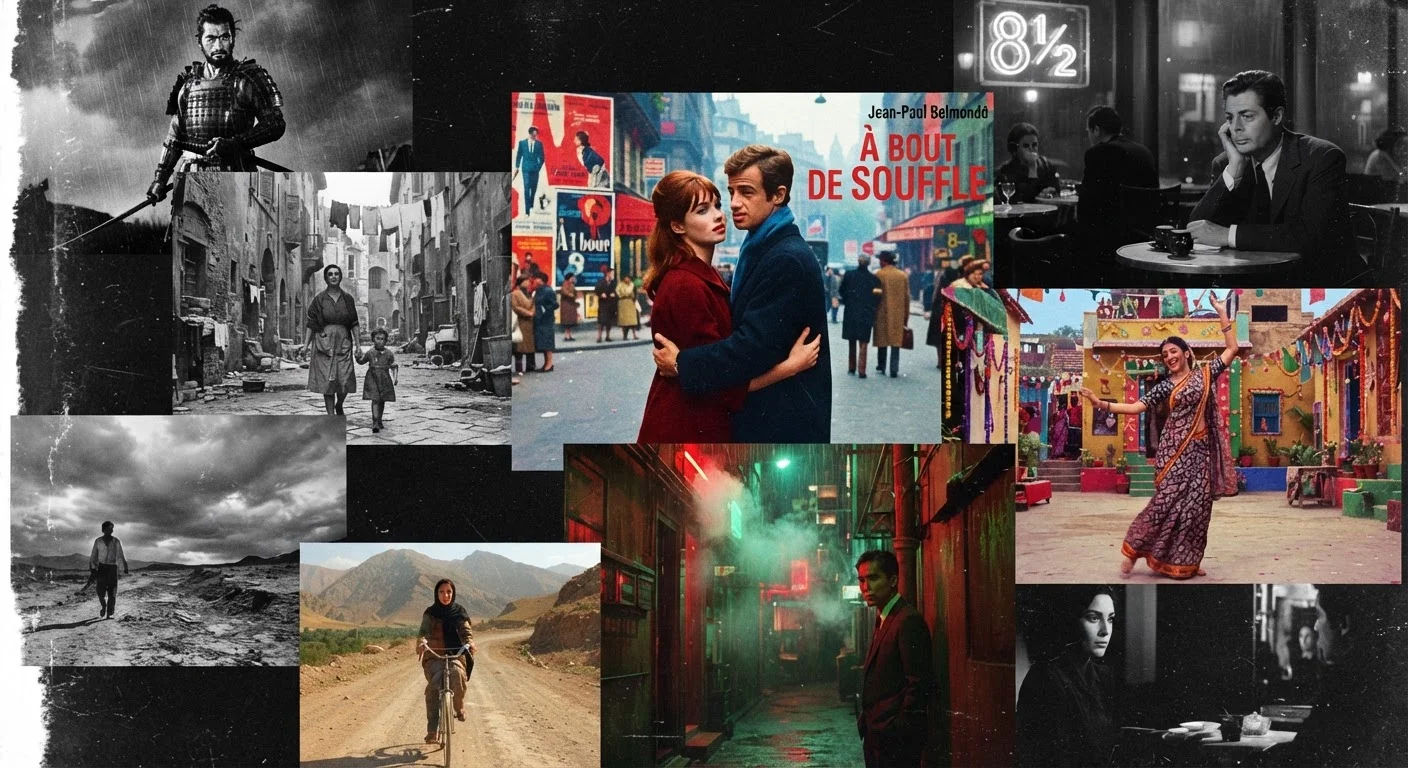
Photo credit: faqsnest.com
In this article
From Italian Neorealism to the Korean New Wave, these global film movements challenged convention and changed what cinema could express.
Key Takeaways
- World cinema movements were almost always responses to political upheaval, social crisis, or cultural repression.
- Many techniques now standard in Hollywood — handheld cameras, jump cuts, location shooting — originated in global movements.
- Understanding these movements deepens how audiences read any film, regardless of its country of origin.
- The Korean New Wave represents one of the most commercially and critically successful global cinema surges in recent history.
- Film movements rarely die — their ideas resurface across generations and continents.
Why Film Movements Matter
Cinema has never been a single, unified art form — it has always been a field of competing visions, shaped by geography, ideology, economics, and revolt. The most transformative developments in film history have often originated not in Hollywood studios but in postwar apartments in Rome, cramped editing rooms in Paris, or state-funded studios in Tehran. These movements didn't just produce great individual films; they fundamentally redefined what cinema could do and who it could speak for.
For anyone serious about understanding film — whether building a personal film canon or simply wanting to watch more critically — these seven movements offer essential context. They clarify where modern cinematic language comes from and why so much of it still resonates.
Italian Neorealism (1940s–1950s)
Emerging from the rubble of Fascism and World War II, Italian Neorealism was less a manifesto than a moral necessity. Directors such as Roberto Rossellini, Vittorio De Sica, and Luchino Visconti rejected the theatrical artifice of studio filmmaking in favor of location shooting, non-professional actors, and stories drawn from working-class and impoverished life. Films like Bicycle Thieves (1948) and Rome, Open City (1945) treated dignity and desperation as equally worthy of the camera's gaze.
The movement's formal innovations — natural light, documentary-style framing, elliptical plotting — gave future generations a template for depicting social reality without sentimentality. Its influence can be traced through the British Kitchen Sink movement, Brazilian Cinema Novo, and American independent film.
Neorealism treated the lives of ordinary people as inherently worthy of serious cinematic attention.
French New Wave (1950s–1960s)
Born partly from film criticism — the writers at Cahiers du Cinéma who became directors — the French New Wave (La Nouvelle Vague) was an act of creative rebellion against polished, literary French cinema. Jean-Luc Godard, François Truffaut, Agnès Varda, and their contemporaries brought jump cuts, direct address to the camera, and a self-conscious playfulness with film grammar that broke the invisible fourth wall audiences had taken for granted.
The movement also advanced the auteur theory — the idea that the director is the primary author of a film, akin to a novelist — which remains one of the dominant frameworks for film criticism worldwide. Understanding the visual grammar filmmakers deploy becomes considerably richer when read through this lens.
The New Wave insisted that cinema's grammar itself could be the subject of a film.
Japanese New Wave (1950s–1970s)
Often overshadowed internationally by the prestige of Akira Kurosawa's earlier classical work, the Japanese New Wave represented a sharper, angrier break with convention. Directors including Nagisa Oshima, Shohei Imamura, and Yoshishige Yoshida interrogated Japanese society's postwar social contract — confronting sexuality, class resentment, and the psychological aftermath of atomic trauma in ways mainstream Japanese studio cinema had carefully avoided.
Formally, these filmmakers embraced fragmentation, ambiguity, and provocation. Their influence on South Korean cinema — and on global genre filmmaking's willingness to disturb rather than comfort — is substantial and underacknowledged.
Japan's New Wave used cinema as a site of confrontation with national mythology and collective denial.
New German Cinema (1960s–1980s)
The Oberhausen Manifesto of 1962, in which a group of young German filmmakers declared that the old cinema was dead and a new one would be born, announced one of postwar Europe's most politically urgent film cultures. Rainer Werner Fassbinder, Wim Wenders, Werner Herzog, and Margarethe von Trotta — working amid the divided nation's search for identity — produced films of radical formal and ethical ambition.
Fassbinder's melodramas dissected the Federal Republic's suppressed guilt and bourgeois hypocrisy; Herzog pushed documentary and fiction to their philosophical extremes; von Trotta placed women's inner lives at the center of historical drama. The movement's willingness to sit with unresolved moral weight has rarely been equaled.
New German Cinema forced a nation to examine its own conscience through the medium of film.
Iranian New Wave (1960s–Present)
Iran's contribution to world cinema is one of its most enduring and politically complex. Beginning with the pre-revolutionary work of directors like Dariush Mehrjui and continuing through figures such as Abbas Kiarostami, Mohsen Makhmalbaf, and Jafar Panahi, Iranian cinema developed a distinctive approach to restraint — finding enormous emotional depth through indirection, ellipsis, and the poetics of everyday detail.
The post-1979 censorship environment paradoxically intensified the movement's sophistication. Working within strict content restrictions, Iranian filmmakers developed oblique methods of social critique that resonated internationally precisely because they demanded active, interpretive viewing. Kiarostami's work in particular challenged Western assumptions about narrative closure and cinematic realism.
Iran's filmmakers transformed censorship constraints into a discipline of extraordinary cinematic understatement.
Taiwanese New Cinema (1980s–1990s)
Emerging in a period of rapid modernization and political liberalization, Taiwanese New Cinema — associated primarily with Hou Hsiao-hsien and Edward Yang — produced some of the most formally rigorous and emotionally layered films of the late twentieth century. Long takes, minimal camera movement, and a refusal of conventional dramatic emphasis placed the viewer in an unusually active interpretive role.
Yang's Yi Yi (2000) and Hou's A City of Sadness (1989) are regularly cited among the greatest films ever made. The movement's insistence on duration and observation as moral stances — rather than mere aesthetic choices — influenced filmmakers from Apichatpong Weerasethakul in Thailand to Kelly Reichardt in the United States.
Taiwanese New Cinema demonstrated that stillness and duration could carry as much weight as conventional dramatic action.
Korean New Wave (1990s–Present)
No global film movement has achieved greater mainstream visibility in recent years than South Korean cinema. Following the liberalization of censorship laws in the late 1980s and the dismantling of import quotas, Korean filmmakers including Park Chan-wook, Bong Joon-ho, Lee Chang-dong, and Hong Sang-soo rapidly developed a shared identity around genre sophistication, class critique, and tonal unpredictability that proved both internationally legible and distinctly Korean.
Bong Joon-ho's Parasite winning the Academy Award for Best Picture in 2020 was a watershed moment in global cinema's relationship with English-language dominance. But the movement's significance predates that recognition — films like Oldboy (2003) and Memories of Murder (2003) had already demonstrated that Korean cinema could operate simultaneously as visceral genre entertainment and devastating social commentary, a combination that remains its defining contribution. This is also worth reading alongside our analysis of postwar crime cinema and its discontents.
Korean cinema proved that genre entertainment and serious social critique are not opposites but natural collaborators.
A Living Legacy
These movements didn't end when their founding directors aged or their funding dried up. Their techniques and philosophies have continued circulating through film schools, international festivals, and streaming platforms, influencing filmmakers who may never have formally studied them. The handheld intimacy of Italian Neorealism echoes in American independent cinema; the reflexive playfulness of the French New Wave surfaces in music videos and prestige television; the moral complexity of the Iranian New Wave quietly shaped how prestige drama constructs ambiguity.
Where to Begin with World Cinema
If these movements feel overwhelming as a starting point, consider beginning with a single director from each — Vittorio De Sica, Jean-Luc Godard, Abbas Kiarostami — rather than attempting comprehensive coverage. A focused entry point often provides more genuine understanding than a broad survey. Festival programmers and institutions like Criterion Collection curate accessible entry-level selections across most of these traditions.
Understanding these movements also reframes the contemporary theatrical landscape. As explored in our analysis of what actually happened to theatrical cinema in the streaming era, global art-house and festival-circuit films have found new audiences through digital distribution — suggesting that world cinema's influence may be broader now than at any previous point. The story of cinema has always been global. These seven chapters are essential reading.

Author
Entertainment & Media Editorial Team
Entertainment & Media Editorial Team is the collective byline for our editorial team and contributor network. Articles published under this byline or an editorial pen name are researched, written, and reviewed according to our editorial standards for clarity, consistency, and independence before publication.
View all articles →