
Building a Career Development Plan From Scratch
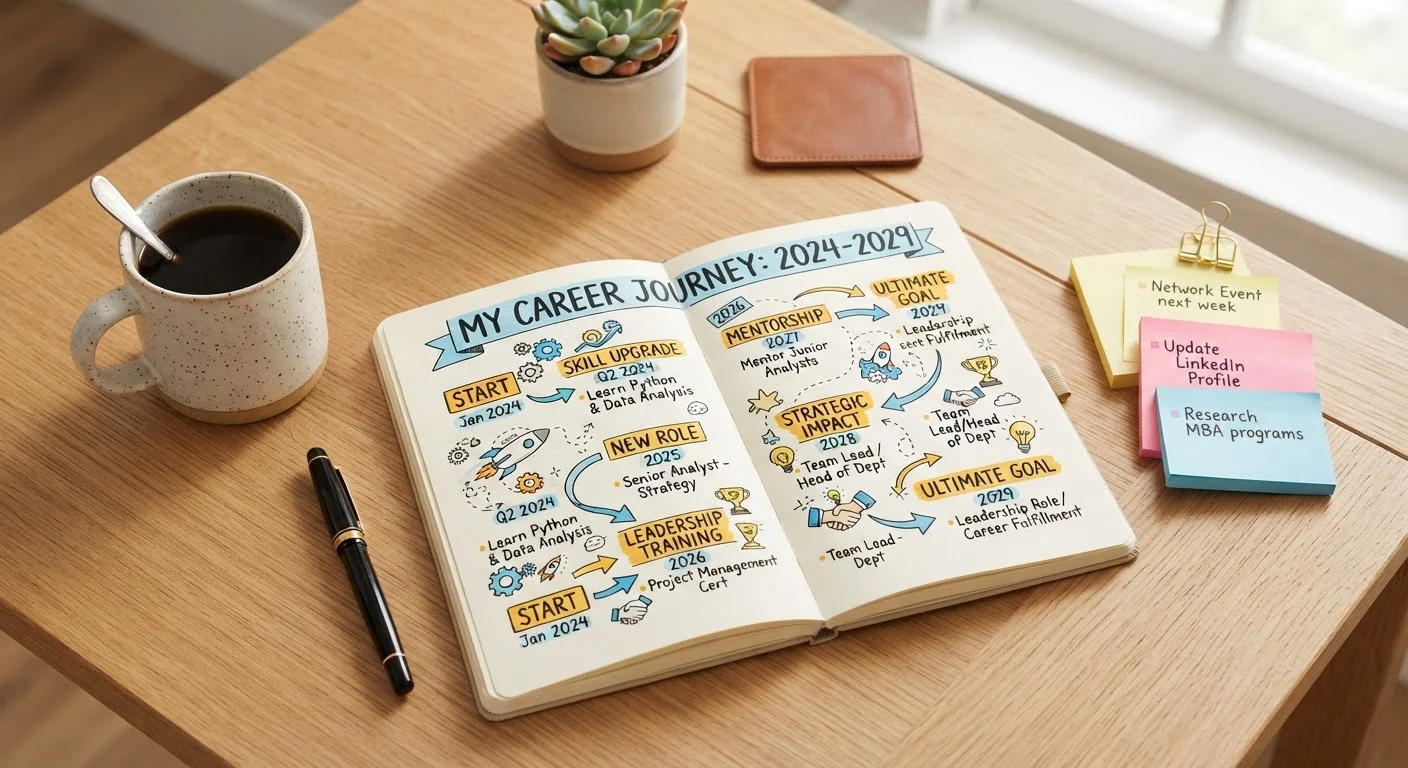
Photo credit: faqsnest.com
In this article
A practical walkthrough for creating a personalised career development plan, from identifying goals to mapping the skills and steps needed to reach them.
Key Takeaways
- A career development plan is a personal roadmap connecting your current position to a meaningful future goal.
- Starting with an honest self-assessment prevents you from building a plan on shaky foundations.
- Goals are only useful when paired with specific skills gaps and concrete actions to close them.
- Regular reviews turn a static document into a living guide that adapts as you grow.
- Career development is broader than promotion — it includes skills, values, and working style.
What a Career Development Plan Actually Is
A career development plan is a structured, personal document that connects where you are professionally right now to where you want to be — and maps out what it will take to get there. It is not a wish list, and it is not a rigid schedule. Think of it as a navigational tool: specific enough to give you direction, flexible enough to accommodate change.
Before diving into the steps, it helps to understand what career development actually encompasses. As explored in a broader look at career development, many people define it too narrowly — equating it with promotions or salary increases only. In reality, it covers skills growth, working values, role satisfaction, and the kind of professional you want to become over time.
Skills audit
A structured review of the skills you currently have, including how confident and competent you are in each one. It gives you an accurate starting point rather than an assumed one.
Gap analysis
The process of comparing your current skills and experience against what a target role or goal requires, revealing what you need to develop to move forward.
Milestone
A specific, measurable checkpoint within a larger goal — something you can clearly mark as complete, which tells you your plan is working.
Long-term vision
A broad picture of where you want your career to be in three to five years. It provides direction and motivation without requiring every detail to be decided in advance.
Action plan
The specific steps, resources, and timelines you assign to each skill gap or goal — the operational layer of a career development plan.
Informational interview
A conversation with someone working in a role or field you are curious about, used to gather insight rather than to apply for a job. A practical tool for clarifying career direction.
Step 1: Clarify Where You Are Now
Every useful plan starts with an honest baseline. Before you can map a route, you need to know your actual starting position — not an idealised version of it.
Conduct a personal skills audit. List the technical and interpersonal skills you use regularly, then rate your current competence in each. Be candid: overestimating your starting point means your plan will set unrealistic timelines. Alongside skills, note your values — what makes work feel meaningful to you — and your working preferences: environments, team dynamics, pace.
Gather external signals too. Review recent performance feedback, ask a trusted colleague what they see as your strengths, and look at job descriptions for roles one level above yours to see what employers in your field actually expect.
Step 2: Define What You're Working Toward
Once you have a clear picture of your starting point, you can set meaningful goals. Vague aspirations like "advance my career" are not useful targets. Instead, aim for goals that are specific, realistic given your current situation, and connected to something you genuinely care about.
Try working at two levels: a long-term vision (three to five years) and near-term milestones (six to twelve months). The long-term vision gives your plan direction and motivation. The near-term milestones give it traction — they are the concrete checkpoints that tell you whether you are moving in the right direction.
If you are unsure of your direction, treat exploration itself as a valid goal. Informational interviews, short trial projects, or even reading deeply in a new field are legitimate early steps. Clarity usually follows action.
Step 3: Map the Skills and Experience Gap
Gap analysis is the bridge between your current self-assessment and your stated goals. It answers the question: what do I need to develop, acquire, or demonstrate to reach my target?
Work through each goal and identify the skills, credentials, experiences, or relationships it requires. Then compare that list against your baseline audit. The difference is your gap — and closing it becomes the substance of your action plan.
Be specific. "Improve communication skills" is too broad to act on. "Practise presenting data findings to non-technical audiences, starting with one internal presentation per quarter" is actionable. If self-directed learning is part of how you plan to close the gap, the self-study planning checklist is a useful tool for verifying your approach before you invest significant time.
Step 4: Build Your Action Plan
This is where your plan becomes operational. For each gap identified, list the specific actions you will take, the resources you will use, and a realistic timeframe. Keep actions small enough to fit into your actual life — ambitious weekly commitments that collapse after two weeks help no one.
A workable structure for each action item includes: the action itself, the resource or method (online course, internal project, coaching conversation), a target completion date, and how you will know it is done. That final element — a success indicator — prevents actions from drifting into permanent "in progress" status.
If you are curious how career-focused self-study differs from designing a general learning curriculum, see building a personal curriculum from scratch for a complementary approach focused on sequencing knowledge rather than professional outcomes.
Keep Action Items Small and Specific
Resist the temptation to write sweeping commitments like "learn data analysis this year." Break every action down to its smallest repeatable unit — a weekly tutorial session, a single project to volunteer for, one book to finish in a month. Smaller actions are easier to schedule, easier to complete, and easier to build into consistent habits.
Keeping the Plan Alive Over Time
A career development plan only works if you return to it. The most common failure mode is writing a thoughtful document, then filing it away and never consulting it again.
Schedule quarterly reviews as a recurring calendar event. Use each review to check three things: what milestones have you reached, what has changed in your circumstances or goals, and what needs to be adjusted going forward. Plans that are updated regularly evolve into accurate records of your growth — useful not just as guides but as evidence of development when the time comes for performance conversations or new opportunities.
For learners building skills independently as part of their plan, the self-taught skills hub offers practical guidance on acquiring new capabilities outside formal education. Career development, ultimately, is a continuing practice — not a one-time exercise.
Frequently Asked Questions

Author
Learning & Skills Editorial Team
Learning & Skills Editorial Team is the collective byline for our editorial team and contributor network. Articles published under this byline or an editorial pen name are researched, written, and reviewed according to our editorial standards for clarity, consistency, and independence before publication.
View all articles →