
Insulation Materials Side by Side: Fibreglass, Mineral Wool, and Rigid Foam
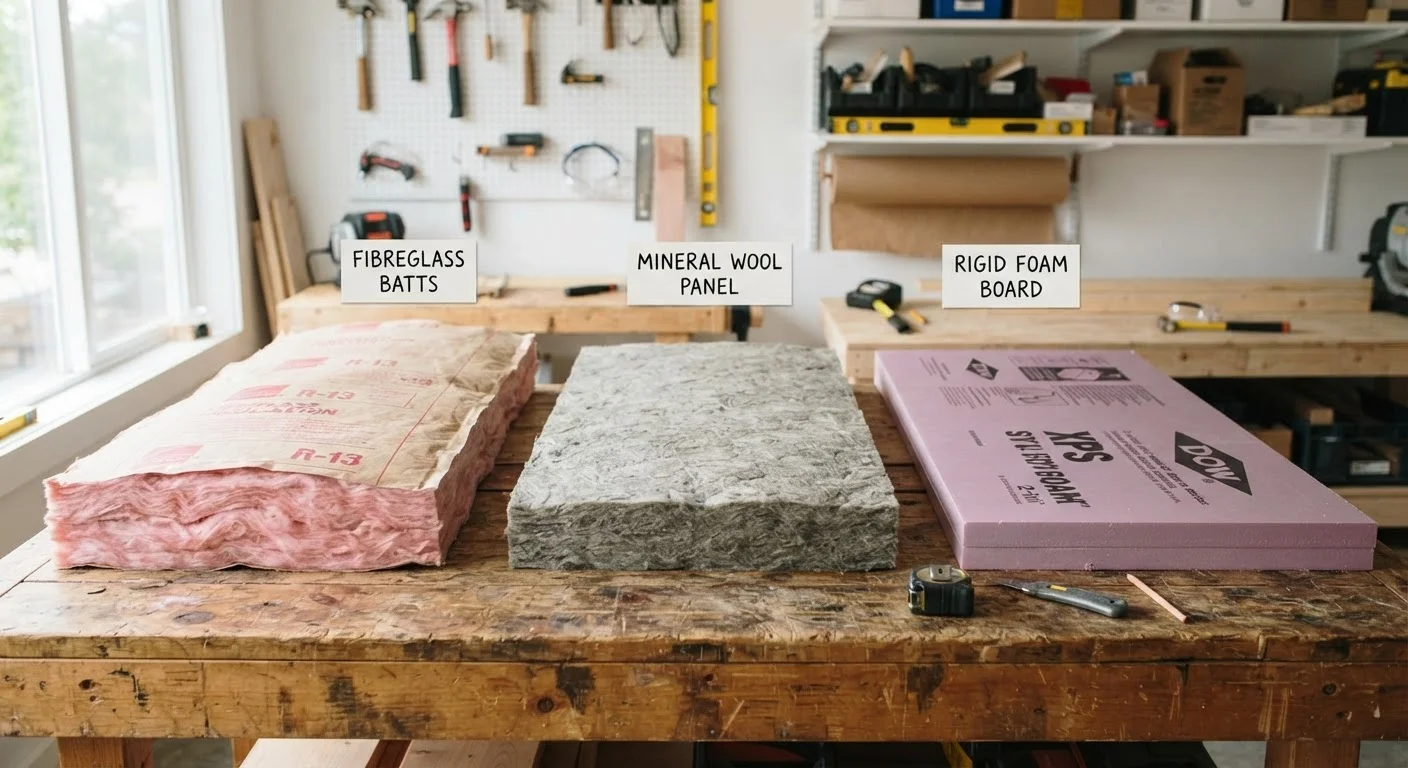
Photo credit: faqsnest.com
In this article
Compare three common insulation types across R-value, moisture resistance, fire rating, and ease of DIY installation.
Key Takeaways
- Fibreglass batts are the most widely available and budget-friendly option for standard stud-bay insulation.
- Mineral wool offers superior fire resistance and soundproofing compared to fibreglass at a higher price point.
- Rigid foam delivers the highest R-value per inch, making it ideal where space is limited.
- Moisture resistance varies significantly — rigid foam leads, fibreglass trails without a vapor barrier.
- DIY difficulty increases from fibreglass to rigid foam, though all three are manageable for motivated homeowners.
Understanding the Three Contenders
When you're planning an insulation project — whether upgrading an attic, finishing a basement, or improving wall performance — you'll almost inevitably face a choice among three dominant material categories: fibreglass batts, mineral wool (also sold as rock wool or slag wool), and rigid foam board. Each is manufactured differently and behaves differently once installed.
Fibreglass is spun from molten glass into fine fibers and is sold in pre-cut batts or rolls sized to fit standard 16- or 24-inch stud spacing. It's the material most homeowners picture when they think of insulation — the pink or yellow fluffy rolls at every hardware store.
Mineral wool is made from volcanic rock or recycled industrial slag spun into dense fibers. It looks similar to fibreglass but is noticeably heavier and stiffer, which contributes to several of its performance advantages.
Rigid foam board comes in three main chemistries: expanded polystyrene (EPS), extruded polystyrene (XPS), and polyisocyanurate (polyiso). Each offers a hard, board-like panel that can be cut with a utility knife and installed against solid surfaces or layered over wall sheathing.
Performance Comparison: R-Value, Fire, Moisture, and Sound
| Fibreglass Batts | Mineral Wool | Rigid Foam (XPS/Polyiso) | |
|---|---|---|---|
| R-Value per Inch | R-2.2 to R-2.7 | R-2.8 to R-3.2 | R-5 to R-6.5 |
| Moisture Resistance | Low — needs vapor barrier | High — naturally hydrophobic | Very High — especially closed-cell |
| Fire Resistance | Non-combustible | Non-combustible, higher temp rating | Combustible — requires thermal barrier |
| Sound Attenuation | Moderate | Good | Poor |
| DIY Ease | Easiest — pre-cut batts | Easy — rigid, holds shape | Moderate — sealing gaps critical |
| Relative Cost per R-value | Lowest | Mid-range | Highest |
| Best Primary Application | Attics, interior walls | Fire-rated walls, floors | Basements, exterior sheathing |
The comparison table above captures the headline numbers, but context matters for each category.
R-Value per Inch
R-value measures thermal resistance — higher means better insulating performance per inch of thickness. Fibreglass batts typically achieve R-2.2 to R-2.7 per inch. Mineral wool performs similarly, around R-2.8 to R-3.2 per inch. Polyiso rigid foam can reach R-6 to R-6.5 per inch, though its effective R-value decreases in very cold temperatures (a known phenomenon called thermal drift). XPS averages around R-5, and EPS around R-3.8 per inch.
Moisture Resistance
Fibreglass loses effectiveness when wet and does not dry quickly; a vapor barrier or retarder is generally required in humid or mixed climates. Mineral wool is hydrophobic — water beads off its fibers — making it more forgiving in damp conditions. Closed-cell rigid foam (XPS and polyiso) is the most moisture-resistant of the three and is commonly used in below-grade or crawlspace applications.
Fire Resistance
Neither fibreglass nor mineral wool is combustible, but mineral wool is tested to withstand higher sustained temperatures, making it a common choice for fire-rated wall assemblies. Rigid foam is flammable in most formulations and is required by building codes to be covered with a thermal barrier — typically 1/2-inch drywall — when used in occupied spaces. Always verify local code requirements before installation.
Sound Attenuation
Mineral wool's density gives it a meaningful edge for soundproofing interior walls and floor-ceiling assemblies. Fibreglass provides modest acoustic dampening. Rigid foam contributes little to airborne sound control on its own.
DIY Installation: What Each Material Demands
All three materials can be installed by a motivated homeowner, but the skill and tool requirements differ.
Fibreglass Batts
Fibreglass is the most beginner-friendly option. Batts are pre-sized, compress for easier handling, and require minimal tools — a utility knife, straightedge, and a good pair of gloves. The fibers are an irritant to skin, eyes, and lungs, so wearing long sleeves, safety glasses, and an N95 respirator is essential, not optional. Fit matters: gaps and compression both reduce effective R-value, so take time to cut pieces that fill each bay without being forced.
Mineral Wool
Mineral wool is denser and easier to cut cleanly with a serrated knife. Its semi-rigid nature means it holds its shape in open wall cavities without sagging — a practical advantage for walls and soundproofing applications. The same protective gear applies: wear gloves, eye protection, and respiratory protection. Mineral wool products are generally heavier to transport and carry a higher per-square-foot cost.
Rigid Foam Board
Cutting rigid foam requires a utility knife (score-and-snap works well for thinner boards) or a circular saw with a fine-tooth blade for thicker panels. The main installation challenge is achieving tight, gap-free seams — any air pathway undermines performance. Seams and edges should be sealed with compatible foam-board tape or canned foam sealant. Because many rigid foam types are vapor impermeable, placement within the wall assembly requires attention to where condensation might form; consulting your local climate zone guidelines or a building professional is advisable for complex assemblies.
Always Check Local Building Codes First
Insulation requirements — including minimum R-values, vapor barrier placement, and thermal barrier rules for foam — vary by climate zone and local jurisdiction. Before purchasing materials, look up your area's applicable energy code or consult your local building department. This step can prevent costly re-work and ensure your project passes inspection if a permit is required.
Cost Considerations and When to Combine Materials
Cost per square foot (at equivalent R-value) generally ranks from lowest to highest: fibreglass, mineral wool, then rigid foam. However, raw material cost is only part of the equation. If mineral wool's moisture resistance eliminates the need for a separate vapor barrier product, or if rigid foam's thinness allows you to avoid bumping out wall framing, the total project cost can shift.
Many high-performance assemblies combine materials — for example, fibreglass or mineral wool between studs paired with a continuous layer of rigid foam on the exterior. This approach reduces thermal bridging through framing, which can account for a meaningful portion of overall heat loss in a wood-framed wall. Hybrid assemblies are worth researching if you're undertaking a larger renovation rather than a targeted single-wall project.
Before purchasing any insulation, check whether your local utility or state energy office offers rebates for meeting certain R-value thresholds — many do, and the savings can offset the cost difference between material tiers. Verify requirements directly with the program, as eligibility rules vary.

Author
Home & Garden Editorial Team
Home & Garden Editorial Team is the collective byline for our editorial team and contributor network. Articles published under this byline or an editorial pen name are researched, written, and reviewed according to our editorial standards for clarity, consistency, and independence before publication.
View all articles →