
Spaced Repetition: The Memory Technique Backed by Cognitive Science
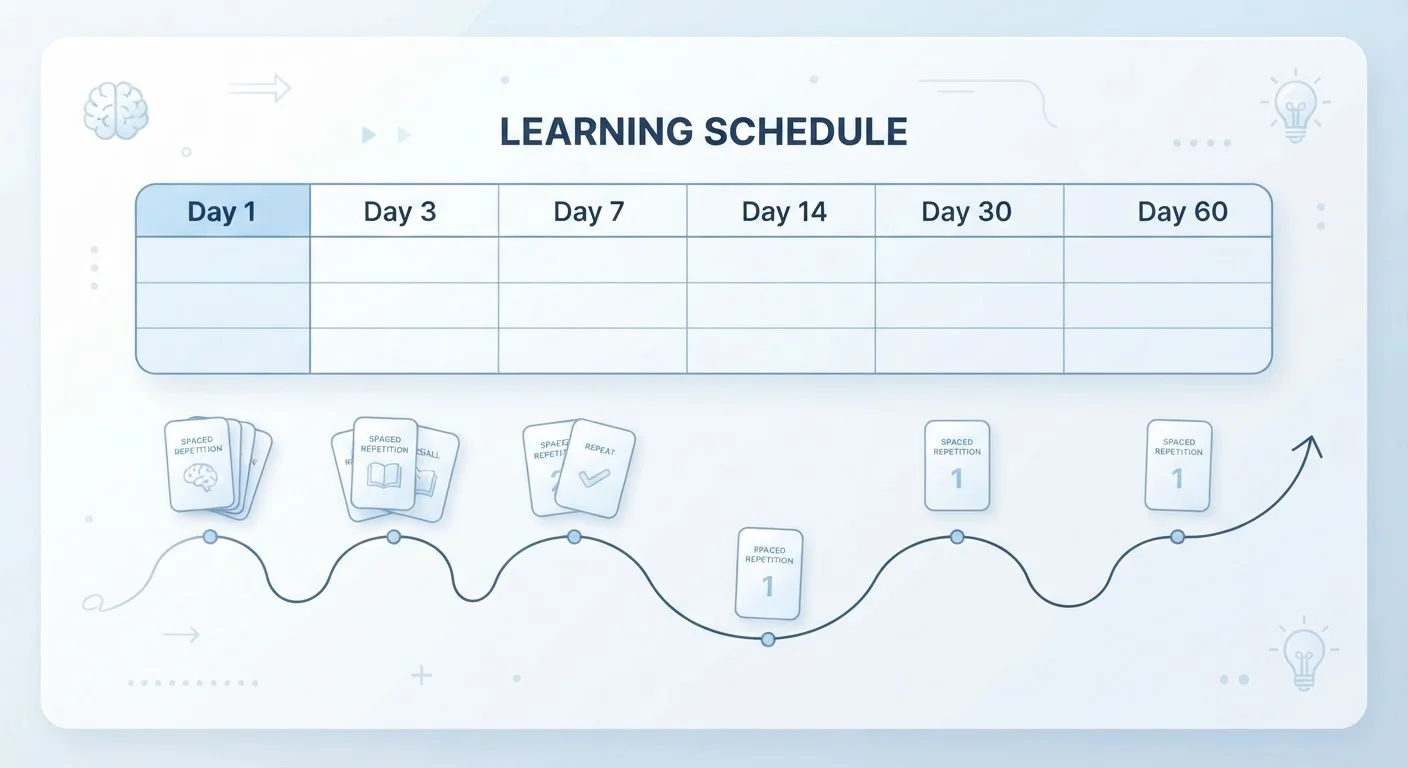
Photo credit: faqsnest.com
In this article
Understand how spaced repetition works, why forgetting is part of learning, and how to apply this research-backed method to retain more long-term.
Key Takeaways
- Spaced repetition works by reviewing material at increasing intervals timed to beat forgetting.
- Forgetting is not a failure — it is a necessary part of building stronger, lasting memories.
- The spacing effect has been consistently replicated in cognitive science research for over a century.
- Spaced repetition is more efficient than massed practice (cramming) for long-term retention.
- The technique can be applied to almost any subject, from languages to medical concepts to historical facts.
Why Forgetting Is Actually the Point
Most learners treat forgetting as the enemy of studying. Spaced repetition reframes it entirely: forgetting is not a sign of failure — it is the mechanism your brain uses to determine what is worth remembering.
Cognitive psychologists call this the desirable difficulty principle. When you attempt to recall something that has faded slightly, your brain works harder to retrieve it. That retrieval effort, sometimes called the retrieval practice effect, signals to your memory system that this information matters. The memory is then reconsolidated in a stronger form than before.
This stands in sharp contrast to passive review — rereading notes or highlighting text — which creates an illusion of familiarity without meaningfully reinforcing the memory trace. Research consistently shows that testing yourself on material, even imperfectly, leads to better long-term retention than re-exposure alone. For a closer look at that comparison, see active recall vs. passive review.
The key insight is that timing matters as much as frequency. Reviewing material immediately after learning it provides very little benefit — you haven't had time to forget anything. The productive moment to review is just before the memory would slip away entirely.
The Forgetting Curve and the Science Behind Spacing
In the 1880s, German psychologist Hermann Ebbinghaus conducted systematic experiments on his own memory, memorizing and testing himself on lists of nonsense syllables over time. He charted his results as the forgetting curve: a steep, predictable decline in retention that begins almost immediately after learning and flattens as time passes.
Ebbinghaus also documented the spacing effect — the finding that distributing study sessions over time produces far greater retention than massing them together. This is one of the most replicated results in all of cognitive psychology.
~56%
Retention drop within one hour of learning
Ebbinghaus's original forgetting curve research estimated that roughly half of newly learned information is forgotten within an hour without review or reinforcement.
200%
Retention improvement with spaced vs. massed practice
Research published in Psychological Science has found that spaced practice can more than double long-term retention compared to an equivalent amount of massed study time.
10–20 min
Typical daily spaced repetition session length
Practitioners and researchers generally report that consistent short daily review sessions are more effective than infrequent long ones for maintaining a spaced repetition schedule.
Modern researchers have refined these early findings considerably. Studies published in journals such as Psychological Science and Memory & Cognition have confirmed that spaced practice outperforms massed practice across a wide range of ages, subjects, and learner types. The effect holds for everything from vocabulary acquisition to surgical skill training.
What makes spaced repetition a practical system — rather than just a theoretical insight — is its use of algorithms that calculate review intervals individually. Rather than following a fixed schedule, the system adapts to each learner's performance: items you struggle with come back sooner; items you know well are pushed further out.
How to Apply Spaced Repetition in Practice
Applying spaced repetition doesn't require sophisticated technology. The core requirement is a system for tracking when each piece of information should next be reviewed.
The Leitner Box Method
Sebastian Leitner's physical flashcard system organizes cards into a series of labeled compartments. A new card starts in Box 1 and is reviewed daily. When you answer correctly, the card advances to Box 2, reviewed every other day. Correct again, and it moves to Box 3, reviewed weekly — and so on. An incorrect answer sends the card back to Box 1. The system naturally concentrates your effort on weaker material while reducing time spent on what you already know well.
Digital Scheduling Tools
Several software applications implement spaced repetition algorithms automatically. You create cards, rate your recall after each review, and the algorithm handles the rest. This removes the bookkeeping burden and makes the method scalable to large volumes of material.
Pairing Spaced Repetition with Other Techniques
Spaced repetition is powerful for memorization but works best as part of a broader learning strategy. Combining it with interleaved practice — alternating between different subjects or problem types — can deepen understanding beyond simple recall. It's also worth being mindful of cognitive load: introducing too many new cards at once can overwhelm working memory. See cognitive load theory for guidance on managing mental effort effectively.
Start Small to Build the Habit
When beginning with spaced repetition, limit yourself to 10 to 15 new cards per day. The daily review queue grows quickly as cards cycle back, and taking on too much at the start leads to backlogs that are hard to recover from. Consistency over weeks matters far more than volume in any single session.
What Spaced Repetition Cannot Do
Spaced repetition is a precision tool, not a universal solution. Understanding its limits helps you deploy it where it will have the most impact.
The technique excels at retaining discrete, retrievable facts — definitions, formulas, dates, translations, anatomical terms. It is less suited to developing conceptual understanding, problem-solving ability, or the kind of flexible thinking that complex subjects demand. Knowing the definition of a concept is not the same as being able to apply it creatively under new conditions.
The method also requires consistency. Unlike cramming, which delivers a short-term boost before a test, spaced repetition accumulates its benefits over weeks and months. Irregular practice disrupts the scheduling logic and reduces effectiveness.
Finally, the quality of your cards matters enormously. Poorly written questions — too vague, too broad, or testing rote phrases rather than genuine understanding — will produce surface-level memory rather than meaningful knowledge. Cards should test one specific idea per item and be written in your own words wherever possible.
Used thoughtfully within its strengths, spaced repetition remains one of the most evidence-supported tools available to self-directed learners.
Frequently Asked Questions

Author
Learning & Skills Editorial Team
Learning & Skills Editorial Team is the collective byline for our editorial team and contributor network. Articles published under this byline or an editorial pen name are researched, written, and reviewed according to our editorial standards for clarity, consistency, and independence before publication.
View all articles →