
Learning in Public vs. Learning in Private
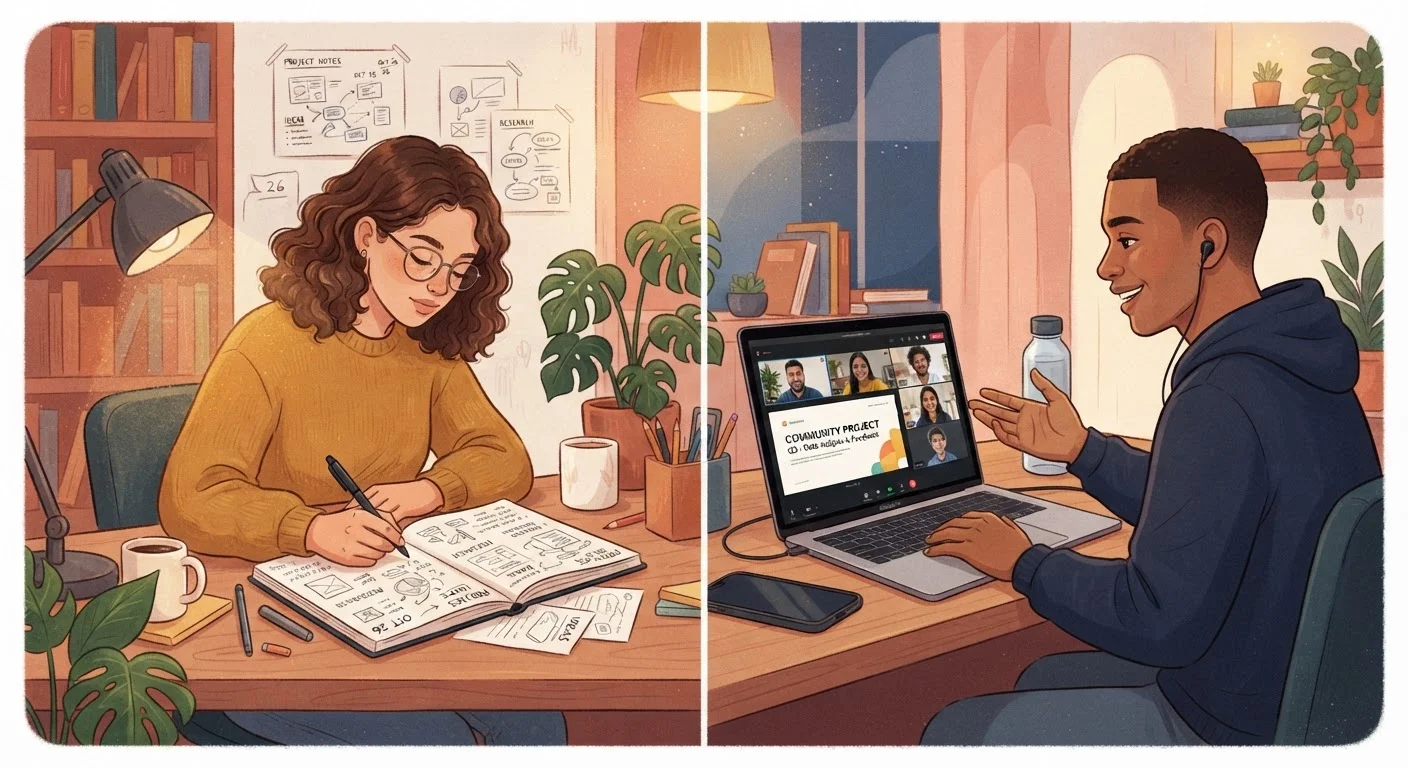
Photo credit: faqsnest.com
In this article
Explore how sharing your learning journey openly compares to studying quietly—and which approach suits different goals and personalities.
Key Takeaways
- Learning in public builds accountability and community but exposes you to external judgment and distraction.
- Learning in private preserves focus and psychological safety, though it can limit feedback and motivation over time.
- Neither approach is universally superior — the right choice depends on your goals, personality, and learning stage.
- Many experienced learners combine both methods, sharing selectively rather than committing to one extreme.
- The stage of learning matters: early exploration often benefits from privacy, while later stages can gain from public sharing.
What Each Approach Actually Means
Learning in public means deliberately making your learning process visible — posting work-in-progress notes, sharing questions on forums, writing about what you're studying, or documenting mistakes on social platforms. Learning in private means keeping study largely internal: personal notebooks, quiet practice sessions, and progress that isn't broadcast beyond your own awareness.
Neither is a monolith. "Public" doesn't require broadcasting to thousands of followers, and "private" doesn't mean isolated from all human feedback. The distinction really comes down to intention: are you treating your learning journey as something to be witnessed, or as something to be protected until it's ready?
This question matters more than it might seem. The environment in which you learn shapes what you learn, how quickly you build confidence, and how you sustain motivation over time. For a broader look at how self-directed study fits career growth, see Formal Education vs. Self-Directed Learning for Career Advancement.
The Case for Learning in Public
Public learning has gained significant momentum in developer and creative communities, where practitioners document projects openly on platforms like GitHub or write regular posts about what they're figuring out. The benefits are concrete.
- Accountability pressure: When others can see your progress, slipping quietly into inactivity becomes harder. This social commitment effect is well-documented in behavior research.
- Accelerated feedback: Sharing unfinished thinking invites corrections and suggestions you'd never generate alone. This is especially valuable in fields where your blind spots are hard to identify from the inside.
- Network formation: Visible learners attract collaborators, mentors, and peers who are on similar paths. Over time, this can open professional doors that private study rarely does.
- Teaching as learning: Explaining a concept to an audience — even a small one — forces clarity. The process of articulating an idea reveals gaps in your understanding faster than rereading notes.
If accountability is a recurring challenge, Staying Accountable When Nobody Is Checking Your Progress offers practical frameworks you can layer onto either approach.
| Learning in Public | Learning in Private | |
|---|---|---|
| Accountability | High — social visibility creates commitment | Self-generated — requires internal discipline |
| Feedback quality | Rich external input from community | Limited to self-assessment and trusted peers |
| Focus depth | Can be fragmented by audience management | Typically deeper, fewer interruptions |
| Psychological safety | Lower — exposure to criticism and judgment | Higher — mistakes carry no social cost |
| Network building | Strong — attracts collaborators and mentors | Minimal — connections require separate effort |
| Best learning stage | Intermediate to advanced | Beginner to intermediate |
| Effort overhead | Higher — content creation adds work | Lower — all effort goes to learning |
The Case for Learning in Private
Private learning is sometimes mischaracterized as passive or timid. In practice, it can be the most rigorous form of study. Without the pressure to package ideas for an audience, you can sit with confusion longer, explore tangents freely, and develop a genuine understanding rather than a presentable one.
- Psychological safety: Beginners in particular benefit from an environment where mistakes carry no social cost. The fear of public embarrassment can cause learners to stay in comfortable territory rather than tackling genuinely hard material.
- Deeper focus: Crafting posts, responding to comments, and managing an audience presence takes time and cognitive energy — resources that could go directly into practice and study.
- Honest self-assessment: Without an audience to perform for, it's easier to notice when you're faking understanding versus actually grasping something. Private reflective practice — journaling, self-testing — tends to produce more honest feedback loops.
- Protection during sensitive learning: Some subjects — personal finance, health literacy, emotionally difficult history — are better explored away from public scrutiny, at least initially.
Private study pairs naturally with structured personal planning. See Building a Personal Curriculum from Scratch for a practical guide to designing that kind of intentional solo learning plan.
How to Choose — and When to Combine Both
The most useful frame isn't "which is better" but "which is better right now for this specific subject." A few orienting questions help:
- How foundational is this material? Early-stage learning — where you're still building mental models from scratch — tends to benefit from private exploration. Sharing half-formed ideas publicly before you understand the basics can entrench misconceptions.
- Do you need external motivation to sustain effort? If isolation causes you to drift, structured public sharing (a weekly post, a study group, a peer accountability partner) can inject the friction that keeps you moving.
- Is the goal the skill itself, or the visible demonstration of acquiring it? Career changers and portfolio-builders often need public artifacts of their learning. Hobbyists and deep-curious learners may find public performance actively distracts from the intrinsic pleasure of study.
Many experienced learners practice what might be called selective sharing: keeping most of the process private while periodically publishing finished reflections, project outputs, or synthesized notes. This preserves the focus benefits of private study while still generating community and feedback at key moments.
The mindset behind your approach matters as much as the method itself. The Mindset Shifts That Separate Lifelong Learners from One-Time Dabblers explores the mental habits that help self-taught learners sustain momentum across years — whichever visibility mode they favor.

Author
Learning & Skills Editorial Team
Learning & Skills Editorial Team is the collective byline for our editorial team and contributor network. Articles published under this byline or an editorial pen name are researched, written, and reviewed according to our editorial standards for clarity, consistency, and independence before publication.
View all articles →