
Structured Courses vs. Open-Ended Exploration: Choosing Your Learning Path
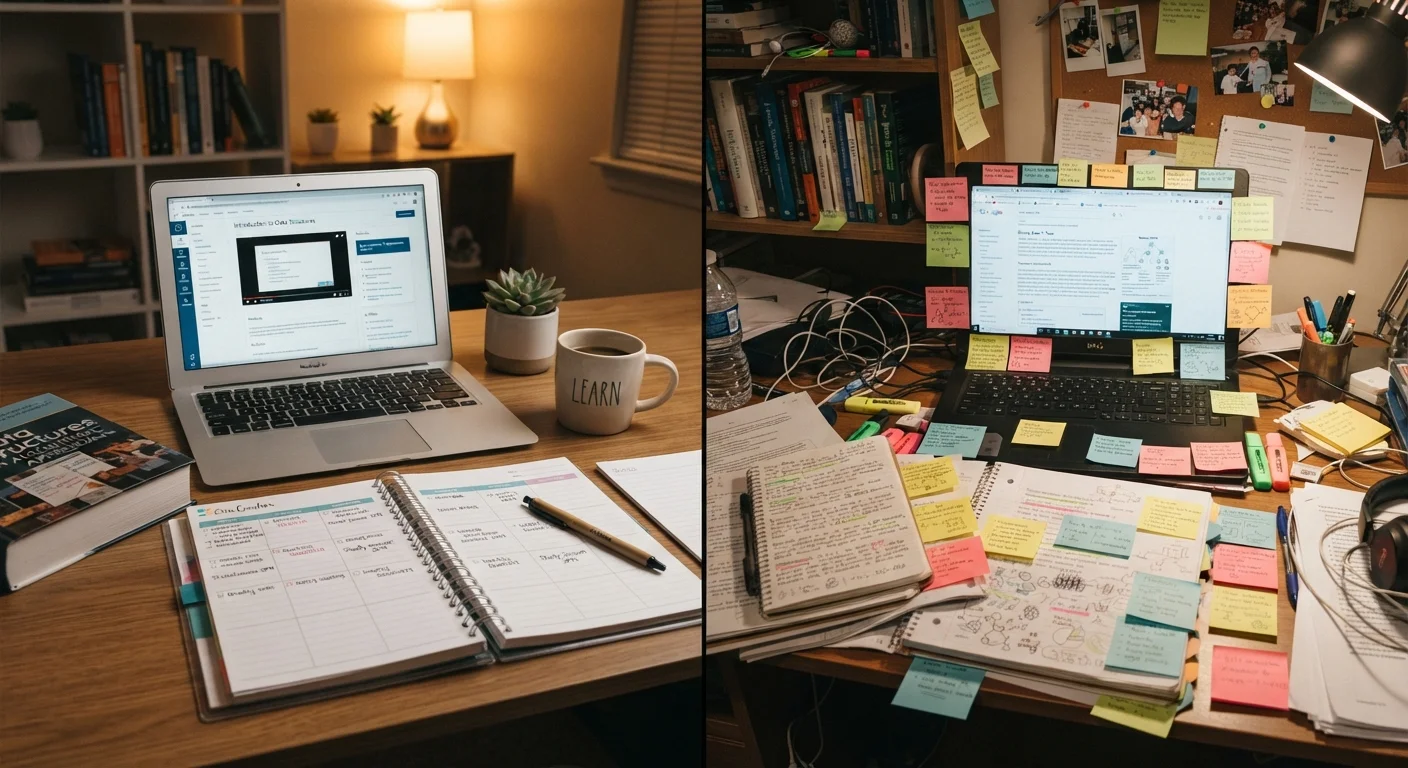
Photo credit: faqsnest.com
In this article
Weigh the trade-offs between following a curriculum and pursuing curiosity-led learning to find what works for your goals.
Key Takeaways
- Structured courses provide accountability and a pre-built roadmap, which lowers decision fatigue for beginners.
- Open-ended exploration builds intrinsic motivation and allows faster pivots when interests or goals shift.
- Neither approach is universally superior — the best fit depends on your goal, timeline, and prior knowledge.
- Hybrid strategies, alternating between guided and exploratory phases, are often the most sustainable for long-term learners.
- Credentials and verifiable outcomes matter more in some career contexts than the depth of exploration alone.
What Sets These Two Paths Apart
At their core, structured courses and open-ended exploration differ in who controls the sequence. A structured course — whether a university module, a MOOC (Massive Open Online Course), or a cohort program — places that control with an instructor or curriculum designer. Topics build on each other in a planned order, assessments confirm understanding, and a defined endpoint signals completion.
Open-ended exploration hands that control to you. You might start with a book, follow a citation into a research paper, watch a documentary, and then spend an afternoon on a related podcast. The path is nonlinear by design. This approach is sometimes called self-directed learning or heutagogy — the practice of learning how to learn, not just what to learn.
Neither model is inherently more rigorous. Research in adult education, including frameworks developed by educator Malcolm Knowles around self-directed learning in the 1970s, suggests that adults often learn best when they have autonomy over the process — but that autonomy without sufficient prior knowledge can lead to gaps or misconceptions. Understanding this tension is the starting point for making a smart choice. See also the honest trade-offs of learning outside formal education for a broader look at what self-directed study can and cannot replace.
The Case for Structured Courses
Structure offers something that pure exploration rarely delivers upfront: reduced cognitive load at the start. When you do not yet know what you do not know, a well-designed curriculum makes sequencing decisions for you. You learn prerequisite A before advanced concept B, which prevents the frustration of hitting material you are not ready for.
Structured learning also tends to produce verifiable outcomes. Certificates, transcripts, and portfolio assessments give employers and collaborators a recognizable shorthand for your competency. If your goal connects to career advancement, this signal can matter considerably — particularly in credentialed fields like healthcare, law, engineering, or finance.
Accountability mechanisms are another underrated benefit. Deadlines, peer forums, and instructor feedback create external pressure that many learners need to push through difficult material. Without these guardrails, it is easy to stall at the first challenging concept during self-study.
| Criterion | Structured Courses | Open-Ended Exploration |
|---|---|---|
| Sequence control | Instructor or curriculum designer | The learner |
| Credential output | Often yes (certificate, grade) | Rarely formal |
| Accountability | External (deadlines, assessments) | Self-imposed |
| Flexibility to pivot | Limited within the course | High — change direction anytime |
| Best entry point | Beginners or credential-seekers | Intermediate or advanced learners |
| Motivation source | Extrinsic (grades, completion) | Intrinsic (curiosity, interest) |
| Risk of knowledge gaps | Lower — syllabus fills gaps | Higher without deliberate planning |
The trade-off is flexibility. Most courses cover what the designer decided was important, which may not perfectly match your specific application. You may also spend time on topics that are adjacent to — but not exactly — what you need, simply because the curriculum includes them.
The Case for Open-Ended Exploration
Exploration-led learning excels in one area that structured courses often cannot match: intrinsic motivation. When you pursue what genuinely interests you, you are more likely to sustain effort over long periods. Psychologist Edward Deci's research on self-determination theory consistently links autonomy to deeper engagement and retention — a learner who chose the topic tends to stay curious longer than one who enrolled because it was required.
Exploration also respects how knowledge actually grows. Insight rarely arrives in a tidy sequence. Reading broadly across disciplines, making unexpected connections, and revisiting the same concept from different angles are practices that structured courses rarely have time to support. Many creative, entrepreneurial, and research-oriented thinkers credit this kind of wide-ranging self-study for their most significant breakthroughs.
It is also faster to pivot. If your goals shift, you can change direction immediately — no waiting for the next enrollment window, no sunk cost in a syllabus that no longer fits. This agility is especially valuable in fast-moving fields where course curricula risk becoming outdated before you finish them.
The downside is real, though: without a map, you may wander productively for a while and then realize you have a collection of impressions rather than a coherent skill. If you are building a systematic body of knowledge, the personal curriculum planning process can bring structure to exploration without eliminating its flexibility.
How to Decide — and When to Combine Both
A few practical questions sharpen the decision quickly:
- Do you need external validation? If a credential, certificate, or institutional affiliation matters for your goal, lean toward structured courses.
- How much do you already know? Beginners typically benefit from structure; intermediate and advanced learners often benefit more from exploration.
- What is your timeline? A fixed deadline favors the predictability of a course; an open-ended personal project favors exploration.
- How do you respond to accountability? Honest self-knowledge here matters more than any preference you think you should have.
Many experienced learners use a phase-based hybrid: take a structured course to build a reliable foundation, then shift to open exploration once the fundamentals are secure. This mirrors how formal education has always worked at its best — a structured early phase giving way to independent research and application.
Before committing to either path, it is worth doing a quick reality check on your resources and environment. The self-study planning checklist covers the practical groundwork — time, tools, and goal clarity — that determines whether any learning approach will actually stick. For those weighing how these paths intersect with formal education, formal education vs. self-directed learning for career advancement offers a useful parallel perspective.
Neither Path Requires a Full Commitment
You do not have to choose one approach and stick with it permanently. Many learners alternate: a structured course to build a foundation, followed by open exploration to deepen and personalize that knowledge. Treating learning as a flexible, evolving practice — rather than a binary choice — tends to produce more durable results. Revisit your approach whenever your goals or circumstances change.

Author
Learning & Skills Editorial Team
Learning & Skills Editorial Team is the collective byline for our editorial team and contributor network. Articles published under this byline or an editorial pen name are researched, written, and reviewed according to our editorial standards for clarity, consistency, and independence before publication.
View all articles →