
The Role of Ritual in Keeping Families Together
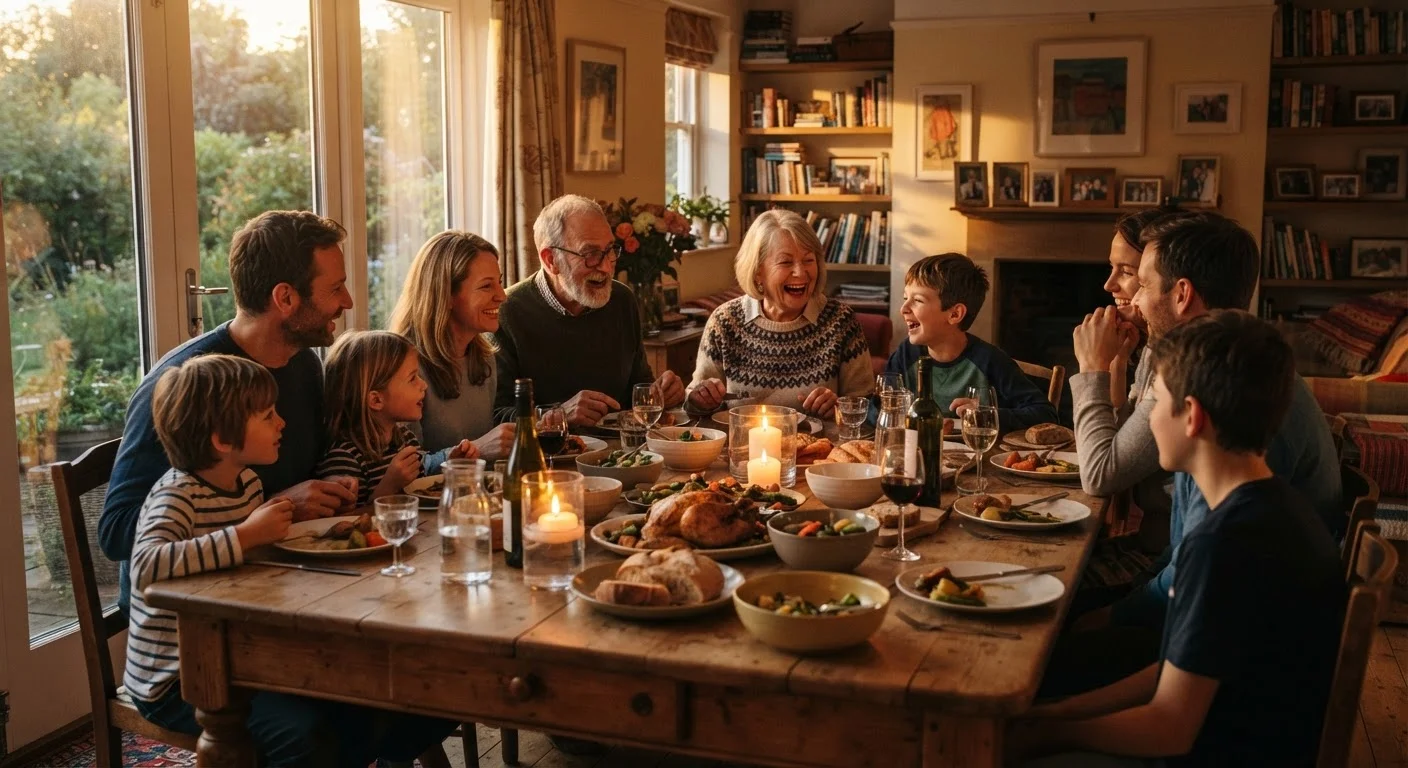
Photo credit: faqsnest.com
In this article
From Sunday dinners to annual traditions, rituals shape family identity. Explore the sociological reasons recurring practices strengthen relational bonds.
Key Takeaways
- Family rituals provide psychological security by creating predictable, emotionally resonant touchpoints across time.
- Rituals reinforce shared identity, helping family members understand who they are as a collective unit.
- Even small, low-cost rituals can have measurable effects on family cohesion and children's sense of belonging.
- Rituals adapt across life stages and family structures, including chosen families and blended households.
- The meaning attached to a ritual matters more than its scale or formality.
Why Rituals Are More Than Repeated Behavior
Sociologists have long recognized that rituals serve a function far beyond the activities themselves. Drawing on Émile Durkheim's concept of collective effervescence — the heightened sense of connection that arises when people engage in shared, synchronized activity — researchers have applied similar logic to the domestic sphere. When a family gathers for a recurring practice, something more than logistics is happening: participants are reaffirming their membership in a shared social world.
This distinction matters. A household where everyone eats dinner at the same time out of scheduling convenience is running a routine. A household where dinner involves a specific seating arrangement, a shared moment of gratitude, or a family-specific conversation opener is performing a ritual. The symbolic layer transforms the experience and, crucially, the social effect.
Anthropologist Barbara Myerhoff described rituals as "practices that make the invisible visible" — they externalize and reinforce internal commitments and relationships that might otherwise remain unspoken. In family life, this means rituals do the quiet work of saying: we belong to each other. That's a message with measurable psychological consequences, particularly for children and adolescents navigating identity formation. This dynamic also connects to broader mechanisms of group cohesion — explored in depth through the lens of social identity theory.
The Psychological Architecture of Ritual
Research in family psychology has consistently found that ritual participation correlates with stronger relational bonds, higher family satisfaction, and greater individual resilience. Developmental psychologist Barbara Fiese, whose work focused extensively on family routines and rituals, identified a meaningful distinction: routines communicate "this is what we do," while rituals communicate "this is who we are." That identity-signaling function is where much of the psychological power resides.
~50%
Higher family satisfaction linked to ritual practice
Research by Barbara Fiese and colleagues found families with consistent rituals reported notably higher satisfaction and cohesion compared to those without established practices.
3 in 4
Adults who say family traditions are very important
Pew Research Center surveys on American family life have consistently found strong majorities placing high value on shared family traditions across demographic groups.
17+
Years studied in landmark family ritual longitudinal research
Fiese's longitudinal work tracked the effects of family rituals across multiple developmental stages, from early childhood through adolescence.
For children, predictable family rituals create what attachment theorists call a "secure base" — a reliable relational structure that supports exploration and risk-taking in other domains of life. Adolescents in families with strong ritual practices tend to show clearer personal identity formation, likely because they have a defined relational context to both accept and, inevitably, push against.
For adults, rituals provide continuity across life's transitions. The Thanksgiving meal that looks similar across decades becomes a kind of temporal anchor — a way of experiencing both change and stability simultaneously. This is part of why the loss of a ritual (through divorce, death, or geographic dispersal) can feel disproportionately significant: what's lost is not just an activity but an entire layer of relational meaning.
How Rituals Build and Sustain Family Identity
Family identity — the shared narrative a family holds about who they are — doesn't emerge spontaneously. It's constructed over time through repeated, meaningful interactions. Rituals are among the most efficient mechanisms for this construction because they encode values, history, and relational roles into memorable, repeatable form.
Consider the annual camping trip that has occurred for three generations. On one level, it's a leisure activity. On another, it's a living archive of family history — a site where stories are retold, roles are rehearsed (who navigates, who cooks, who tells the ghost stories), and the family's self-conception as "outdoorsy people" or "adventurous people" is renewed. The ritual doesn't just reflect identity; it actively produces it.
This identity-producing function becomes especially visible in chosen family networks, where shared biology or legal recognition doesn't automatically confer belonging. Research on LGBTQ+ chosen families, for example, shows deliberate and often creative ritual-building — friendsgiving gatherings, annual reunions, specific celebration practices — as a mechanism for establishing kinship bonds that feel substantive and durable without conventional institutional scaffolding.
Small Rituals, Large Effects
One of the most practically useful insights from family ritual research is that scale does not determine impact. Grand annual traditions matter, but so do micro-rituals — the specific way a parent says goodnight, a particular Saturday morning routine, a text thread that springs to life every time the family's sports team plays. These small, recurring touchpoints accumulate into a dense relational fabric that families draw on during stress and transition.
This finding resonates with behavioral science research on habit formation more broadly. Just as sustainable daily routines tend to succeed through consistency and low friction rather than complexity, family rituals gain their power through repetition and reliability rather than elaborate execution.
Starting a New Ritual Doesn't Require Occasion
Families often assume meaningful rituals must be tied to cultural holidays or life milestones. In practice, rituals can be created at any time — a regular walk, a shared podcast, a specific weekly meal. What matters is consistency and the mutual intention to treat the practice as significant. Even declaring "this is our thing now" is often enough to initiate the symbolic layer that transforms routine into ritual.
Family therapists often note that families under strain — navigating divorce, grief, or economic pressure — benefit significantly from preserving or introducing even modest rituals. A consistent shared meal several times per week, or a reliable check-in practice, can provide enough relational structure to maintain cohesion during periods when larger traditions have collapsed. The ritual signals continuity even when circumstances have changed dramatically.
This also speaks to the adaptability of ritual. Families that relocate, reconfigure through remarriage, or expand to include new members often find that deliberately constructing new rituals — rather than waiting for them to emerge organically — accelerates the process of relational integration. Ritual, in this sense, is both a product of family closeness and a tool for building it.
Frequently Asked Questions

Author
People & Culture Editorial Team
People & Culture Editorial Team is the collective byline for our editorial team and contributor network. Articles published under this byline or an editorial pen name are researched, written, and reviewed according to our editorial standards for clarity, consistency, and independence before publication.
View all articles →