
Moments That Reshaped Digital Media: A Timeline of Streaming's Turning Points
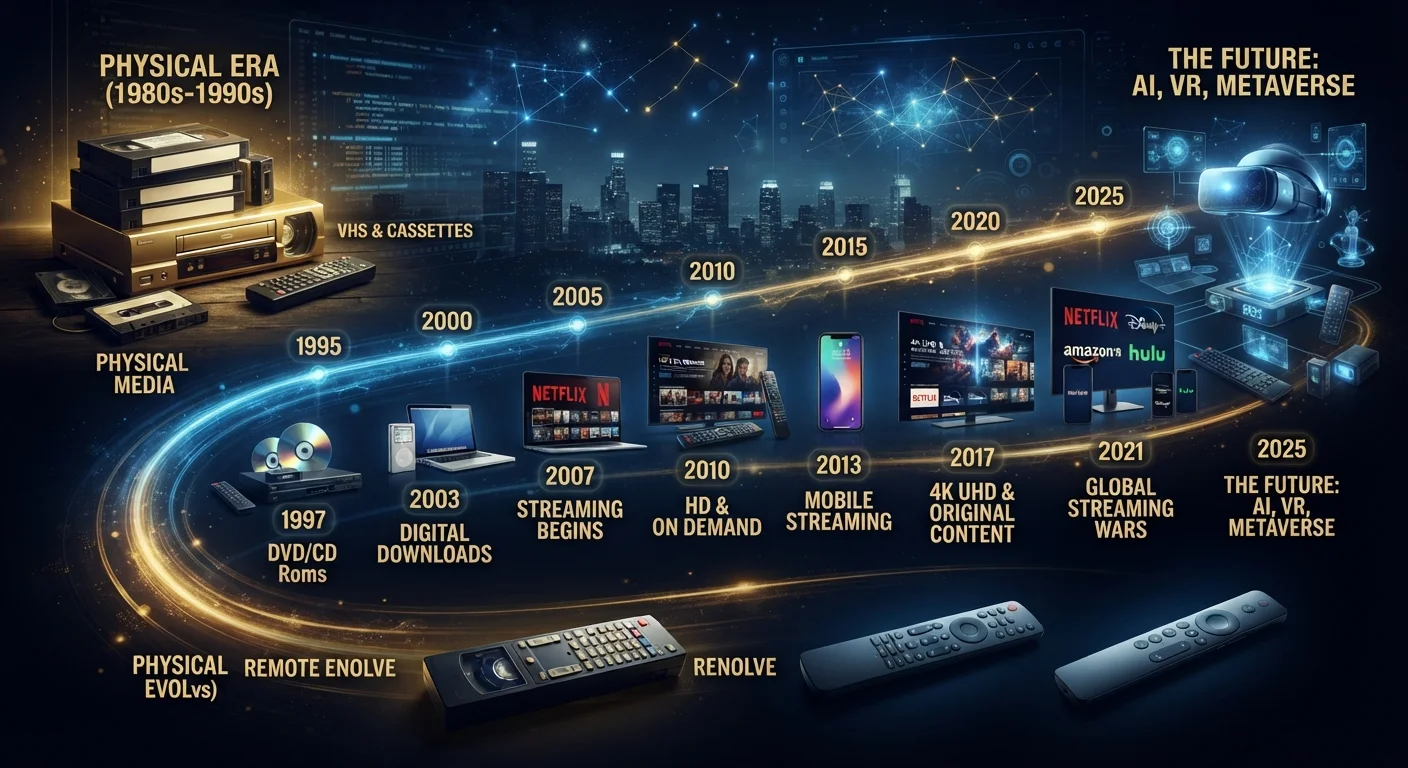
Photo credit: faqsnest.com
In this article
A curated look at the industry milestones — from DVD-by-mail to global streaming — that defined how digital media reached its current form.
Key Takeaways
- Netflix's 1997 DVD-by-mail launch planted the seed for on-demand media consumption before broadband made streaming viable.
- The shift from physical to digital distribution eliminated geographic and scheduling barriers that once defined media access.
- Platform-exclusive original content transformed streaming services from distributors into full-scale studios and cultural tastemakers.
- Global licensing deals and international originals pushed streaming beyond its US origins into a worldwide industry.
- Each major turning point created new industry terminology, business models, and audience expectations that persist today.
How Streaming Went from Novelty to Necessity
No industry disruption arrives fully formed. The transformation of media consumption from scheduled broadcast television and physical rental stores into the always-on, algorithm-curated streaming landscape we navigate today unfolded through a series of identifiable inflection points — each one building on the last in ways that weren't always obvious at the time.
Understanding those moments helps explain not just where streaming came from, but why the current competitive landscape looks the way it does. For a deeper dive into the economics driving today's platform wars, see our streaming wars explainer. The timeline below traces the pivotal developments that reshaped digital media from a niche technological curiosity into the dominant mode of entertainment delivery.
Netflix Launches DVD-by-Mail (1997–1999)
When Netflix launched its DVD rental-by-mail service in 1997 and introduced its flat-rate subscription model in 1999, the company wasn't yet a streaming service — but it established the conceptual infrastructure that would later define one. The subscription model removed per-title transaction friction, and the cueing system gave users the feeling of a personalized library rather than a store shelf. These design choices — subscription pricing, queue-based discovery, no late fees — would prove more durable than the physical format they initially supported.
The subscription model removed per-title friction before streaming even existed.
iTunes and the Rise of Digital Purchase (2003)
Apple's iTunes Music Store demonstrated in 2003 that consumers would pay for licensed digital content if the experience was convenient enough. Though initially music-focused, the model soon extended to television episodes and films, establishing digital ownership as a legitimate alternative to physical media. This moment normalized paying for digital files and created regulatory and commercial frameworks — particularly around digital rights management — that streaming negotiations would later build upon and, eventually, largely abandon in favor of access-based models over ownership.
iTunes proved consumers would pay for digital content when the experience was frictionless.
YouTube Democratizes Video Distribution (2005–2006)
YouTube's 2005 launch — followed by its acquisition by Google in 2006 for approximately $1.65 billion — fundamentally altered the assumption that video required institutional gatekeeping to reach an audience. For the first time, distribution was separated from production infrastructure. While YouTube's early catalog consisted largely of amateur content, its underlying logic — any video, any time, searchable and shareable — set audience expectations that professional streaming services would need to meet. It also introduced advertising as a viable funding mechanism for digital video, a model that has since returned to subscription platforms through ad-supported tiers.
YouTube separated video distribution from institutional gatekeeping for the first time.
Netflix Begins Streaming (2007)
Netflix's introduction of streaming as an add-on to its DVD subscription in 2007 is the moment most media historians point to as the true origin of the modern streaming era. Broadband penetration in the United States had reached a threshold that made buffering tolerable, and the Watch Now feature — limited in catalog but unlimited in usage — gave subscribers a direct experience of what on-demand viewing could feel like without scheduling constraints. The company would spend the next several years licensing content aggressively while its DVD business subsidized the infrastructure buildout streaming required. For context on how that transition reshaped viewing behavior, see our analysis of linear TV versus on-demand streaming.
Netflix's 2007 streaming launch gave audiences their first real taste of scheduling-free viewing.
Original Content Changes the Value Proposition (2013)
The simultaneous release of House of Cards Season 1 on Netflix in February 2013 marked a decisive pivot: streaming platforms were no longer merely distributors of content produced elsewhere, they were studios. The decision to release all thirteen episodes at once also introduced the practice of binge-watching as a deliberate distribution strategy rather than an accidental viewer behavior. For the first time, a streaming platform won Primetime Emmy Awards, a signal to the creative industry that prestige production had migrated beyond traditional broadcast and cable. This shift fundamentally altered talent negotiations, licensing economics, and how platforms marketed their subscriber value. Explore more about this cultural moment through our Movies & TV hub.
Releasing an entire season at once transformed binge-watching from accident to industry strategy.
Global Licensing and the International Turn (2016)
Netflix's expansion to 130 new countries in January 2016 — bringing its total to over 190 markets virtually overnight — represented a scale of international media distribution that had no precedent. The move required simultaneous negotiation of content rights across dozens of regulatory environments and accelerated investment in local-language original productions. Shows produced in Spain, South Korea, Brazil, and India began reaching global audiences not as curiosities but as mainstream hits. This internationalization shifted the streaming industry's center of gravity away from a US-centric model and introduced the concept of cultural soft power through platform content in ways that continue to reshape both entertainment and pop culture globally.
Netflix's 2016 global expansion redefined streaming as a truly international cultural force.
The Streaming Wars Era Begins (2019–2020)
The near-simultaneous launches of Disney+, Apple TV+, and HBO Max between late 2019 and mid-2020 signaled that every major media conglomerate had concluded streaming was the primary battleground for audience attention. Legacy studios began pulling content from Netflix to anchor their own platforms, fragmenting a catalog that had felt comprehensive into exclusive silos. Subscription fatigue became a recognized consumer phenomenon, and industry analysts began tracking churn rates — the percentage of subscribers who cancel — as a core health metric. This competitive intensification is the direct antecedent of the current streaming landscape; for a structured breakdown of the strategies involved, our streaming wars analysis provides essential context.
Legacy studios launching rival platforms fragmented streaming's once-comprehensive content catalog into exclusive silos.
What These Milestones Mean for Media's Future
Looking at these turning points as a sequence rather than isolated events reveals a consistent pattern: each disruption lowered a barrier — to access, to convenience, to creative ambition — and once audiences experienced that lower barrier, returning to the previous model became unthinkable. The shift from linear schedules to on-demand queues is one of the most documented behavioral changes in media history, a transition explored in depth in our piece on how viewing habits shifted over a decade.
What emerges is an industry still in active flux. Subscriber growth has plateaued in mature markets, advertising-supported tiers have returned as a mainstream offering, and the question of what sustainable streaming economics look like remains genuinely open. If the terminology used across this space feels dense, our guide to key streaming industry terms offers a useful reference. The milestones above didn't just change how content is delivered — they redefined what audiences expect, what creators can risk, and what cultural influence looks like in a fragmented media era.
Track Industry Language as Platforms Evolve
The streaming industry generates new terminology rapidly — SVOD, AVOD, FAST, churn rate, and content spend each describe specific business realities that shape what you watch and how it's funded. Familiarizing yourself with these terms helps decode platform strategy announcements and industry reporting. Our streaming industry glossary is a useful starting point for building that vocabulary.

Author
Entertainment & Media Editorial Team
Entertainment & Media Editorial Team is the collective byline for our editorial team and contributor network. Articles published under this byline or an editorial pen name are researched, written, and reviewed according to our editorial standards for clarity, consistency, and independence before publication.
View all articles →