
Linear TV vs. On-Demand Streaming: How Viewing Habits Have Shifted Over a Decade
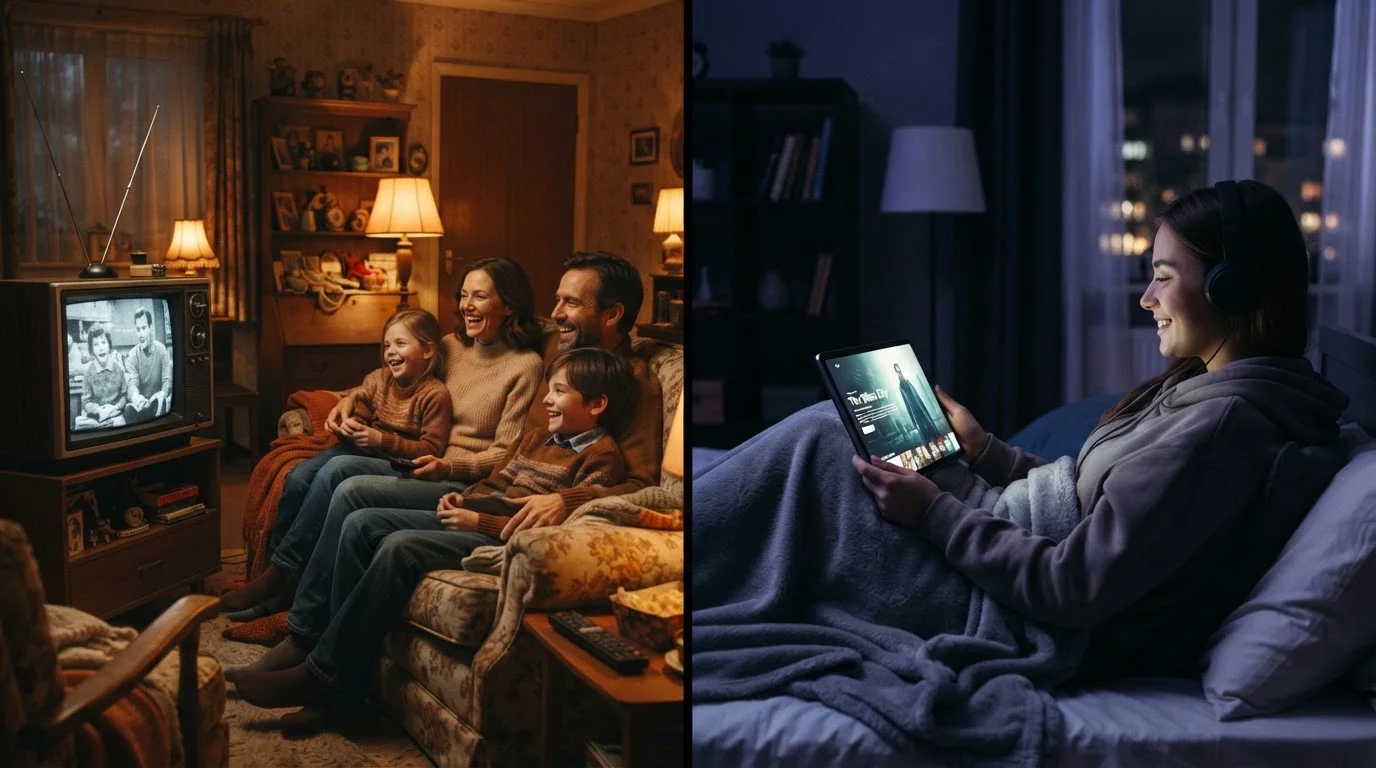
Photo credit: faqsnest.com
In this article
A data-informed look at how audiences moved from scheduled broadcasts to on-demand viewing and what drove that transition.
Key Takeaways
- Linear TV viewership in the U.S. has declined significantly since the early 2010s, while streaming audiences have grown substantially.
- On-demand viewing shifted cultural power from networks to audiences, who now control what they watch and when.
- Live events — sports, breaking news, awards shows — remain a stronghold where linear TV retains unique value.
- Streaming's growth has driven fragmentation, making shared cultural moments increasingly rare but not extinct.
- Both models continue to coexist, with many households maintaining hybrid viewing approaches.
The Decade That Rewired How America Watches
Around 2013, something began quietly accelerating in American living rooms. Cable subscription numbers, long treated as an immovable pillar of household spending, started a downward drift that would become a structural decline. Simultaneously, streaming services — still widely seen as a supplement to cable — began attracting audiences large enough to reshape the entire media economy.
By the early 2020s, Nielsen data indicated that streaming had surpassed traditional broadcast and cable combined in terms of total television usage share among U.S. audiences, a milestone that would have seemed implausible a decade earlier. This shift was not merely technological; it reflected deep changes in how people relate to storytelling, schedule their leisure time, and define the concept of "watching TV" itself.
Understanding this transition requires examining what each model offered, where each fell short, and why audiences ultimately reorganized their habits around the on-demand paradigm — while never fully abandoning the scheduled broadcast.
Linear TV: Strengths, Structures, and Stubborn Advantages
Linear television — broadcasting on a fixed schedule over cable, satellite, or over-the-air signals — dominated American media consumption for over six decades. Its architecture was built around appointment viewing: a specific program at a specific time, watched collectively by audiences who had no practical alternative. That shared simultaneity had genuine cultural power. Water-cooler moments, season finales, and live events generated national conversation because millions watched at the same hour.
Even as streaming eroded its dominance in scripted content, linear TV retained durable advantages in two areas: live programming and passive viewing. Sports leagues, awards ceremonies, breaking news coverage, and major political events consistently draw audiences back to linear channels. According to research from Magna Global and similar media analytics firms, live sports alone accounts for a disproportionate share of linear viewership, which is why broadcast rights deals for major leagues remain extraordinarily valuable.
Passive viewing — the habit of simply turning on the TV and letting it run — also favors linear formats. For segments of the audience less interested in active content selection, the scheduled flow of programming removes friction rather than adding it. This behavioral reality helps explain why linear TV, while diminished, has not disappeared.
| Linear TV | On-Demand Streaming | |
|---|---|---|
| Viewing schedule | Fixed broadcast times | Anytime, viewer-controlled |
| Live event coverage | Strong — sports, news, awards | Limited; improving with live tiers |
| Content discovery | Passive channel surfing | Active search and algorithm-driven |
| Shared cultural moments | High — simultaneous mass audiences | Lower — staggered individual viewing |
| Original scripted content | Declining investment | Major investment and innovation |
| Subscription/cost model | Bundle-based cable/satellite fees | Per-platform monthly subscriptions |
| Advertising exposure | High — embedded in broadcast flow | Variable — ad-free or ad-supported tiers |
On-Demand Streaming: How Viewer Control Changed Everything
The core proposition of on-demand streaming is deceptively simple: watch what you want, when you want it. But this seemingly modest shift in control produced outsized consequences for storytelling, business models, and audience behavior alike.
When Netflix released all episodes of House of Cards simultaneously in 2013, it was widely treated as a bold experiment. It quickly became a template. The full-season drop normalized binge-watching — a behavior that fundamentally reshaped audience engagement by collapsing the week-long suspense of episodic television into a single sitting. Attention shifted from the broadcast calendar to the subscriber's own schedule.
Streaming also enabled a new economics of content. Because platforms competed for subscribers rather than advertisers (initially), they could commission series too niche, too serialized, or too expensive for traditional network television. This opened space for prestige drama to flourish outside the network constraints that had historically shaped what kinds of stories could be told at scale.
The audience-behavior change was equally significant. Streaming viewers are active selectors rather than passive receivers. They search, browse, queue, and abandon content with a fluency that linear viewers never developed. This active relationship with programming elevated expectations for quality and personalization — and, as researchers have noted, also contributed to decision fatigue among viewers confronted with near-infinite choice.
The Fragmentation Problem: What Was Lost in the Transition
The shift toward on-demand consumption carried a significant cultural trade-off: the erosion of shared media moments. When audiences self-select into thousands of discrete content streams rather than gathering around a common schedule, the conditions for mass cultural synchrony become rare. A prestige drama that receives universal critical acclaim may still be watched by different households across a span of weeks or months, diluting the collective conversation that once surrounded major television events.
This fragmentation is a well-documented consequence of the streaming era, and it intersects with broader patterns in how viral and algorithmic media have reconfigured American attention. Content no longer moves through society on a shared clock; it moves through personal recommendation queues, social media shares, and algorithmic suggestion engines.
The industry has responded in ways that reveal the tension between the two models. Streaming platforms have increasingly experimented with weekly episode releases — a deliberate reintroduction of linear television's appointment-viewing logic — precisely to sustain audience conversation and reduce churn. For a deeper look at how those release strategies affect cultural impact, see our analysis of binge-watching versus weekly schedules.
Where the Two Models Stand Today — and Where They're Heading
The current media landscape is not a clean victory for streaming so much as a negotiated coexistence. Most U.S. households that subscribe to at least one streaming service also retain some form of linear TV access, whether through a skinny cable bundle, a live TV streaming service, or over-the-air antenna. The categories have begun to blur: platforms like Hulu and YouTube TV are technically streaming services that deliver a linear experience, while traditional broadcasters now operate robust streaming apps alongside their scheduled channels.
The competitive dynamics driving this convergence are explored in depth in our analysis of the streaming wars, which examines why so many services have entered an already crowded field. The short answer is that subscriber growth has slowed for early-market leaders, intensifying the competition for content — particularly for original programming that retains subscribers better than licensed libraries alone.
For audiences making sense of this landscape, the practical reality is that neither model has won decisively. The decade of transition has produced a more fragmented, more personalized, and in many ways more demanding media environment — one that offers unprecedented choice while requiring more active navigation than the linear TV era ever did. Those new to navigating these choices will find useful grounding in our guide for new cord-cutters.

Author
Entertainment & Media Editorial Team
Entertainment & Media Editorial Team is the collective byline for our editorial team and contributor network. Articles published under this byline or an editorial pen name are researched, written, and reviewed according to our editorial standards for clarity, consistency, and independence before publication.
View all articles →