
Prestige Drama vs. Procedural Television: Two Ways TV Earns Your Attention
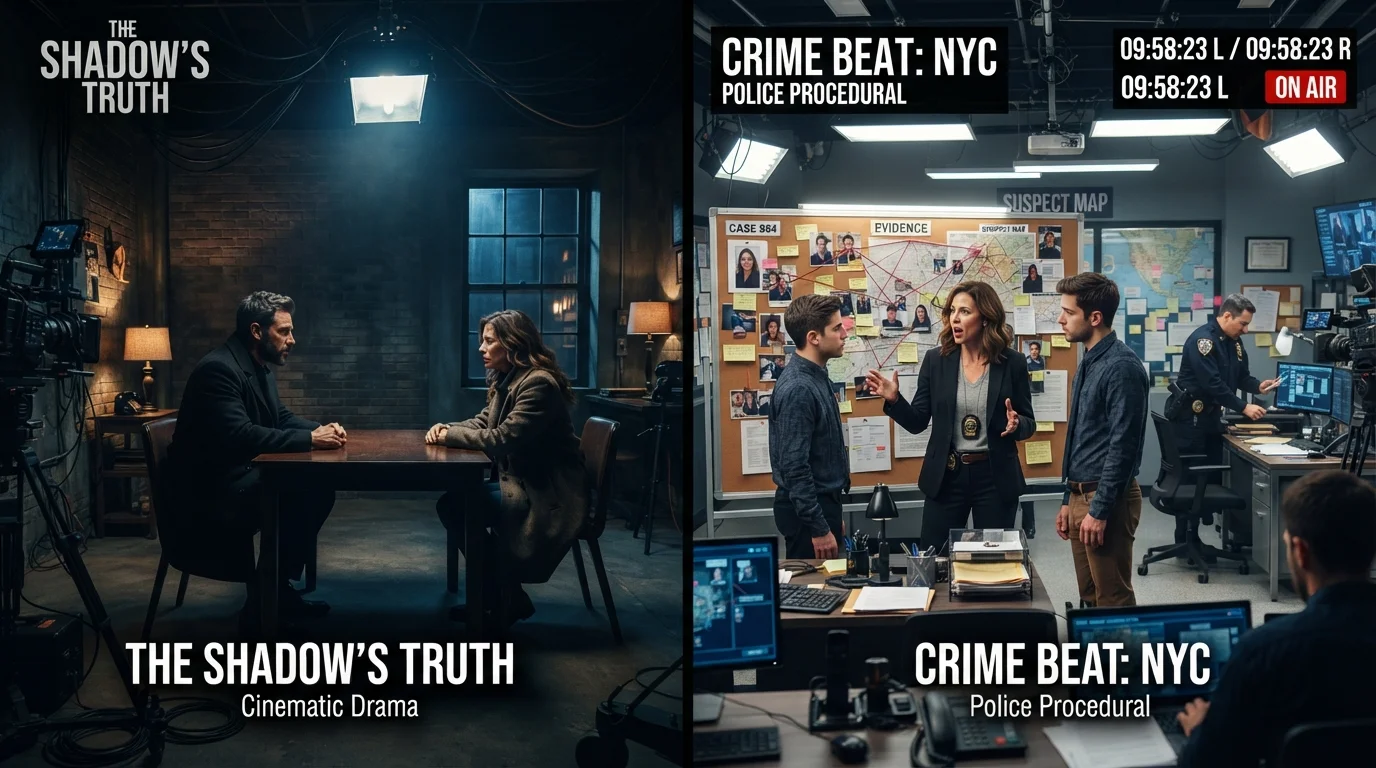
Photo credit: faqsnest.com
In this article
Prestige serials reward patience; procedurals reward habit. Here's how each model hooks viewers differently and what each demands of storytellers.
Key Takeaways
- Prestige dramas build narrative across an entire season or series, demanding sustained viewer investment.
- Procedurals offer self-contained episodes that reward casual, habit-based viewing without punishing missed episodes.
- Each format makes distinct creative and structural demands on writers, directors, and showrunners.
- Streaming has blurred the line between formats, producing hybrid shows that mix serial depth with episodic closure.
- Cultural staying power differs: prestige dramas tend to dominate awards cycles while procedurals dominate ratings and longevity.
Two Contracts With the Viewer
Every television show implicitly negotiates a deal with its audience. It promises a certain kind of experience, establishes rules for how stories will be told, and sets expectations about what showing up week after week — or session after session — will deliver. The two most durable models in American television history represent fundamentally different versions of that deal: the prestige drama and the procedural.
The prestige drama, a form that gained cultural traction in the early 2000s alongside cable's creative ambitions, asks viewers to invest in complexity. Character psychology deepens across seasons. Plot threads are seeded episodes in advance. Missing an installment means arriving confused. The reward is cumulative — emotional payoffs that feel earned precisely because they required patience.
The procedural operates on an older and, in many ways, more democratic logic. A case, a crime, a medical emergency, or a legal dispute is introduced, investigated, and resolved within a single episode. Regular characters provide continuity of personality rather than continuity of plot. A viewer can tune in after a month away and reorient in minutes. This is television designed for the rhythm of ordinary life, not the intensity of committed fandom.
Understanding how each model works — structurally, emotionally, and culturally — helps explain not just what we watch, but why certain shows become appointment viewing while others become long-running institutions. See also how release schedule affects viewer engagement, since format and scheduling are deeply intertwined.
The Architecture of Prestige Drama
Prestige drama borrows heavily from literary fiction. Its organizing principle is the arc — character arcs, seasonal arcs, and in some cases multi-season narrative arcs that treat the full series as a single extended work. The pilot functions less as a standalone story and more as an extended opening chapter, as explored in detail in the analysis of TV pilot design. Everything is setup; payoff lives elsewhere.
This structure places enormous demands on the writing room. Continuity must be maintained across dozens of hours. Character decisions made in season one must remain consistent or be deliberately, meaningfully subverted later. Themes need to accumulate rather than simply repeat. When executed well — think of how a single visual motif can accrue meaning over the course of a season — the form can achieve an emotional density rarely possible in film's two-hour canvas.
The risk is equally high. A prestige drama that loses the thread of its own mythology, or that allows character behavior to become inconsistent for plot convenience, tends to collapse spectacularly in viewer esteem. The format's demand for coherence is the very thing that makes failures feel so personal to invested audiences.
| Prestige Drama | Procedural | |
|---|---|---|
| Narrative unit | Season or full series arc | Single self-contained episode |
| Viewer commitment required | High — sequential viewing essential | Low — any episode works as entry point |
| Character development | Deep, transformative arcs across seasons | Consistent personality, incremental growth |
| Typical run length | 3–5 seasons average | 10–20+ seasons possible |
| Awards performance | Dominates major drama categories | Rarely wins top categories, occasional acting nods |
| Syndication viability | Low — episode order dependency | High — any episode stands alone |
| Creative risk profile | High — coherence across hundreds of hours | Moderate — quality at sustained volume |
Critically, prestige dramas are shaped heavily by auteur influence. A single showrunner's vision often dominates the tone, and episode directors are expected to serve that vision rather than express their own. This centralization of creative authority is part of what gives the best examples their distinctive aesthetic consistency.
The Architecture of the Procedural
The procedural's foundational unit is the episode, not the season. Each installment presents a problem — a crime to solve, a patient to save, a case to argue — and resolves it before the credits roll. Recurring characters carry emotional continuity, but their internal states rarely transform in ways that affect a new viewer's understanding. A detective's dry wit or a surgeon's perfectionism is constant; growth, when it occurs, is incremental and backgrounded.
This makes procedurals structurally resilient in ways prestige dramas cannot match. They tolerate cast changes, can run for fifteen or twenty seasons, and perform well in syndication because any episode can serve as an entry point. The creative challenge isn't sustaining a single vision but rather maintaining quality and energy across hundreds of hours — a different kind of discipline entirely.
Writers on long-running procedurals develop sophisticated micro-story techniques: the cold open hook, the mid-episode misdirect, the final-act reveal. Within the apparent repetition of the format, skilled practitioners find genuine creative space. The constraint itself generates invention.
Watching Procedurals as a Craft Student
Procedurals reward close attention to micro-story structure. Pay attention to how information is withheld and released within a single episode — the cold open's hook, the act-break cliffhanger, the way a misdirect is planted. These techniques are highly portable and appear in condensed form across all genres of scripted television.
The relationship between procedurals and broadcast scheduling deserves attention. The procedural format was, in many ways, built for linear television's weekly appointment model — an ecosystem explored in depth in how viewing habits have shifted from linear to on-demand. When Netflix and its peers disrupted that model, procedurals were initially considered the format most at risk. That prediction proved only partially correct.
Cultural Status, Longevity, and What Each Format Actually Wins
Prestige dramas dominate the awards landscape and the critical conversation. They generate the think-pieces, the academic syllabi, and the water-cooler debates about what television as an art form can accomplish. Their cultural half-life tends to be intense but sometimes short — a season's discourse can feel exhausted within a year of airing.
Procedurals, by contrast, rarely win major drama awards but frequently outlast prestige contemporaries by a decade or more. They generate reliable advertising revenue, sustain studios through syndication licensing, and build parasocial relationships with audiences that span generations. A family that watches the same procedural franchise across fifteen years has a shared cultural reference point that no prestige hit can match on sheer duration.
20+
Seasons achieved by top procedural franchises
Long-running procedural brands like Law & Order and its spin-offs have demonstrated the format's extraordinary durability in the broadcast landscape.
~60%
Of Emmy Drama nominations historically going to serialized shows
Analysis of Emmy nomination patterns over the past two decades shows serialized prestige dramas commanding the majority of top drama category attention.
The tension between these two cultural modes has become more creatively productive as the formats increasingly borrow from each other. Many contemporary series incorporate procedural episode structures — a case-of-the-week, a medical crisis — while threading a serialized emotional spine through the season. This hybridization allows shows to be accessible to casual viewers while rewarding committed ones. For viewers interested in what analytical frameworks apply across both forms, a critical viewing framework offers useful vocabulary that transfers directly to serialized and episodic television alike.
What neither format can do without, ultimately, is the quality of the writing. The procedural's apparent simplicity is deceptive — it demands efficient, propulsive scene construction and character consistency under enormous production pressure. The prestige drama's complexity is real but can become self-defeating if narrative ambition outpaces emotional clarity. The best television in either mode earns attention through craft, not category.

Author
Entertainment & Media Editorial Team
Entertainment & Media Editorial Team is the collective byline for our editorial team and contributor network. Articles published under this byline or an editorial pen name are researched, written, and reviewed according to our editorial standards for clarity, consistency, and independence before publication.
View all articles →