
Moments When Fashion and Music Fused Into Something Bigger Than Both
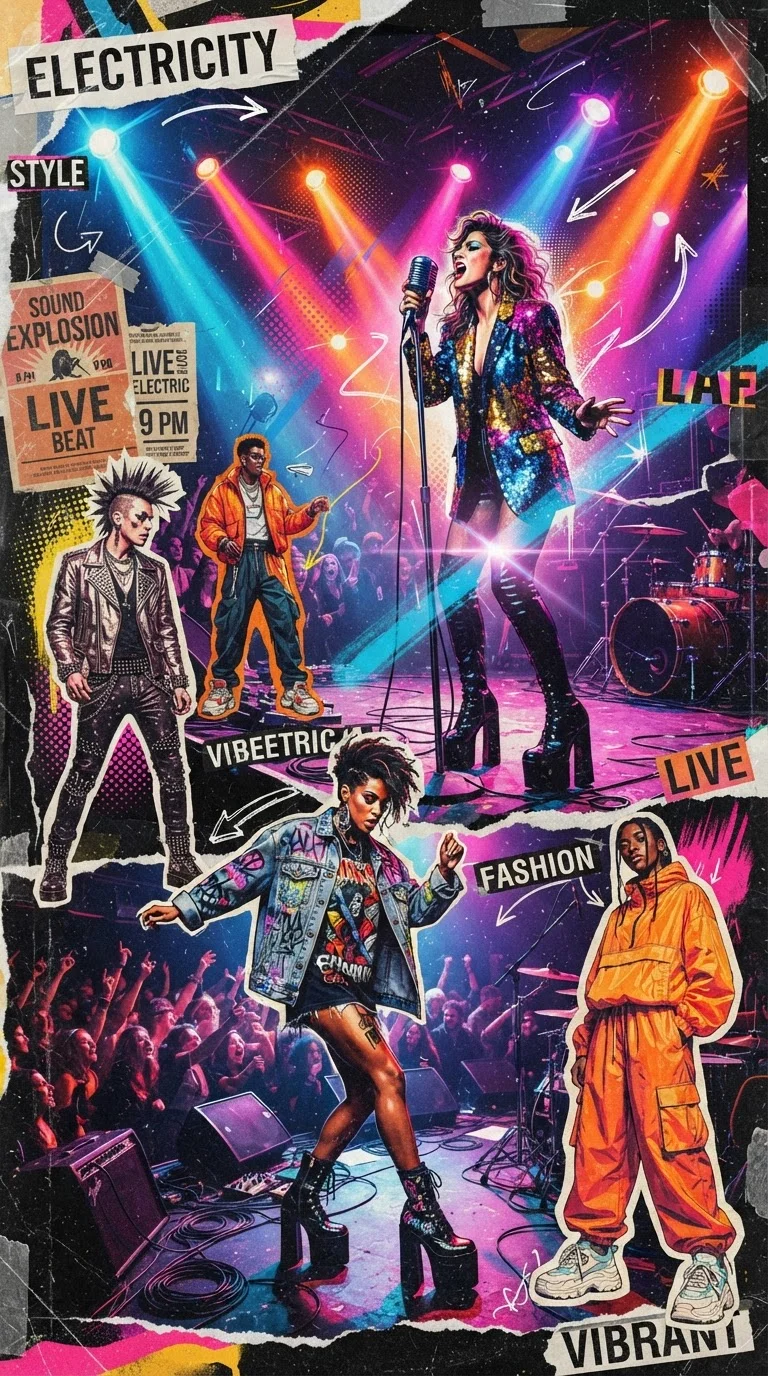
Photo credit: faqsnest.com
From glam rock to hip-hop streetwear, certain music scenes didn't just soundtrack culture — they dressed it. Here are the most defining fusions.
Key Takeaways
- Fashion and music have repeatedly merged to create cultural movements larger than either art form alone.
- These fusions typically reflect deeper social shifts — in identity, race, class, and generational values.
- Specific aesthetic moments became shorthand for entire eras, shaping how we remember both the sound and the look of a generation.
- The relationship between music and fashion is reciprocal: artists borrow from designers, and designers mine music scenes for inspiration.
- Many of the most enduring fusions emerged from underground or marginalized communities before entering the mainstream.
When the Look Became the Message
There are moments in cultural history when what artists wore said as much as what they sang. Fashion and music have always flirted, but at certain pivotal junctures, the relationship became something structural — a full fusion in which style and sound reinforced each other so completely that separating them would be like describing a song by its lyrics alone.
These moments weren't accidents. They emerged from specific social pressures, technological shifts, and the ambitions of artists who understood that performance extended far beyond the stage. The result, again and again, was a unified aesthetic language that told an audience not just what to hear, but who they could be. Understanding these fusions means understanding why some eras feel so vivid in cultural memory — a question closely related to what makes certain tracks feel like their entire era.
Glam Rock and the Politics of Spectacle (Early 1970s)
When David Bowie introduced Ziggy Stardust in 1972, he wasn't just launching an album — he was proposing a new relationship between performer and identity. Glam rock made costuming central to the music's meaning. Platform boots, glitter, androgynous silhouettes, and theatrical makeup weren't accessories to the sound; they were arguments about gender fluidity, theatricality, and the constructed nature of the self.
This was fashion as philosophical statement. Designers and artists were working in parallel, and what emerged influenced everything from punk aesthetics to the visual vocabulary of pop decades later. Glam said, explicitly, that image was not superficial — it was the point.
Glam rock didn't just look different — it argued that looking different was itself radical.
Punk and DIY as Aesthetic Doctrine (Mid-to-Late 1970s)
Punk's fashion wasn't designed — it was assembled in opposition. Torn clothing held together with safety pins, repurposed military surplus, hand-stenciled band names, and deliberately ugly boots created a unified anti-aesthetic that mirrored the music's hostility to polish and professionalism.
What made punk's fashion fusion distinct was its ideological coherence. The look and the sound shared the same argument: that access to culture shouldn't require resources or gatekeepers. DIY clothing matched DIY recording. The result was a subculture in which aesthetic and ethics were inseparable — and whose influence on fashion design, particularly through figures like Vivienne Westwood, extended well into haute couture.
Punk made the seams visible on purpose — in music and on the jacket.
Hip-Hop Streetwear and the Rewriting of Luxury (1980s–1990s)
Hip-hop's relationship with fashion evolved rapidly from Adidas tracksuits and Kangol hats in the early 1980s to a sophisticated engagement with luxury brands — many of which initially resisted or ignored the community adopting their products. Artists from Run-DMC to Notorious B.I.G. transformed the meanings of specific garments, demonstrating that luxury could be reclaimed and recontextualized on terms the industry hadn't sanctioned.
This tension ultimately reshaped fashion economics. By the 2000s, collaborations between hip-hop figures and legacy fashion houses became industry standard, not novelty. The sampling culture that shaped hip-hop's musical identity — detailed in the history of how sampling became hip-hop's creative backbone — had a direct aesthetic parallel in the way the genre remixed fashion signifiers.
Hip-hop didn't ask luxury fashion for permission — it redefined what luxury meant.
Grunge and the Deliberate Rejection of Style (Early 1990s)
Grunge is one of the most paradoxical fashion-music fusions in modern cultural history: a scene that explicitly rejected fashion became one of the most imitated aesthetics of its decade. Flannel shirts, ripped jeans, worn-out boots, and deliberately unkempt presentation were expressions of Pacific Northwest working-class identity and disenchantment — not a coordinated look, but a shared disposition.
When the fashion industry responded with runway grunge collections — notably Marc Jacobs' controversial 1993 Perry Ellis collection — it illustrated how completely the aesthetic had traveled. The irony was not lost: a scene built on rejecting commodification was being commodified in real time. That tension gave grunge's fashion legacy an ambivalence that still makes it a compelling case study in how music subcultures are absorbed and transformed.
Grunge proved that refusing to dress for the industry is itself a fashion statement.
Beyoncé, Formation, and Fashion as Political Choreography (2010s)
When Beyoncé performed at the 2016 Super Bowl halftime show in Black Panther-inspired costuming — and followed it with the visual album Lemonade, which deployed fashion as carefully as cinematography — she demonstrated how completely contemporary artists could wield image as argument. Each garment choice in that era was deliberate, drawing on Black Southern identity, Black feminist aesthetics, and African visual traditions.
This represented a maturation of the fashion-music relationship: not just a scene or a subculture producing a unified look, but a single artist using fashion with the intentionality of a filmmaker. The conversation around artists who become political symbols finds in Beyoncé a case where the artist fully controlled that symbolism, deploying it on her own terms through coordinated sound and image.
In Beyoncé's hands, fashion became as compositional as the music itself.
K-Pop's Engineered Aesthetic Ecosystem (2010s–Present)
K-pop represents perhaps the most deliberately engineered fusion of music and fashion in contemporary entertainment. Acts are developed within systems that treat visual identity, choreography, and music as equally weighted components of a total product. Styling is not incidental — it is central to fandom engagement, brand identity, and the genre's global expansion.
What distinguishes K-pop's fashion dynamic is its bidirectionality: luxury fashion houses began collaborating with K-pop acts not as novelty partnerships but as serious market strategy, recognizing the genre's influence on a global Generation Z audience. The result is a feedback loop in which K-pop aesthetics shape mainstream fashion trends, while high fashion credentials elevate the genre's cultural standing — a fusion that now operates at an institutional, not just subcultural, level.
K-pop treats fashion not as an accessory to music but as an equal creative system.
Why These Fusions Still Matter
Each of the moments explored above had something in common: they operated as more than aesthetic trends. They were identity declarations — ways for listeners and wearers to locate themselves within a broader social narrative. In that sense, fashion-music fusion has always been a form of communication, one that spoke in silhouettes, colors, and textures as much as chords and lyrics.
The erosion of monoculture means these kinds of mass-scale fusions are increasingly rare, a dynamic explored in depth through the lens of shared generational cultural touchstones. But the impulse — to dress in alignment with sound, to make clothing an extension of musical identity — has not disappeared. It has fragmented into countless subcultures, each with its own codes. The most powerful fusions of music and fashion have always begun at the margins, in communities expressing something the mainstream hadn't yet named. That dynamic hasn't changed. The stages and platforms have.
Look Beyond the Surface When Studying These Moments
The most analytically productive way to understand fashion-music fusions is to ask what social conditions made them possible. Who was being addressed by the aesthetic, and who was excluded? Understanding the audience — and the community producing the look — typically reveals more about cultural meaning than analyzing the garments themselves. Music festivals, as examined in the anatomy of a music festival, are one of the clearest living laboratories for observing how musical identity translates into collective fashion expression.

Author
Entertainment & Media Editorial Team
Entertainment & Media Editorial Team is the collective byline for our editorial team and contributor network. Articles published under this byline or an editorial pen name are researched, written, and reviewed according to our editorial standards for clarity, consistency, and independence before publication.
View all articles →