
Why Concert Tours Are a Business, an Art Form, and a Cultural Event All at Once
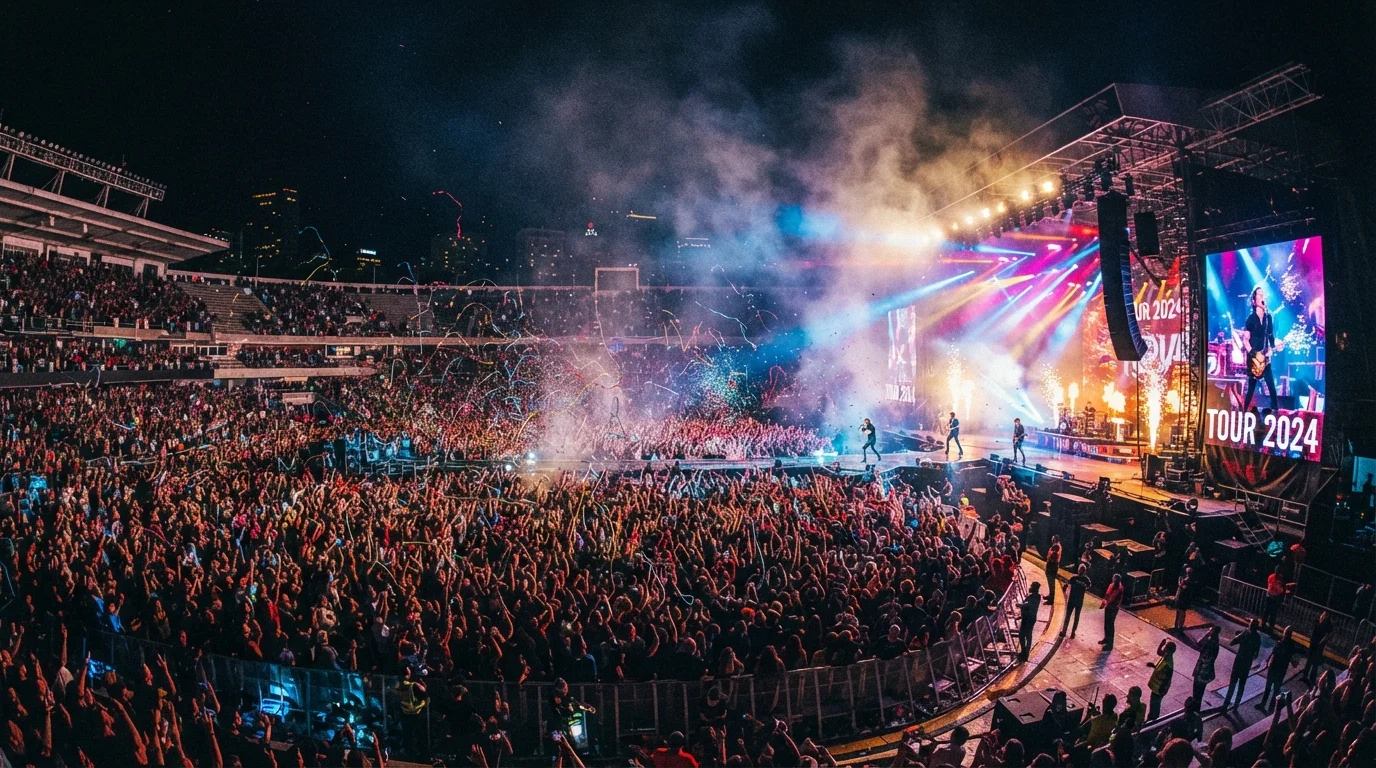
Photo credit: faqsnest.com
In this article
Live touring involves far more than setlists and ticket sales. Explore the logistics, economics, and cultural weight of major concert tours.
Key Takeaways
- Concert tours generate billions in revenue and are a primary income source for most major artists.
- The logistics behind a major tour involve hundreds of crew members, complex supply chains, and months of planning.
- Live performances carry cultural weight far beyond ticket sales, shaping collective memory and social identity.
- Touring has significant environmental costs that the industry is beginning to address more seriously.
- For fans, attending a major concert tour is often a once-in-a-generation communal experience.
Primary revenue source in a streaming-dominated era
For most major artists, live touring generates far more income per performance than recorded music. It provides financial stability that streaming royalties alone cannot deliver.
Creates irreplaceable shared communal experiences
Concert attendance fosters social bonding and collective memory in ways that recorded media cannot replicate, marking significant moments in fans' personal and cultural lives.
Allows ambitious artistic expansion beyond recordings
Tours give artists the opportunity to reimagine their work through staging, choreography, and visual storytelling, producing experiences that function as distinct creative works.
Stimulates local economies along the touring route
Cities hosting major tour stops typically see increased hotel occupancy, restaurant traffic, and retail spending, with economic benefits spreading well beyond the venue itself.
Deepens artist-audience relationships across geographies
Touring allows artists to build and sustain meaningful connections with fans in cities and regions far from media industry centers, broadening cultural reach.
Production and logistics costs are enormous
Top-tier tours can cost tens of millions to produce before a single dollar of ticket revenue arrives, placing significant financial risk on artists, promoters, and investors alike.
Significant and underaddressed environmental footprint
Freight transport, aviation, and venue energy consumption combine to make large concert tours among the more carbon-intensive activities in the entertainment sector.
Ticket pricing increasingly excludes working-class fans
Dynamic and algorithmic pricing models have pushed ticket costs for major acts well beyond what many fans can reasonably afford, narrowing the audience to higher-income brackets.
Demanding conditions for crew and touring staff
The workers who build, run, and tear down touring productions face long hours, physical strain, and extended periods away from home, often with limited formal labor protections.
Logistical failures can ripple into public relations crises
Vendor breakdowns, weather events, or crowd management failures at large-scale events can cause significant harm and generate lasting reputational damage for artists and promoters.
The Economics Behind the Spectacle
Live music has become the financial backbone of the modern music industry. With recorded music revenue increasingly distributed across streaming platforms — often paying artists fractions of a cent per play — touring has emerged as the dominant revenue stream for established acts. A single stadium run can generate tens of millions of dollars in gross ticket revenue, while associated merchandise, sponsorship deals, and licensing agreements layer additional income on top.
The economics are not one-sided, however. Producing a large-scale tour is extraordinarily expensive. A major production might carry a touring crew of 200 or more people, requiring trucks, flights, hotel blocks, custom staging, and miles of cabling just to set the show in motion. Production costs for top-tier stadium tours can run into the tens of millions before a single ticket is sold. Promoters, venues, and artists each absorb different layers of financial risk.
$9.7B
Global concert tour revenue in a recent peak year
According to Pollstar industry data, global concert touring revenue has reached multi-billion dollar figures annually, underscoring its central role in the music economy.
200+
Crew members on a major stadium tour
Large-scale productions routinely employ over 200 touring crew members, from riggers and lighting directors to caterers and security coordinators.
Ticket pricing has also become a flashpoint in public discourse. Dynamic pricing models — which adjust ticket costs based on demand algorithms — have drawn criticism for making live music inaccessible to many fans. The tension between maximizing revenue and maintaining cultural accessibility is one the industry has yet to fully resolve.
Tour as Artistic Statement
Beyond the ledger, a great concert tour functions as a distinct creative work. Artists increasingly approach touring as a medium in its own right, using elaborate set design, choreography, narrative arcs, and visual storytelling to create experiences that recordings simply cannot replicate. Productions by major touring acts have employed theatrical directors, architects, and even video game designers to shape the audience experience.
The setlist itself is a curatorial act — decisions about song selection, sequencing, and tempo shifts reflect the same intentionality as an album's track order. Some artists use tours to recontextualize older material, inviting audiences to hear familiar songs in new emotional registers. Others build a tour around an album's themes so completely that attending a show becomes a full narrative immersion.
Primary revenue source in a streaming-dominated era
For most major artists, live touring generates far more income per performance than recorded music. It provides financial stability that streaming royalties alone cannot deliver.
Creates irreplaceable shared communal experiences
Concert attendance fosters social bonding and collective memory in ways that recorded media cannot replicate, marking significant moments in fans' personal and cultural lives.
Allows ambitious artistic expansion beyond recordings
Tours give artists the opportunity to reimagine their work through staging, choreography, and visual storytelling, producing experiences that function as distinct creative works.
Stimulates local economies along the touring route
Cities hosting major tour stops typically see increased hotel occupancy, restaurant traffic, and retail spending, with economic benefits spreading well beyond the venue itself.
Deepens artist-audience relationships across geographies
Touring allows artists to build and sustain meaningful connections with fans in cities and regions far from media industry centers, broadening cultural reach.
This artistic ambition has genuine consequences for how tours are remembered. Productions that push formal boundaries — integrating dance, film projections, political commentary, or environmental themes — often become reference points for what live music can achieve as an art form.
The Cultural and Social Dimensions
Concert tours do something that few other entertainment forms can: they gather communities of strangers into shared physical space around a common emotional experience. The sociological function of live music — reinforcing identity, creating collective memory, marking life stages — is well-documented in cultural studies. Fans often describe concert experiences as transformative in ways streaming playlists cannot approach.
Major tours also function as cultural events in cities and towns along the route. Local economies benefit from hotel bookings, restaurant traffic, and retail spending. Regional newspapers cover tour stops as civic events. In some cases, an artist's arrival in a particular city carries deep resonance — connecting to the history of a music scene, a social movement, or a particular community's cultural identity.
Compare this with the festival context: while music festivals aggregate multiple artists into a single location, a concert tour brings a singular artistic vision across dozens of cities, creating a sustained cultural conversation. The anatomy of a music festival explores how those multi-artist gatherings build their own distinct legacies — a useful counterpoint to the tour's concentrated focus.
Production and logistics costs are enormous
Top-tier tours can cost tens of millions to produce before a single dollar of ticket revenue arrives, placing significant financial risk on artists, promoters, and investors alike.
Significant and underaddressed environmental footprint
Freight transport, aviation, and venue energy consumption combine to make large concert tours among the more carbon-intensive activities in the entertainment sector.
Ticket pricing increasingly excludes working-class fans
Dynamic and algorithmic pricing models have pushed ticket costs for major acts well beyond what many fans can reasonably afford, narrowing the audience to higher-income brackets.
Demanding conditions for crew and touring staff
The workers who build, run, and tear down touring productions face long hours, physical strain, and extended periods away from home, often with limited formal labor protections.
Logistical failures can ripple into public relations crises
Vendor breakdowns, weather events, or crowd management failures at large-scale events can cause significant harm and generate lasting reputational damage for artists and promoters.
What the Industry Must Still Reckon With
The concert touring industry faces legitimate structural challenges that go beyond economics. Environmental impact is significant: freight trucks transporting equipment between cities, charter flights for artists and crew, and the energy demands of large venues add up to a substantial carbon footprint. Several artists and production companies have begun publishing sustainability riders and experimenting with solar power backstage, but systemic change remains incremental.
Sustainability Efforts Are Growing but Uneven
A growing number of touring acts have adopted green riders — contractual requirements that specify sustainable practices at venues, from renewable energy sourcing to waste reduction. Organizations like Julie's Bicycle have worked with the music industry to develop frameworks for measuring and reducing touring's environmental impact. However, adoption remains voluntary and inconsistent across the industry, meaning that progress is real but far from systemic.
Labor conditions for touring crew — the riggers, audio technicians, wardrobe staff, and drivers who make productions possible — have also drawn increasing scrutiny. Long touring cycles with irregular hours and significant time away from home take a toll, and the industry has been slow to formalize protections for these workers compared to other entertainment sectors. The romanticized image of life on the road often obscures the demanding reality for those behind the scenes.
Despite these tensions, the concert tour endures as a defining institution of modern entertainment. Its capacity to be economically vital, artistically ambitious, and socially meaningful all at once is precisely what makes it worth examining with care.

Author
Entertainment & Media Editorial Team
Entertainment & Media Editorial Team is the collective byline for our editorial team and contributor network. Articles published under this byline or an editorial pen name are researched, written, and reviewed according to our editorial standards for clarity, consistency, and independence before publication.
View all articles →