
Emotion vs. Reason: How Feelings Actually Influence Rational Thinking
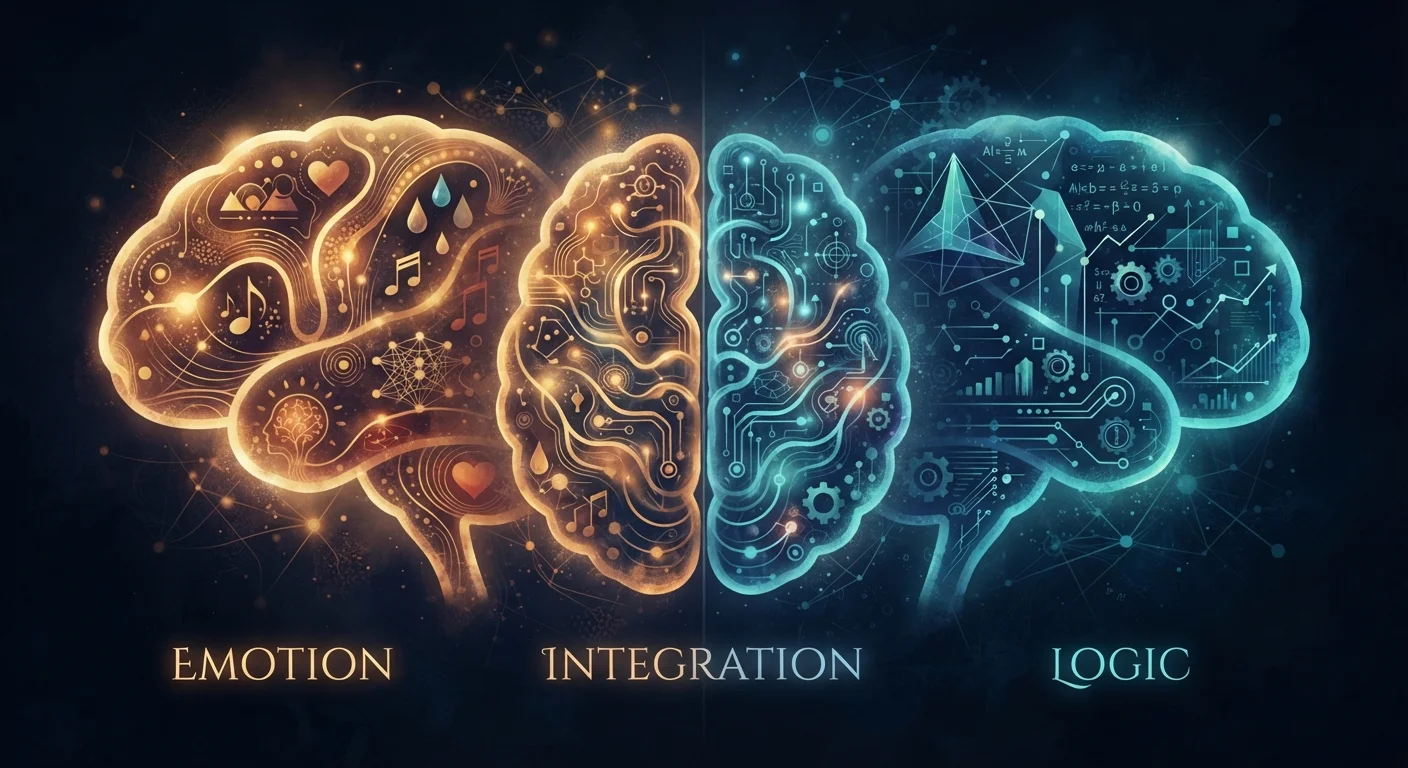
Photo credit: faqsnest.com
In this article
The idea that emotion and logic are opposites doesn't hold up under scrutiny. Behavioral research reveals a more nuanced and surprising relationship.
Key Takeaways
- Emotion and reason are not opposites — neuroscience shows they share overlapping brain systems.
- Purely rational decision-making is largely a myth; emotion provides critical input to most choices.
- Emotional signals can improve decisions by encoding past experience as fast, usable information.
- Unchecked emotion can introduce systematic bias, making reflective reasoning a necessary corrective.
- The most effective thinking integrates both systems rather than suppressing one in favor of the other.
The False War Between Head and Heart
Western intellectual tradition has long cast emotion and reason as adversaries — with reason as the noble rider and emotion as the unruly horse. Plato introduced this metaphor, and it proved remarkably durable. But behavioral science and neuroscience have spent the last several decades quietly dismantling it.
The research picture that has emerged is considerably more interesting: emotion and reason are not separate systems locked in combat. They are deeply interdependent processes that constantly inform and regulate each other. As neuroscientist Antonio Damasio's work on patients with damage to the brain's emotional centers demonstrated, people who lose access to emotional processing don't become clearer thinkers — they become paralyzed decision-makers, unable to weigh even simple options without the felt sense of what matters.
This challenges one of the most persistent myths about human nature: that purely rational thinking is both possible and preferable. In practice, reasoning without emotional input tends to produce shallow, context-free judgments rather than rigorous ones.
What Each System Actually Does
Understanding the distinction requires some precision about what we mean by each term. Emotion, in behavioral science terms, refers to fast, often automatic affective responses — fear, disgust, enthusiasm, unease — that arise before conscious deliberation kicks in. These responses are not random noise. They reflect the brain's rapid pattern-matching against prior experience, encoding what has helped or harmed us in similar situations before.
Reason, by contrast, refers to the slower, effortful process of consciously evaluating evidence, constructing arguments, and applying logical rules. Psychologist Daniel Kahneman's influential dual-process model describes these as System 1 (fast, intuitive, emotionally tinged) and System 2 (slow, deliberate, effortful).
Critically, System 2 does not operate in an emotional vacuum. We choose which problems are worth reasoning about — and how much effort to invest — partly based on emotional salience. A decision feels important because we care about it. Reason then examines that emotionally flagged problem more carefully.
| Criterion | Emotion | Reason |
|---|---|---|
| Processing speed | Fast, automatic | Slow, deliberate |
| Primary input | Past experience, bodily signals | Evidence, logic, rules |
| Strength in context | High-stakes social and value judgments | Complex trade-off analysis |
| Main failure mode | Systematic bias and distortion | Paralysis without emotional input |
| Role in motivation | Primary driver of sustained effort | Supports goal-setting and planning |
| Relationship to the other | Flags what matters for reasoning | Checks and calibrates emotional signals |
When Emotion Improves Decision Quality
Contrary to the popular ideal of the cold, detached decision-maker, emotional input frequently improves the quality of real-world choices. Research on somatic markers — a concept developed from Damasio's work — suggests that the body generates felt signals tied to anticipated outcomes, and these signals serve as useful shortcuts when time and information are limited.
In studies of experienced professionals such as physicians and firefighters, researchers have found that expert intuition often outperforms laborious conscious analysis — not because it bypasses reason, but because it has internalized vast amounts of evidence into rapid, emotionally coded pattern recognition. The expert's gut feeling is, in effect, compressed experience.
Emotions also function as a motivational engine. People consistently pursue goals they care about more persistently than goals they merely calculate to be logical. Values — which are fundamentally emotional commitments — give reason something to optimize for in the first place.
When Reason Must Check Emotion
None of this means emotions are always reliable guides. The same fast-processing system that enables useful intuition also produces systematic bias. Loss aversion — the tendency to feel losses more acutely than equivalent gains — is an emotionally driven heuristic that can lead to irrational risk avoidance. In-group favoritism, disgust responses triggered by unfamiliar ideas, and mood-congruent memory (recalling more negative information when feeling low) are all emotional influences that can undermine judgment.
This is precisely where deliberate reasoning earns its keep. Reflective thought can identify when an emotional response is being triggered by irrelevant cues — a tactic sometimes called cognitive reappraisal — and recalibrate accordingly. The psychology of everyday decision-making shows that structured pauses, considering alternatives, and seeking disconfirming evidence are all reasoning strategies that counteract predictable emotional distortions.
~95%
Decisions influenced by non-conscious processing
Researchers including Gerald Zaltman at Harvard Business School have estimated that the vast majority of purchase and social decisions involve processes below conscious awareness, many of which are emotionally driven.
2x
Weight people assign to losses vs. equivalent gains
Kahneman and Tversky's landmark prospect theory research found that losses feel roughly twice as powerful as gains of the same size — a fundamentally emotional asymmetry in judgment.
40+
Years of dual-process research
Since the 1970s, cognitive and social psychologists have developed and refined dual-process models showing that intuitive and deliberate thinking operate in parallel, not in sequence.
Integration, Not Suppression
The practical implication of this research is not a prescription to feel less or to think harder in isolation. It is an argument for metacognitive awareness — the habit of monitoring which system is driving a given judgment and whether the other system needs to be consulted.
Strong decisions tend to emerge from a sequence: an emotional signal flags that something is important or wrong; reason investigates and tests whether that signal is reliable; and the final choice integrates both the felt urgency and the logical analysis. Suppressing emotion in the name of objectivity typically just means those emotional influences operate invisibly — which is worse than acknowledging them.
Building this kind of integrative thinking is not about achieving a mythical neutrality. It is about becoming a more accurate reader of your own cognitive process — recognizing that both your feelings and your analysis are inputs to a fundamentally human form of judgment, not contestants in a zero-sum match.

Author
People & Culture Editorial Team
People & Culture Editorial Team is the collective byline for our editorial team and contributor network. Articles published under this byline or an editorial pen name are researched, written, and reviewed according to our editorial standards for clarity, consistency, and independence before publication.
View all articles →