
Nudge Theory and the Architecture of Choice
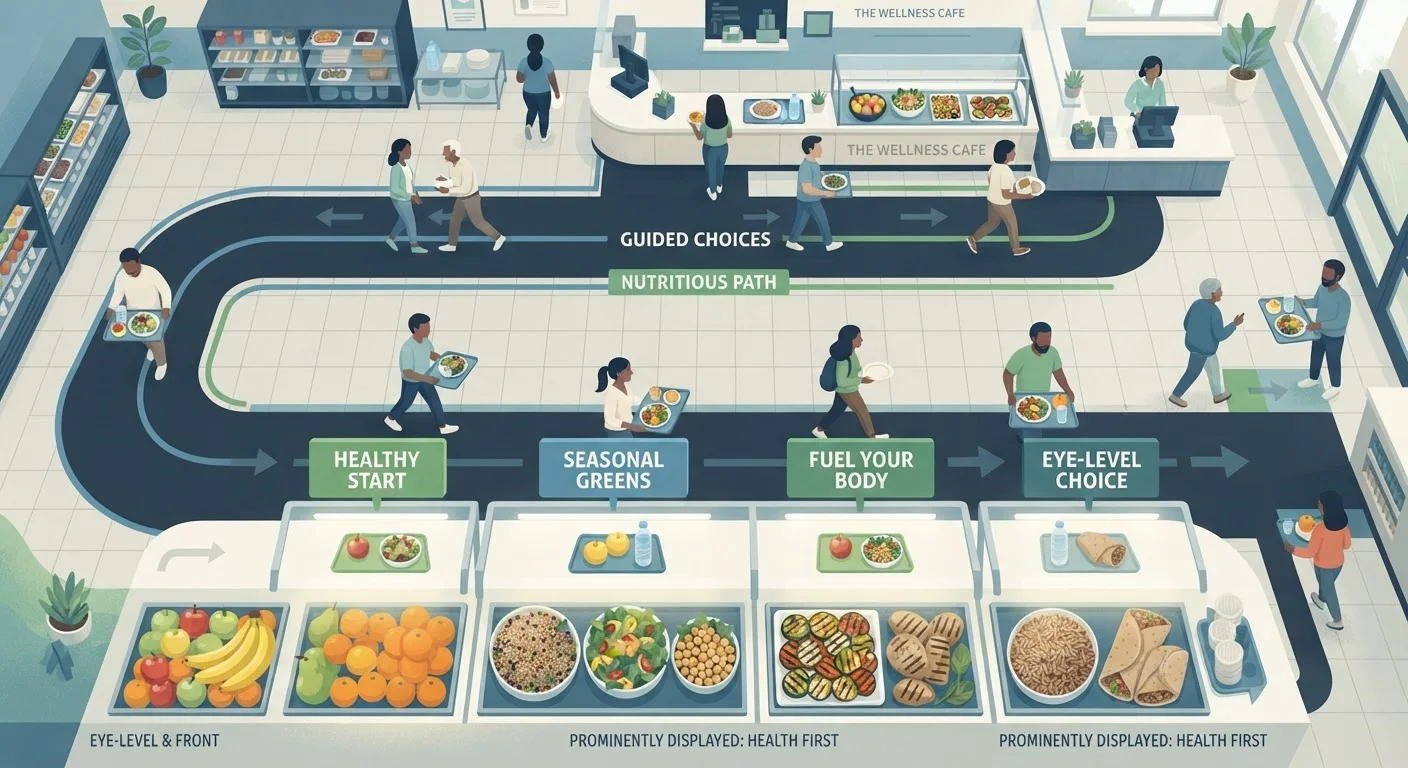
Photo credit: faqsnest.com
In this article
How small, deliberate changes to how options are presented can shift behavior — without restricting freedom or relying on incentives.
Key Takeaways
- Nudge theory shows that how choices are presented influences decisions as much as the options themselves.
- Nudges work by aligning environments with natural cognitive tendencies rather than fighting them.
- Defaults, framing, and social norms are among the most powerful nudging tools.
- Nudge theory is used in public health, retirement savings, energy conservation, and education.
- Effective nudges preserve individual freedom — people can always opt out or choose differently.
The Invisible Architecture of Every Decision
Every time you make a choice — what to eat, how much to save, whether to donate an organ — you're doing so inside an environment someone designed. That environment has a structure: which options appear first, what's labeled as the default, how trade-offs are framed. Nudge theory starts from a simple but unsettling observation: that structure matters enormously, and it is never neutral.
Behavioral scientists use the term choice architecture to describe the deliberate or accidental design of decision environments. A grocery store layout is choice architecture. So is the order of items on an online form, or whether a retirement plan requires you to opt in or opt out. These structural details quietly steer behavior — and nudge theory is the discipline of making that steering intentional and transparent.
For a deeper grounding in why our minds are susceptible to these environmental cues, see this introduction to behavioral science, which traces the core ideas that make nudging possible.
How Nudges Actually Work
Nudges exploit reliable patterns in human cognition — the same mental shortcuts that help us function in a complex world also make us predictably responsive to how information is arranged. Three mechanisms are especially well-documented:
- Default effects: People tend to stick with whatever option is pre-selected. Making organ donation the default (requiring action to opt out rather than opt in) has dramatically increased donor registration rates in several European countries. Inertia is a powerful force, and defaults channel it.
- Framing: The way information is described shapes how it's evaluated. Describing a surgical outcome as a "90% survival rate" feels meaningfully different from a "10% mortality rate" — even though both communicate identical information. Communicators who understand framing can present accurate data in ways that land more effectively.
- Social norms: Humans are deeply social, and we calibrate behavior by observing what others do. Telling hotel guests that "the majority of guests in this room reuse their towels" is more effective than a general environmental appeal — because it anchors the choice to observable community behavior.
These mechanisms connect directly to the cognitive shortcuts explored in our field guide to cognitive biases, which maps the underlying tendencies that nudges are designed to work with.
~90%
Organ donor registration in opt-out countries
Research comparing opt-in versus opt-out organ donation systems has found dramatically higher registration rates in countries using opt-out defaults, illustrating the power of default effects.
~40%
Increase in retirement plan enrollment from auto-enrollment
Studies of automatic enrollment in US 401(k) plans, including research by Thaler and Benartzi, found participation rates rose substantially compared to voluntary opt-in designs.
2–5%
Average energy reduction from social norm comparisons
Evaluations of utility programs using neighborhood energy comparisons have reported consistent reductions in consumption among high-usage households across multiple US states.
Real-World Applications: Where Nudges Show Up
Nudge theory has moved well beyond academic papers into practical policy and institutional design. Some of the most consequential applications include:
Retirement savings: Automatic enrollment in workplace retirement plans — where employees are enrolled by default and must actively opt out — has substantially increased participation rates. Research examining this intervention found that automatic enrollment dramatically raised the share of workers saving for retirement, with effects concentrated among employees who previously would not have enrolled voluntarily.
Public health: Cafeteria redesigns in schools and hospitals that position nutritious foods more prominently, use smaller serving plates, or make water more accessible than sugary drinks have produced measurable shifts in consumption patterns — without removing any food options.
Energy conservation: Utility companies that show households how their energy use compares to neighbors with similar homes have reduced consumption among high users, leveraging the social norms mechanism. This approach has been piloted across multiple US states with consistent, if modest, results.
Tax compliance: Simply rewriting the language of tax reminder letters — personalizing them, adding social norm statements, or emphasizing what community services taxes fund — has increased on-time payment rates in trials conducted by behavioral insights teams.
The Ethics of Nudging
Nudge theory's power raises legitimate ethical questions that its proponents take seriously. The core tension is transparency: nudges often work precisely because people don't notice them. A cafeteria designed to encourage healthy eating is influencing behavior without the diner's conscious awareness. That influence, even when well-intentioned, involves a form of asymmetry — the designer knows what they're doing; the chooser often doesn't.
Thaler and Sunstein's concept of libertarian paternalism addresses this by insisting that nudges must always preserve free choice. No option should be removed; nudges should only make beneficial choices easier, not coercive. But critics — from both libertarian and progressive traditions — argue that even choice-preserving nudges can encode the values and assumptions of those doing the designing. Who decides what counts as a 'better' outcome, and for whom?
The emerging consensus among behavioral scientists and ethicists is that nudges deployed by institutions — especially governments — should be transparent, evidence-based, and subject to democratic oversight. Nudging is not inherently manipulative, but it requires accountability to remain a legitimate tool rather than a form of paternalistic overreach.
Understanding nudges also enriches how we think about everyday decision-making — and why so many of our seemingly personal choices are shaped by forces outside our awareness.
“A nudge is any aspect of the choice architecture that alters people's behavior in a predictable way without forbidding any options or significantly changing their economic incentives.”
— Richard Thaler and Cass Sunstein, Authors of 'Nudge' (2008); Thaler is a Nobel Prize–winning behavioral economist
Frequently Asked Questions

Author
People & Culture Editorial Team
People & Culture Editorial Team is the collective byline for our editorial team and contributor network. Articles published under this byline or an editorial pen name are researched, written, and reviewed according to our editorial standards for clarity, consistency, and independence before publication.
View all articles →