
Cognitive Biases: A Field Guide to Mental Shortcuts
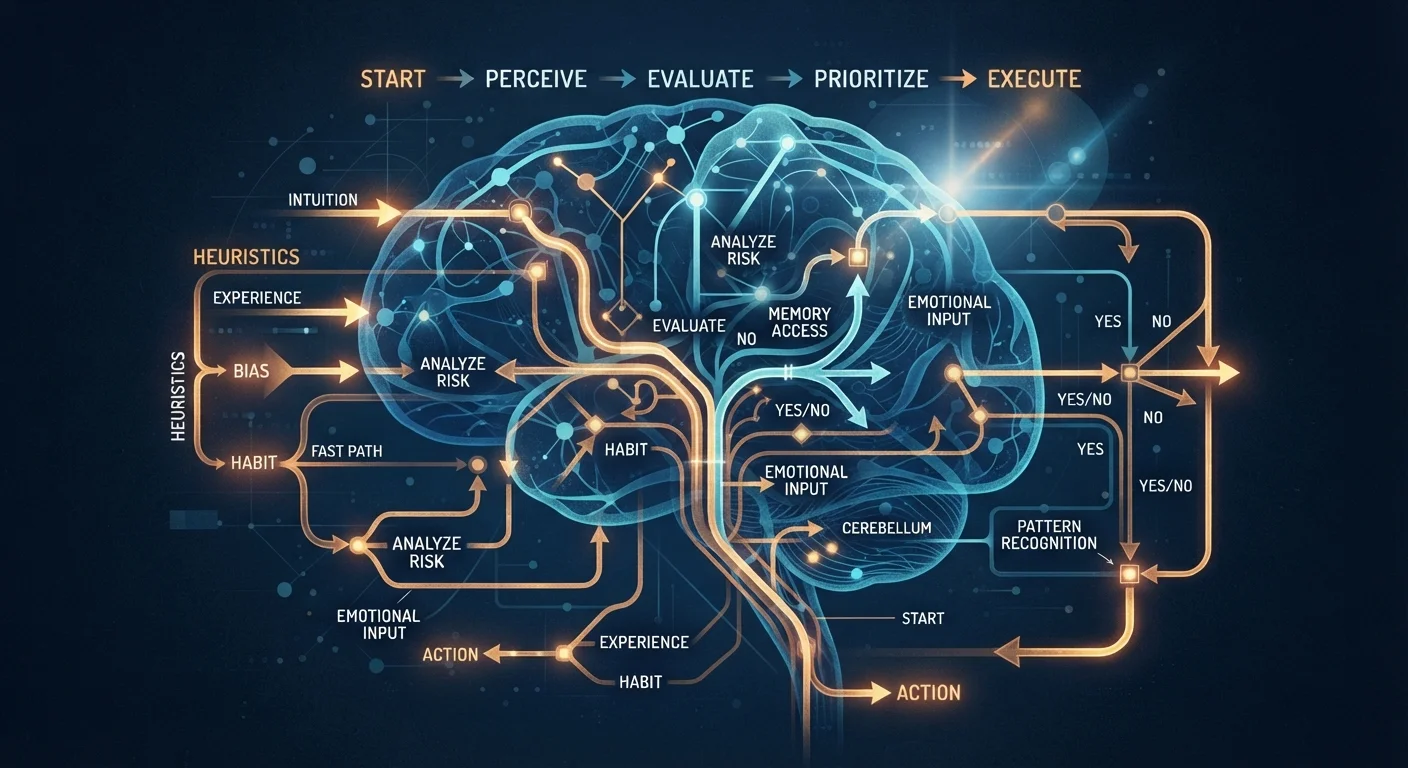
Photo credit: faqsnest.com
A reference to the most documented cognitive biases, what they mean, and how they show up in ordinary thinking and judgment.
Why the Brain Takes Shortcuts
Human cognition operates under significant constraints. The brain processes an estimated 11 million bits of sensory information per second, yet conscious thought handles only a tiny fraction of that. To manage the gap, the mind relies on heuristics — rapid, rule-of-thumb strategies that produce good-enough answers without exhausting mental resources.
Cognitive biases are the predictable errors that emerge when these shortcuts misfire. They are not signs of low intelligence or carelessness; they are structural features of the way all human minds work, documented consistently across cultures and contexts. Behavioral scientists Daniel Kahneman and Amos Tversky mapped many of them through decades of research, framing them within what Kahneman later called dual-process theory — the interplay between fast, automatic thinking and slower, deliberate reasoning. For a deeper look at that framework, see foundational models in behavioral science.
Understanding these biases is not a cure — awareness alone rarely eliminates them — but it sharpens the ability to recognize when a judgment deserves more scrutiny.
Cognitive bias
A systematic pattern of deviation from rational judgment that affects how people perceive information, make decisions, and remember events. Cognitive biases are consistent and predictable, not random errors.
Heuristic
A mental shortcut or rule of thumb that allows quick judgments without exhaustive analysis. Heuristics are efficient but can produce systematic errors in certain conditions.
Anchoring
The tendency to rely too heavily on the first piece of information encountered — the 'anchor' — when making subsequent estimates or decisions, even when that anchor is irrelevant.
Confirmation bias
The tendency to favor information that confirms one's pre-existing beliefs while discounting contradictory evidence. It affects what information people seek, how they interpret it, and what they remember.
Sunk cost fallacy
The tendency to continue an endeavor based on previously invested resources — time, money, or effort — rather than on its current or future value. Rational decision-making should focus only on future costs and benefits.
Dual-process theory
A framework in cognitive psychology describing two modes of thinking: fast, intuitive, automatic processing (System 1) and slow, deliberate, analytical reasoning (System 2). Cognitive biases are most likely to emerge from System 1 processing.
Availability heuristic
A mental shortcut in which the estimated probability of an event is based on how easily examples come to mind. Vivid or recent events are judged as more frequent or likely than they may actually be.
Status quo bias
A preference for the current state of affairs, in which any change from it is perceived as a potential loss rather than a possible gain. It can discourage beneficial decisions and reinforce inertia.
A Reference Catalog of Common Biases
The list below covers some of the most consistently replicated biases across behavioral science literature. Each is grouped loosely by the cognitive function it distorts.
Memory & Perception
- Availability heuristic: We judge the likelihood of events by how easily examples come to mind. Plane crashes feel more common than they statistically are because vivid news coverage makes them highly retrievable. This connects directly to how memory shapes judgment — explored further in our field guide to how memory actually works.
- Rosy retrospection: Past events are remembered more positively than they were experienced, partly because negative emotion fades faster than positive memory.
- Misinformation effect: Post-event information — a leading question, a news report — can alter how an original experience is remembered.
Social Judgment
- Fundamental attribution error: When others behave badly, we attribute it to their character; when we do, we cite circumstances. This asymmetry is pervasive enough to warrant its own investigation — see how this bias distorts social perception.
- In-group bias: People consistently favor members of groups they belong to, often unconsciously, affecting evaluations of competence, trustworthiness, and effort.
- Halo effect: A single positive trait — physical attractiveness, a confident speaking style — inflates overall impressions of a person's unrelated qualities.
Decision-Making
- Anchoring: The first piece of numerical information encountered disproportionately shapes subsequent estimates, even when the anchor is arbitrary.
- Sunk cost fallacy: Resources already spent — money, time, effort — are allowed to influence future decisions, even when continuing a course of action no longer makes rational sense.
- Status quo bias: The current state of affairs is preferred, and departures from it are perceived as losses rather than opportunities.
- Confirmation bias: People selectively seek, interpret, and remember information that confirms existing beliefs, and discount or avoid contradictory evidence.
These patterns quietly shape hundreds of small choices daily. The psychology of everyday decision-making maps how they interact with emotion and social context.
| Number of catalogued biases | 180+ (Wikipedia's cognitive bias codex; count varies by source and classification) |
| Foundational researchers | Daniel Kahneman & Amos Tversky (Prospect theory and heuristics research, 1970s–1990s) |
| Framework type | Behavioral science / cognitive psychology |
| Does awareness eliminate bias? | Generally no (Consistent finding across debiasing research literature) |
| Replication crisis impact | Many classic findings partially or fully failed to replicate (Open Science Collaboration, 2015) |
| Practical debiasing methods | Structured decision checklists, red-teaming, slowing deliberation (Organizational behavior and decision research) |
What Biases Are Not
A common misconception is that identifying a bias explains behavior fully, or that biased thinking is irrational by definition. Neither holds up well. Heuristics are adaptive — they evolved under real-world conditions where speed often outweighed precision. The availability heuristic, for instance, is a reasonable proxy in environments where memorable events genuinely are more frequent.
Biases also vary by context, stakes, expertise, and domain. An experienced emergency physician may be less susceptible to anchoring on a patient's self-reported symptom timeline than a novice, because training creates richer counter-evidence. Expertise does not eliminate bias, but it can recalibrate it.
Finally, many popular claims about cognitive biases circulating in self-help and media are overstated or poorly replicated. The broader field of behavioral science itself has undergone significant scrutiny through the replication crisis — a period in which landmark psychology findings failed to reproduce under controlled conditions. Readers are encouraged to treat specific effect sizes and dramatic real-world applications with proportionate skepticism. For a grounded look at which popular assumptions about human nature hold up, see beliefs about human nature that research keeps contradicting.

Author
People & Culture Editorial Team
People & Culture Editorial Team is the collective byline for our editorial team and contributor network. Articles published under this byline or an editorial pen name are researched, written, and reviewed according to our editorial standards for clarity, consistency, and independence before publication.
View all articles →