
Suburban Isolation vs. Urban Anonymity: Two Different Flavors of Disconnection
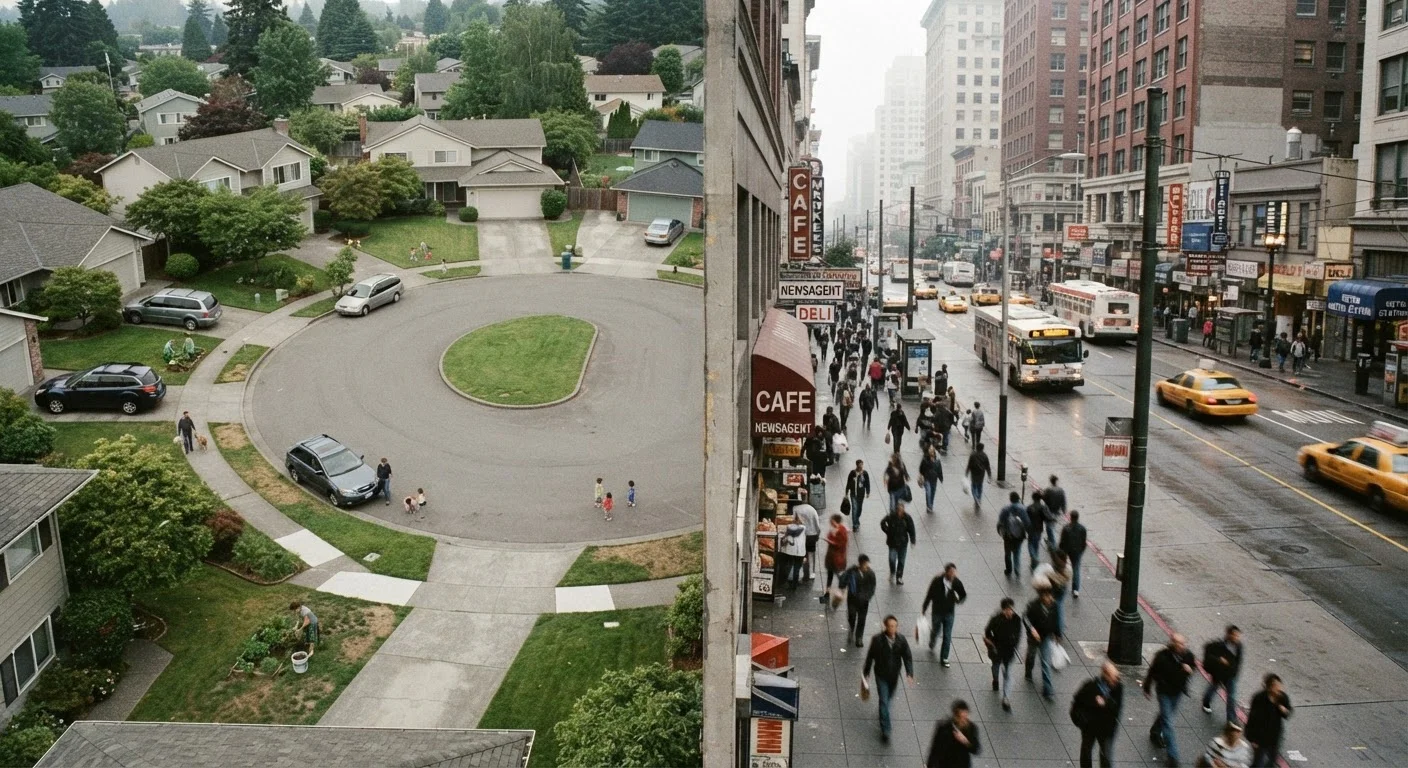
Photo credit: faqsnest.com
In this article
Does where you live shape how socially connected you feel? Compare the distinct social dynamics of suburban and urban environments in America.
Key Takeaways
- Suburban and urban environments produce distinct — but equally real — forms of social disconnection.
- Suburban isolation tends to stem from physical design: car dependency, spatial separation, and reduced spontaneous contact.
- Urban anonymity arises from sensory overload, social norms of non-engagement, and the paradox of density without intimacy.
- Neither setting guarantees belonging; both require deliberate effort to build meaningful community.
- Sociological research suggests place shapes social behavior, but individual agency and local culture also play significant roles.
Two Landscapes, Two Loneliness Blueprints
When Americans talk about feeling disconnected, they rarely frame it as a geography problem. Yet where you live — the density of your block, the walkability of your streets, the design of your neighborhood — quietly engineers your opportunities for human contact. Suburban isolation and urban anonymity are not the same phenomenon dressed in different zip codes. They are structurally distinct experiences rooted in different physical environments, different social norms, and different psychological mechanisms.
Understanding both matters because loneliness in America is not one-size-fits-all. As explored in the social architecture of American friendship, the cultural and geographic forces shaping how people connect are varied and often invisible to those living inside them.
| Criterion | Suburban Isolation | Urban Anonymity |
|---|---|---|
| Primary driver | Physical design and car dependency | Social norms and cognitive overload |
| Social contact frequency | Low incidental contact | High contact, low engagement |
| Cultural narrative | Self-sufficient domestic ideal | Independent cosmopolitan lifestyle |
| Visibility of the problem | Hidden behind prosperity markers | Masked by apparent social abundance |
| Dominant relationship type | Nuclear family, few outside bonds | Weak ties, few strong reciprocal bonds |
| Sociological mechanism | Reduced proximity, reduced familiarity | Civil inattention, proximity overload |
Suburban Isolation: When Space Becomes Distance
Suburban isolation is largely a product of physical design. Low-density residential development, dependence on automobiles, and the spatial separation of daily activities — work, school, commerce, leisure — reduce the frequency of what sociologists call incidental contact: the unplanned, low-stakes interactions that quietly sustain social fabric over time.
Research in environmental psychology has long noted that the design of American suburbs discourages the kind of casual, repeated proximity that tends to generate friendship. When homes face garages rather than sidewalks, when cul-de-sacs replace through-streets, and when daily errands require a car rather than a walk, residents move through their neighborhoods without encountering their neighbors. Familiarity, one of the most reliable predictors of social bond formation, never gets a chance to develop.
There is also an aspirational dimension to suburban isolation. Suburbia was historically marketed as a retreat from urban congestion — a privatized domesticity centered on the nuclear family and the home. This cultural narrative valorizes self-sufficiency, which can quietly stigmatize the need for community. Residents may feel they should be content with what they have, making isolation harder to name and therefore harder to address. For a deeper look at how neighborhood design and attachment intersect, see the sociology of neighborhood belonging.
Urban Anonymity: Density Without Intimacy
Urban anonymity operates through an almost opposite mechanism. Rather than physical separation, it emerges from proximity overload. In dense city environments, residents are constantly surrounded by strangers, and social norms evolve to manage that pressure. The studied non-engagement of a subway car — eyes down, earbuds in — is not rudeness; it is a learned coping strategy that sociologist Erving Goffman described as civil inattention, a mutual granting of privacy in shared public space.
The problem is that civil inattention, scaled across an entire city and a lifetime of daily commutes, can calcify into genuine social invisibility. Urban residents may go weeks without a meaningful conversation with a neighbor, not because the neighbor is hostile, but because urban social norms actively discourage unsolicited engagement. The very tools that make high-density living bearable also make authentic community harder to initiate.
City environments also tend to offer what researchers call weak-tie abundance — a rich web of acquaintances, colleagues, and service relationships — without necessarily providing the strong, reciprocal ties associated with deep belonging. Having thousands of people within walking distance does not automatically translate into having someone to call during a crisis. The relationship between density and social connection is far more complicated than simple proximity suggests, a tension explored in research on online versus in-person belonging.
What Both Environments Share — and What Differs
Despite their structural differences, suburban isolation and urban anonymity converge on a common outcome: a deficit of genuine, reciprocal social bonds. Both environments can leave residents feeling unseen, under-supported, and uncertain about where they truly belong. Research on social connection and wellbeing consistently finds that the quality and depth of relationships matter far more than raw social contact volume.
Where the two experiences diverge is in their cultural interpretation. Suburban isolation is often invisible because it exists behind the veneer of the ideal American life — homeownership, space, privacy. Urban anonymity, by contrast, can be misread as independence or cosmopolitan sophistication. In both cases, the social deficit is real, but the cultural narratives surrounding each lifestyle discourage residents from acknowledging it.
The broader tension mirrors a theme running throughout American civic life: the pull between individualism and the genuine human need for collectivism. Neither suburban nor urban environments are inherently doomed to disconnection — both contain examples of thriving communities built through deliberate effort, shared third places, and cultural investment in neighborliness. But those outcomes require swimming against strong structural and normative currents.

Author
People & Culture Editorial Team
People & Culture Editorial Team is the collective byline for our editorial team and contributor network. Articles published under this byline or an editorial pen name are researched, written, and reviewed according to our editorial standards for clarity, consistency, and independence before publication.
View all articles →