
The Sociology of Neighborhood Belonging
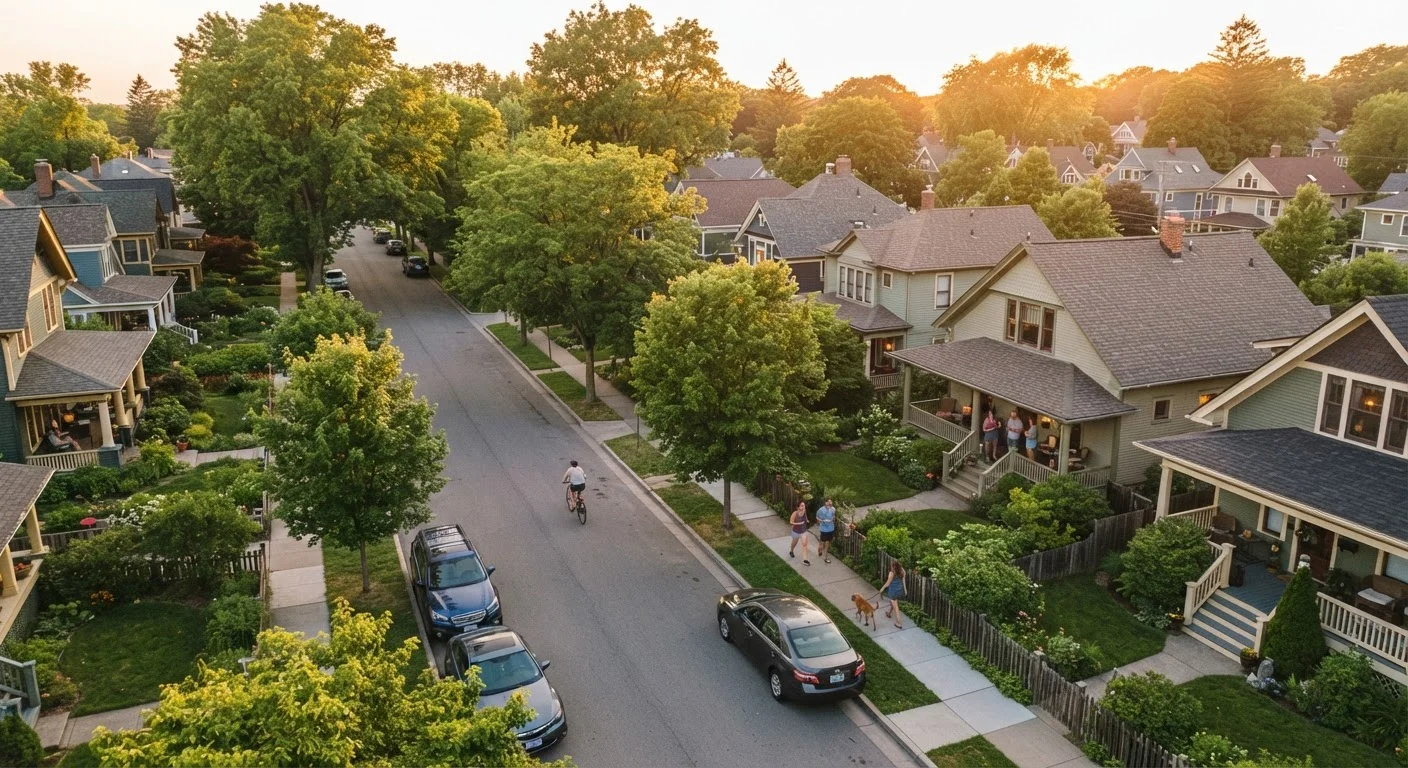
Photo credit: faqsnest.com
In this article
What makes someone feel at home in their neighborhood? An in-depth look at community attachment, identity, and the forces that erode local bonds.
Key Takeaways
- Neighborhood belonging is a sociological construct shaped by trust, shared identity, and routine interaction.
- Physical design, economic stability, and residential tenure all influence how attached residents feel.
- Gentrification, car-centric development, and residential mobility are major disruptors of local bonds.
- Third places and neighborhood rituals are among the most powerful tools for rebuilding community cohesion.
- Place identity — how a neighborhood becomes part of the self — is a measurable psychological and sociological phenomenon.
What Sociologists Mean by 'Neighborhood Belonging'
Feeling at home in a neighborhood is not simply a matter of liking your house or tolerating your commute. Sociologists describe neighborhood belonging as a multidimensional experience that includes emotional attachment to place, a sense of shared community identity, and perceived membership in a local social world. It is distinct from merely living somewhere — it is the felt sense that you are part of where you live.
This concept draws from several theoretical traditions. Robert Sampson's influential work on collective efficacy — the combination of social cohesion and shared willingness to intervene for the common good — helped establish that neighborhood belonging is not just psychological but functionally consequential. Neighborhoods with high collective efficacy tend to have lower crime rates, better health outcomes, and stronger civic participation, regardless of income level.
Separately, sociologists distinguish between social integration (the density and frequency of interpersonal ties) and community sentiment (the degree to which residents share values and emotional investment). Both contribute to belonging, but neither alone is sufficient. You can know many neighbors by name and still feel like an outsider — or feel deeply connected to a place with minimal daily interaction.
Research comparing online and in-person communities consistently finds that physical proximity, when activated by meaningful contact, generates a qualitatively distinct form of belonging that digital spaces struggle to replicate.
The Structural Forces Behind Community Attachment
Belonging does not emerge spontaneously. It is scaffolded by structural conditions that either enable or suppress the interactions from which attachment grows.
Residential tenure is among the strongest predictors of neighborhood attachment. Research consistently finds that the longer a person lives in a place, the more embedded they become in its social fabric — accumulating relationships, local knowledge, and shared history. This is one reason high-mobility communities, such as those dominated by rental housing with rapid turnover, often struggle to develop cohesion.
Physical design matters enormously. Neighborhoods built around walkability, front porches, parks, and mixed-use spaces create what urban planners call friction — the incidental, low-stakes encounters that gradually build familiarity and trust. Car-dependent suburban layouts, by contrast, often reduce spontaneous interaction to near zero. As the sociologist Ray Oldenburg argued, third places — cafés, barbershops, parks, and libraries are the connective tissue of community life, and their disappearance is directly linked to social fragmentation.
Economic homogeneity and heterogeneity also play complex roles. Shared economic circumstance can produce solidarity, but concentrated poverty can generate stress and distrust that undermines collective efficacy. Mixed-income neighborhoods present their own dynamics, including potential tension around divergent uses of shared space.
If you want to deepen your sense of belonging in a neighborhood, prioritize recurring, low-stakes interactions over big social investments. A daily walk at the same time, or a regular stop at a local café, builds the familiarity that trust requires.
Sociological research on community attachment consistently shows that frequency and predictability of contact matter more than intensity. Familiarity built through routine is the substrate from which meaningful social ties emerge.
When evaluating a neighborhood's social health, look for the presence and vitality of third places — not just housing stock or school ratings. A thriving local park or corner café signals the kind of ambient social infrastructure that sustains belonging over time.
Ray Oldenburg's foundational research on third places established that informal gathering spaces are essential mediating institutions between the private household and formal civic life. Their presence correlates with higher reported community satisfaction.
Identity, Place, and the Sociology of Home
For many residents, a neighborhood is not just a backdrop — it is part of how they understand themselves. Environmental psychologists call this place identity: the process by which characteristics of a physical and social environment become incorporated into a person's sense of self.
Place identity operates both individually and collectively. On the individual level, longtime residents often describe their neighborhood as an extension of who they are — a source of pride, memory, and social orientation. Collectively, neighborhoods develop reputations and shared narratives that residents either embrace or resist. These narratives shape behavior: residents who identify strongly with a neighborhood are more likely to participate in local organizations, monitor public spaces, and intervene in conflicts.
This connects directly to social identity theory, which holds that group membership — including membership in a place-based community — becomes a meaningful component of the self-concept. The implication is significant: threats to a neighborhood's character or reputation are not merely inconvenient; they can feel like personal attacks on identity.
The architecture of American friendship is also deeply place-shaped. Studies have found that proximity remains one of the most powerful predictors of friendship formation, even in an era of digital connectivity. The neighbor you wave to daily is structurally positioned to become a meaningful social tie — if the design and culture of the neighborhood allow that wave to grow into something more.
What Erodes Local Bonds
Several forces actively undermine neighborhood belonging in contemporary American life, and understanding them sociologically requires resisting the temptation to reduce them to individual failure or apathy.
Residential mobility is perhaps the most pervasive disruptor. The United States has one of the highest residential mobility rates among wealthy nations. When a significant portion of a neighborhood turns over every few years, the cumulative social capital — the shared trust, norms, and networks — never fully matures.
Gentrification presents a particularly acute challenge. While it often brings investment and physical improvements, rapid gentrification systematically displaces long-term residents, erasing the very social networks and institutional memories that produced belonging in the first place. For displaced residents, the loss is not just housing — it is community, history, and place identity. The distinct social dynamics of suburban and urban environments reflect how built environment interacts with these pressures differently across contexts.
Privatization of public space and the decline of civic institutions — libraries with reduced hours, shuttered community centers, converted parks — remove the neutral ground where cross-class, cross-background interaction might otherwise occur.
Finally, pervasive time scarcity in overworked households reduces the discretionary time available for the low-intensity, recurring interactions that build local bonds. Belonging, as sociologists note, is not built in grand gestures — it is built in the accumulated texture of ordinary contact.
Rebuilding the Sense of Neighborhood
The sociological literature on community attachment points clearly toward several conditions that support its renewal, even in fragmented contexts.
Neighborhood rituals — recurring events that bring residents into shared space and shared experience — are among the most effective tools. Block parties, community gardens, seasonal markets, and local festivals create the kind of repeated, low-stakes encounters that gradually build the trust from which deeper attachment grows. This mirrors findings on how rituals strengthen relational bonds within families — the mechanism translates directly to the neighborhood scale.
Community organizations and neighborhood associations, even imperfect ones, provide structured opportunities for residents to act collectively toward shared goals. The act of working together — on a mural, a zoning dispute, a neighborhood clean-up — builds solidarity that purely social interaction does not.
Design interventions that restore walkability, create gathering spaces, and reduce car dominance can re-establish the physical preconditions for spontaneous interaction. These are not just aesthetic choices; they are sociological ones with measurable effects on social cohesion.
Ultimately, neighborhood belonging cannot be manufactured top-down. But it can be cultivated through the patient, intentional creation of conditions — spatial, institutional, and cultural — that allow ordinary people to gradually recognize themselves in one another, and in the place they share.

Author
People & Culture Editorial Team
People & Culture Editorial Team is the collective byline for our editorial team and contributor network. Articles published under this byline or an editorial pen name are researched, written, and reviewed according to our editorial standards for clarity, consistency, and independence before publication.
View all articles →