
Third Places: The Forgotten Glue of Community Life
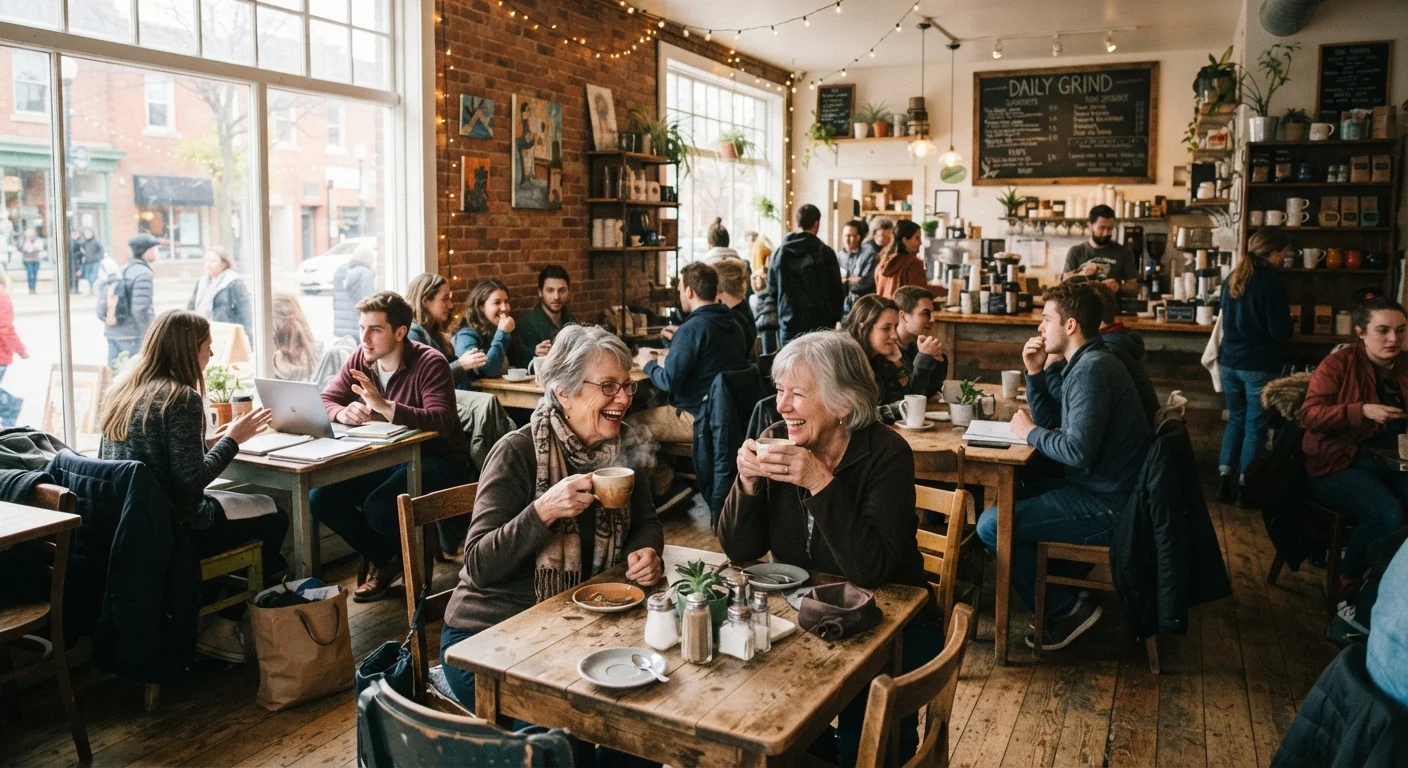
Photo credit: faqsnest.com
In this article
Cafés, barbershops, parks — sociologists call them 'third places.' Understand why they matter for social cohesion and what happens when they disappear.
Key Takeaways
- Third places are informal public gathering spots separate from home and work that foster community cohesion.
- Sociologist Ray Oldenburg identified eight defining qualities that distinguish true third places from ordinary public spaces.
- The decline of third places in many American communities correlates with rising rates of loneliness and social fragmentation.
- Third places support 'weak ties' — the casual acquaintances that research links to resilience, opportunity, and civic life.
- Urban planning decisions, economic pressures, and car-centric design have all contributed to the erosion of third places.
- Digital spaces can supplement but generally do not replicate the social functions of physical third places.
What Ray Oldenburg Saw That Urban Planners Missed
In the late 1980s, sociologist Ray Oldenburg looked at American neighborhoods and noticed something missing — not infrastructure or commerce, but a particular kind of social fabric. The spaces where people simply were together, without agenda or appointment, were vanishing. His diagnosis, laid out in The Great Good Place (1989), named the casualty: the third place.
Oldenburg's critique was pointed. American planning culture had long prioritized the efficiency of the first and second places — housing and workplaces — while treating informal gathering space as a luxury rather than a civic necessity. The consequences, he argued, were not merely architectural. They were social and psychological. Without third places, communities couldn't build the ambient trust and familiarity that hold neighborhoods together.
What makes a space a genuine third place isn't square footage or design — it's social character. Oldenburg's framework holds that third places must be accessible without membership or money acting as barriers; they must accommodate regulars who anchor the space with continuity; and crucially, they must level social hierarchy. In a good barbershop or diner, your title, salary, or ZIP code matters less than your presence and willingness to engage.
“The third place is a great leveler. It is the place where one goes and is, simply, oneself. The third place does not exist for any particular purpose — it exists for the people who use it, and its main activity is conversation.”
— Ray Oldenburg, Sociologist and author of 'The Great Good Place'
The Social Work That Third Places Do
Third places don't just feel good — they perform measurable social functions. Chief among these is the cultivation of what sociologist Mark Granovetter famously called 'weak ties': casual, non-intimate relationships that turn out to carry surprising social weight. The neighbor you nod to at the coffee counter, the retired schoolteacher who holds court at the diner every Tuesday morning — these connections are not deep friendships, but they are threads in a community web. Weak ties often carry more social utility than we expect, connecting people across different social circles and transmitting information, opportunities, and support that tight-knit networks cannot.
Third places are also where civic identity forms. Research in community sociology suggests that shared physical spaces — parks, libraries, local markets — create what some scholars call 'place attachment': an emotional and social investment in a specific locale that motivates civic participation. People who feel rooted in their neighborhood are more likely to vote locally, volunteer, and intervene when they see something wrong. The corner bar or the community garden isn't just pleasant — it's a civic infrastructure.
There's a cross-demographic dimension, too. Unlike algorithmically curated online communities or socioeconomically sorted residential zones, well-functioning third places bring together people who would not otherwise share space. That exposure — even incidental, even superficial — reduces the kind of social insularity that researchers link to polarization and distrust. As explored in our piece on what makes people feel at home in a neighborhood, a sense of belonging rarely forms in the abstract — it forms in specific, recurring, physical contexts.
58%
Americans reporting loneliness
A 2023 Gallup survey found that 58% of American adults reported feeling lonely at least sometimes — a figure that public health researchers have linked in part to declining informal social infrastructure.
1 in 4
Americans with no close friends outside family
Survey data from the Survey Center on American Life (2021) found that roughly one in four American adults reported having no close friends outside their immediate family, up substantially from earlier decades.
50%+
Decline in civic club participation since 1970s
Political scientist Robert Putnam documented in 'Bowling Alone' that participation in civic and community organizations fell by more than half between the 1970s and late 1990s, a trend associated with the erosion of informal social spaces.
Why They're Disappearing — and What That Costs Us
The forces eroding third places in America are structural, not accidental. Decades of car-centric suburban development produced landscapes where walkable gathering is physically impractical. When residents must drive to every destination and destinations are optimized for throughput rather than lingering, spontaneous social contact collapses. Suburban and urban environments create distinct but equally real forms of disconnection — third place erosion is a thread running through both.
Economic pressures compound the problem. Rising commercial rents in desirable neighborhoods displace longtime third-place anchors — the independent bookstore, the neighborhood diner — in favor of higher-margin chain businesses or residential units. Chain establishments, however familiar, rarely function as true third places: they are designed for efficient transactions, not open-ended human presence. A franchise coffee shop with laptop policies and timed seating is architecturally similar to a neighborhood café but socially different in kind.
The digital substitution argument deserves scrutiny. Online communities are real communities, and the social bonds formed there can be meaningful — but research on online versus in-person belonging consistently finds that digital spaces tend to deepen existing identities rather than bridge across differences. They are better at connecting the like-minded than at producing the serendipitous, cross-demographic encounters that define a healthy third place. The social costs of losing those encounters are cumulative and diffuse — harder to attribute to any single cause, which makes them easier to ignore.
Recognizing and Rebuilding Third Places
Understanding the third-place concept changes how you read your own community. The laundromat where neighbors talk while they wait; the public library branch that regulars treat as a living room; the park bench cluster where retirees gather after morning walks — these are not incidental amenities. They are social infrastructure, and their health or absence tells you something real about how connected a community is.
Urban planners, community organizers, and local governments have increasingly engaged with Oldenburg's framework when thinking about civic design. Proposals for mixed-use zoning, pedestrian-friendly streetscapes, and investment in libraries and parks reflect — sometimes explicitly — a recognition that spontaneous social contact is worth designing for. The structures that shape American friendship are rarely accidents; they are downstream of planning decisions made over generations.
For individuals, the implication is less about finding the perfect third place and more about showing up consistently to imperfect ones. Third places are made by their regulars. The sociological literature is consistent on this point: it is repetition and familiarity — not amenity or design — that transforms a public space into a genuine community anchor. Becoming a regular somewhere, and treating that somewhere as worth protecting, is one of the more quietly consequential civic acts available to most people.
Frequently Asked Questions

Author
People & Culture Editorial Team
People & Culture Editorial Team is the collective byline for our editorial team and contributor network. Articles published under this byline or an editorial pen name are researched, written, and reviewed according to our editorial standards for clarity, consistency, and independence before publication.
View all articles →