
Hybrid Vehicle Architectures: Full, Mild, and Plug-In Compared
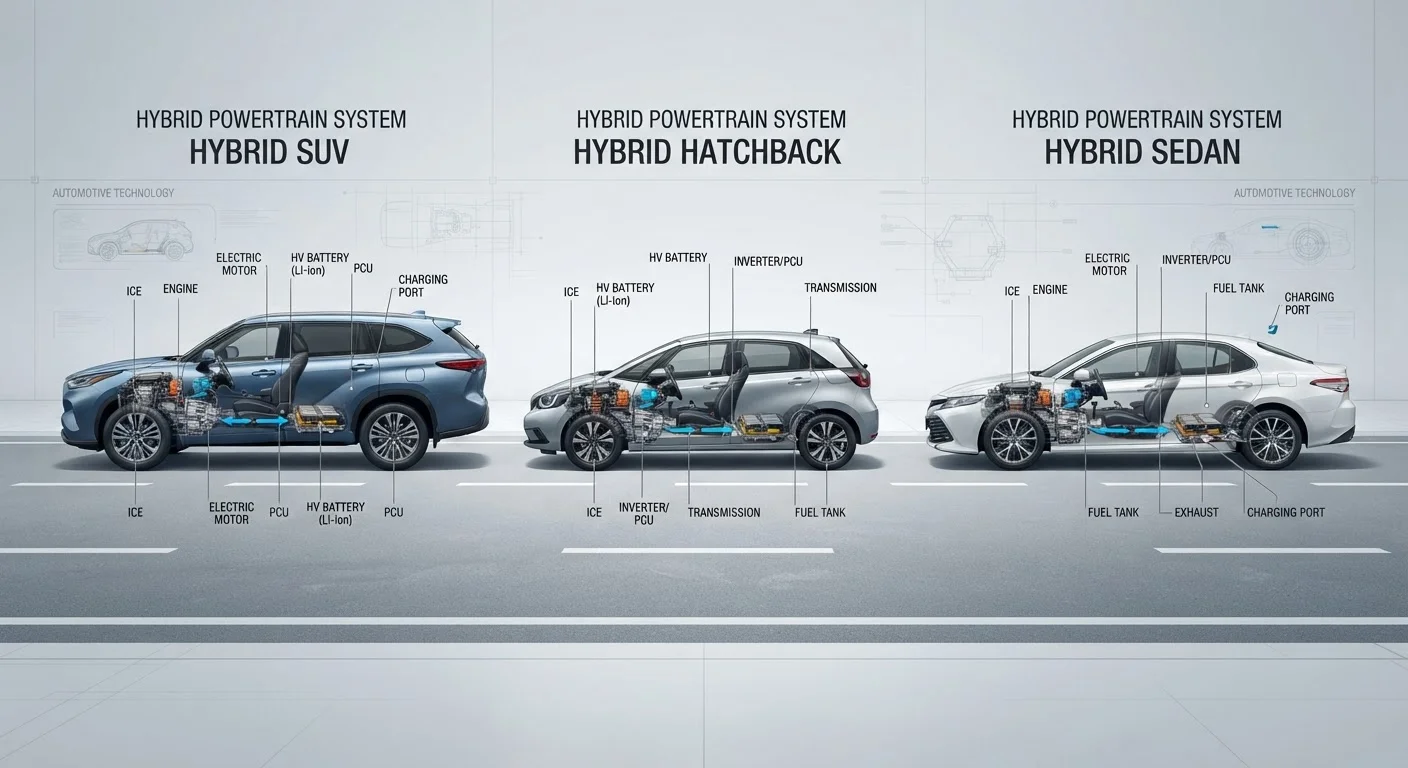
Photo credit: faqsnest.com
In this article
Not all hybrids work the same way. This comparison breaks down how each architecture manages its two power sources and what that means for drivers.
Key Takeaways
- Full hybrids can run on electric power alone for short distances without any external charging.
- Mild hybrids use an electric motor only to assist the combustion engine — they cannot propel the car independently.
- Plug-in hybrids carry a larger battery and can be charged from an outlet, offering meaningful all-electric range.
- The right hybrid type depends on how far you drive daily and whether you have access to home charging.
- All three architectures recover energy through regenerative braking, but the amount stored and used differs significantly.
Why Hybrid Architecture Matters
The word "hybrid" covers a wide range of engineering choices. Lumping all hybrids together is a bit like calling every vehicle with four wheels the same thing. Under the hood — or in the battery pack — the differences are significant enough to change how you refuel, how much you save, and what the car can actually do.
Understanding these architectures doesn't require an engineering degree. What it does require is knowing how each system manages the relationship between its gasoline engine and its electric motor. That single question — who does what, and when — explains most of what separates a full hybrid from a mild hybrid from a plug-in. If you're also curious how the gearbox interacts with these powertrains, see our guide to transmission types for the bigger picture.
Full Hybrids: Electric Assist With Real Independence
A full hybrid — sometimes called a self-charging hybrid — pairs a gasoline engine with an electric motor large enough to move the car on its own at low speeds. The battery charges itself through two routes: the engine, and regenerative braking (a system that recaptures energy normally lost as heat when you slow down). No plug is required.
In practice, a full hybrid will automatically switch between gas, electric, or a combination of both depending on demand. At low city speeds or during light acceleration, the electric motor often handles propulsion alone. On the highway, the gasoline engine takes over. The driver doesn't manage any of this — the system does it seamlessly in the background.
The efficiency advantage is most pronounced in stop-and-go traffic, where the electric motor carries more of the load and regenerative braking has the most opportunity to recover energy. On long highway runs, a full hybrid behaves more like a conventional vehicle and the fuel economy gap narrows.
| Full Hybrid | Mild Hybrid | Plug-In Hybrid | |
|---|---|---|---|
| Can drive on electric only | Yes, at low speeds | No | Yes, significant range |
| Requires external charging | No | No | Yes, to maximize benefit |
| Battery size | Moderate | Small | Large |
| Fuel economy benefit | High in city driving | Moderate, any condition | Very high if charged regularly |
| System complexity | Moderate | Low | High |
| Typical all-electric range | Under 2 miles | None | 20–50 miles (varies) |
| Best driving environment | City and suburban | Highway and mixed | Short commutes with charging |
Mild Hybrids: The Efficiency Assist
A mild hybrid uses a smaller electric motor — often called a belt-integrated starter-generator, or BISG — that works alongside the combustion engine but cannot replace it. The motor can't drive the wheels independently. Instead, it handles tasks like restarting the engine cleanly after stop-start events, reducing strain during acceleration, and recovering a modest amount of energy under braking.
The result is a real but limited fuel economy improvement, typically in the range of 10–15% compared to a comparable non-hybrid version of the same vehicle. The system is lighter, simpler, and cheaper to engineer than a full hybrid setup, which generally keeps the purchase price closer to a conventional car.
If your driving is mostly highway miles, a mild hybrid may deliver noticeable savings with fewer compromises. It's worth noting that the efficiency gains are smaller than a full hybrid in urban conditions, where the inability to run purely on electric power is a meaningful limitation. For a broader look at systems worth understanding as an owner, the Under the Bonnet guide provides useful context.
Plug-In Hybrids: The Bridge to Full Electric
A plug-in hybrid electric vehicle (PHEV) works like a full hybrid but carries a substantially larger battery that can be charged from an external power source — a wall outlet, a home charging unit, or a public charger. That bigger battery enables a genuine all-electric driving range, which varies by model but commonly falls between 20 and 50 miles on a full charge.
For a driver whose daily commute sits within that electric range and who has access to charging at home or work, a PHEV can function as an electric vehicle most of the time while retaining the gasoline engine as a backup for longer trips. Done right, this means weeks between gas station visits for routine driving.
The trade-off is weight and complexity. PHEVs carry a heavier battery pack than full hybrids, which adds mass. They also require the driver to actively manage charging to get the most out of the electric range — a behavioral change that not all drivers want to make. If charging access is unreliable or daily mileage consistently exceeds the electric range, a PHEV reverts to operating much like a conventional full hybrid.
Maximizing a PHEV's Fuel Savings
A plug-in hybrid only delivers its best efficiency if you charge it regularly. Driving a PHEV with a depleted battery still works, but it behaves like a heavier full hybrid, not an electric vehicle. If you have a garage or a reliable workplace charger, plugging in every night makes the electric range — and the economics — work as intended.
How to Think About the Right Fit
The clearest way to evaluate which architecture serves you is to look at three variables: your daily driving distance, your access to charging infrastructure, and your tolerance for behavioral change.
- Short daily distances + home charging: A plug-in hybrid can dramatically reduce gasoline consumption, potentially covering most trips electrically.
- Mixed urban and highway driving, no home charger: A full hybrid delivers consistent savings without any new habits or infrastructure.
- Mostly highway miles, cost-conscious purchase: A mild hybrid adds modest efficiency at the lowest engineering premium.
None of these architectures requires you to compromise on range anxiety in the same way a fully electric vehicle might. All three retain a combustion engine as a fallback. What varies is how much of your driving that electric component can realistically handle — and how much effort you're willing to invest to make it work for you.

Author
Cars & Driving Editorial Team
Cars & Driving Editorial Team is the collective byline for our editorial team and contributor network. Articles published under this byline or an editorial pen name are researched, written, and reviewed according to our editorial standards for clarity, consistency, and independence before publication.
View all articles →