
Transmission Types Explained: Manual, Automatic, CVT, and DCT
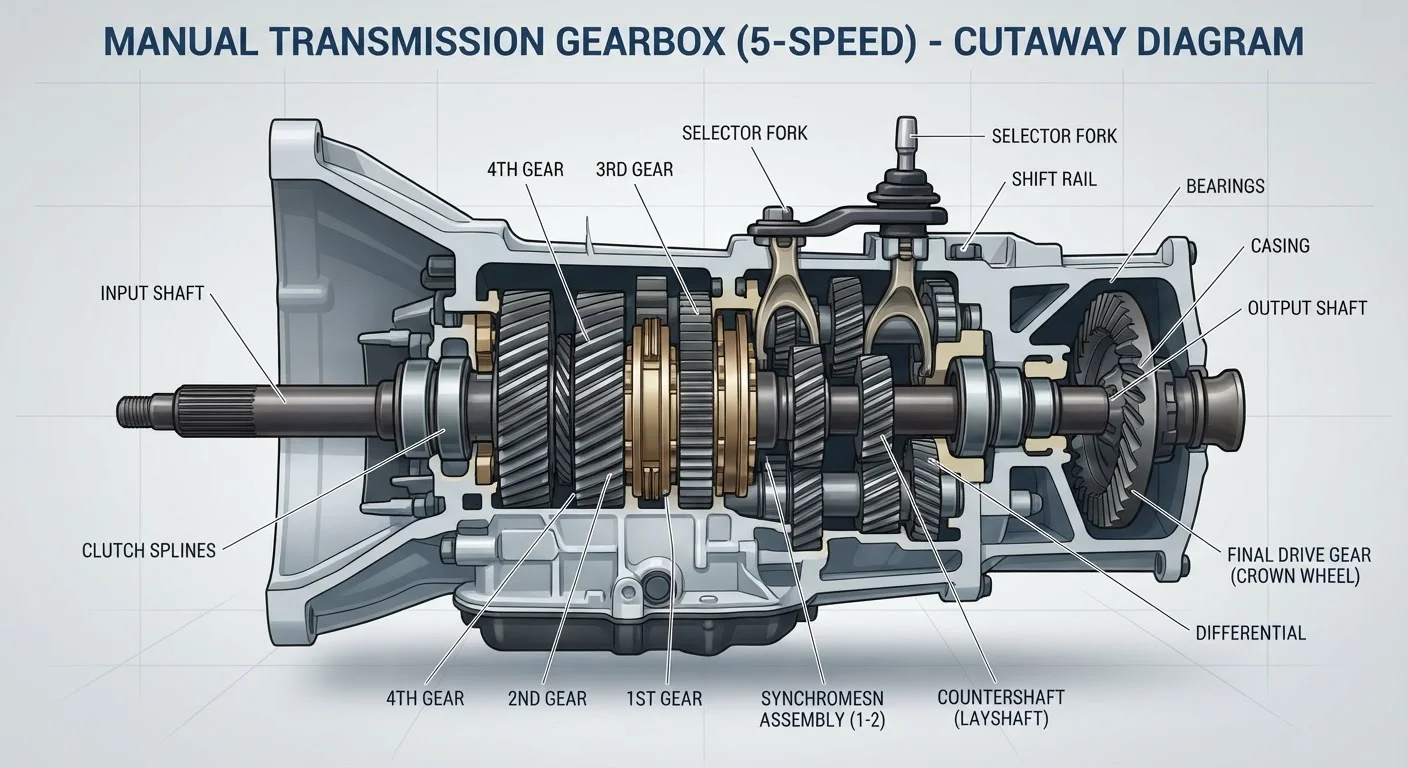
Photo credit: faqsnest.com
In this article
Understand what each gearbox type does, how it works, and the real trade-offs between driving feel, efficiency, and maintenance.
Key Takeaways
- Manual transmissions give the driver direct control but require a learning curve and active engagement on every shift.
- Automatics prioritize ease of use and are the dominant choice in the U.S. market today.
- CVTs deliver smooth, stepless acceleration and often improve fuel economy, but feel different from traditional gearboxes.
- Dual-clutch transmissions blend some manual efficiency with automatic convenience, but can be hesitant at low speeds.
- Maintenance costs and long-term reliability vary meaningfully between transmission types.
What a Transmission Actually Does
An engine produces power across a relatively narrow band of speeds. The transmission's job is to match that power to what the wheels actually need — whether you're crawling through a parking lot or cruising at highway speed. It does this by using different gear ratios: lower gears multiply torque for acceleration; higher gears let the engine spin slowly and efficiently at speed.
Without a transmission, an engine spinning at one fixed rate couldn't move a car from a standstill — the physics simply don't work. Understanding this basic function makes it easier to see why different transmission designs each involve genuine trade-offs. For a broader look at how this fits into the car as a whole, see eight key systems worth understanding.
Manual Transmission: Full Driver Control
A manual gearbox — sometimes called a stick shift — puts the driver in charge of selecting every gear. A third pedal (the clutch) temporarily disconnects the engine from the drivetrain so gears can be changed without grinding. The driver then engages the clutch smoothly to reconnect power.
Advantages: Experienced drivers can extract maximum efficiency and performance from the engine. Fuel economy can be excellent when driven well. Repair costs are generally lower because the mechanical design is simpler. Many drivers also find manuals more engaging and fun.
Disadvantages: There's a real learning curve, and poor technique — slipping the clutch excessively — accelerates wear on the clutch disc, which is a moderately expensive repair. Heavy stop-and-go traffic is more fatiguing. Manuals are increasingly rare in new U.S. vehicles.
| Manual | Automatic | CVT | DCT | |
|---|---|---|---|---|
| Driver involvement | High — clutch and gear selection | Low — fully managed | Low — fully managed | Low to medium — paddles optional |
| Fuel efficiency | High if driven well | Good with modern multi-speed | Often excellent | Good to excellent |
| Shift feel | Direct, mechanical | Smooth, stepped | Seamless, no steps | Very fast, minimal interruption |
| Low-speed behavior | Requires clutch skill | Smooth | Smooth | Can feel jerky |
| Typical maintenance cost | Lower (clutch wears) | Moderate (fluid, filter) | Moderate (specific fluid) | Moderate to higher |
| Repair complexity | Lower | Moderate to high | Moderate to high | High |
| U.S. market availability | Declining | Very common | Common | Increasing |
Automatic Transmission: Ease and Adaptability
A traditional automatic uses a hydraulic torque converter instead of a clutch pedal, and an internal computer selects gears on your behalf. Modern automatics commonly have six, eight, or even ten speeds, which helps them stay efficient across a wide range of driving conditions.
Advantages: Requires no clutch management from the driver. Works well in traffic, on hills, and for drivers of all experience levels. Reliability has improved dramatically over decades, and many current automatics match or exceed manual fuel economy figures thanks to their high gear counts.
Advantages: Traditionally heavier and slightly more complex internally than a manual. Service intervals for transmission fluid matter — neglecting fluid changes is one of the most common causes of automatic transmission problems. Repair costs when something does go wrong can be significant.
CVT: The Stepless Gearbox
A continuously variable transmission (CVT) doesn't use fixed gear steps at all. Instead, it uses a pair of variable-diameter pulleys connected by a belt or chain, allowing it to slide through an infinite range of ratios. The engine can hold whatever speed is most efficient for a given driving demand.
Advantages: Smooth, seamless acceleration with no shift shock. Often delivers better real-world fuel economy than a comparable stepped automatic, particularly in city driving. Generally compact and lighter than a traditional automatic.
Disadvantages: The sensation of the engine revving high while acceleration builds gradually — sometimes called the "rubber band" effect — feels unfamiliar to drivers used to traditional gearboxes. Some CVTs have shown durability concerns, particularly under high-stress use like towing. Repair costs can be high if the belt or pulley system fails.
CVTs are common in hybrid vehicles because they pair naturally with electric motor assistance. For more on how hybrids manage their power sources, see how hybrid architectures work.
DCT: Dual-Clutch Transmission
A dual-clutch transmission (DCT) is essentially two manual gearboxes sharing one housing — one handling odd gears, one handling even gears. While you're in third gear, fourth is already pre-selected and waiting. Shifts happen in milliseconds, with no torque interruption.
Advantages: Extremely fast gear changes. Can be more fuel-efficient than a traditional automatic because there's no torque converter loss. Often available with paddle shifters for manual-style control without a clutch pedal.
Disadvantages: At very low speeds — creeping in traffic, maneuvering in parking lots — DCTs can feel jerky or hesitant because the clutch engagement logic doesn't always replicate the smooth feel of a torque converter. Some earlier DCT designs had reliability issues at low speed. They're also more mechanically complex and can be expensive to service.
Test Drive Matters More Than Specs
Transmission feel is subjective in ways that specifications don't capture. A CVT that looks ideal on paper may feel odd to a driver accustomed to stepped shifts, while a DCT's low-speed behavior might not bother someone who spends most of their time on open roads. If you're evaluating a vehicle, drive it in the conditions that reflect your actual daily use — city stop-and-go, parking lot maneuvering, and highway merging — before forming a judgment.
DCTs are popular in performance-oriented vehicles and increasingly appear in mainstream cars. Understanding how they differ from automatics helps set realistic expectations for driving feel.
Maintenance Considerations Across All Types
Every transmission type requires some form of maintenance, and the details matter:
- Manual: Clutch wear is the main wear item. The transmission fluid itself often lasts a long time but should be inspected per your owner's manual.
- Automatic: Transmission fluid and filter changes are critical. Many automakers specify extended intervals, but high-heat or heavy-use driving can shorten them.
- CVT: CVT-specific fluid is required — using standard automatic transmission fluid can cause damage. Follow manufacturer intervals carefully.
- DCT: Dual-clutch fluid and clutch pack condition should be checked on schedule. Low-speed clutch wear is a documented concern on some designs.
Regardless of transmission type, keeping up with fluid changes is one of the most impactful things you can do to extend the life of your gearbox. Just as with engine oil intervals, the specifics vary by vehicle — your owner's manual is the authoritative source.
If you're weighing transmission choice alongside broader powertrain questions, it's also worth understanding how electric motors differ from combustion engines — electric vehicles typically don't use multi-speed transmissions at all.

Author
Cars & Driving Editorial Team
Cars & Driving Editorial Team is the collective byline for our editorial team and contributor network. Articles published under this byline or an editorial pen name are researched, written, and reviewed according to our editorial standards for clarity, consistency, and independence before publication.
View all articles →