
Electric Motors vs Combustion Engines: How They Differ at a Fundamental Level
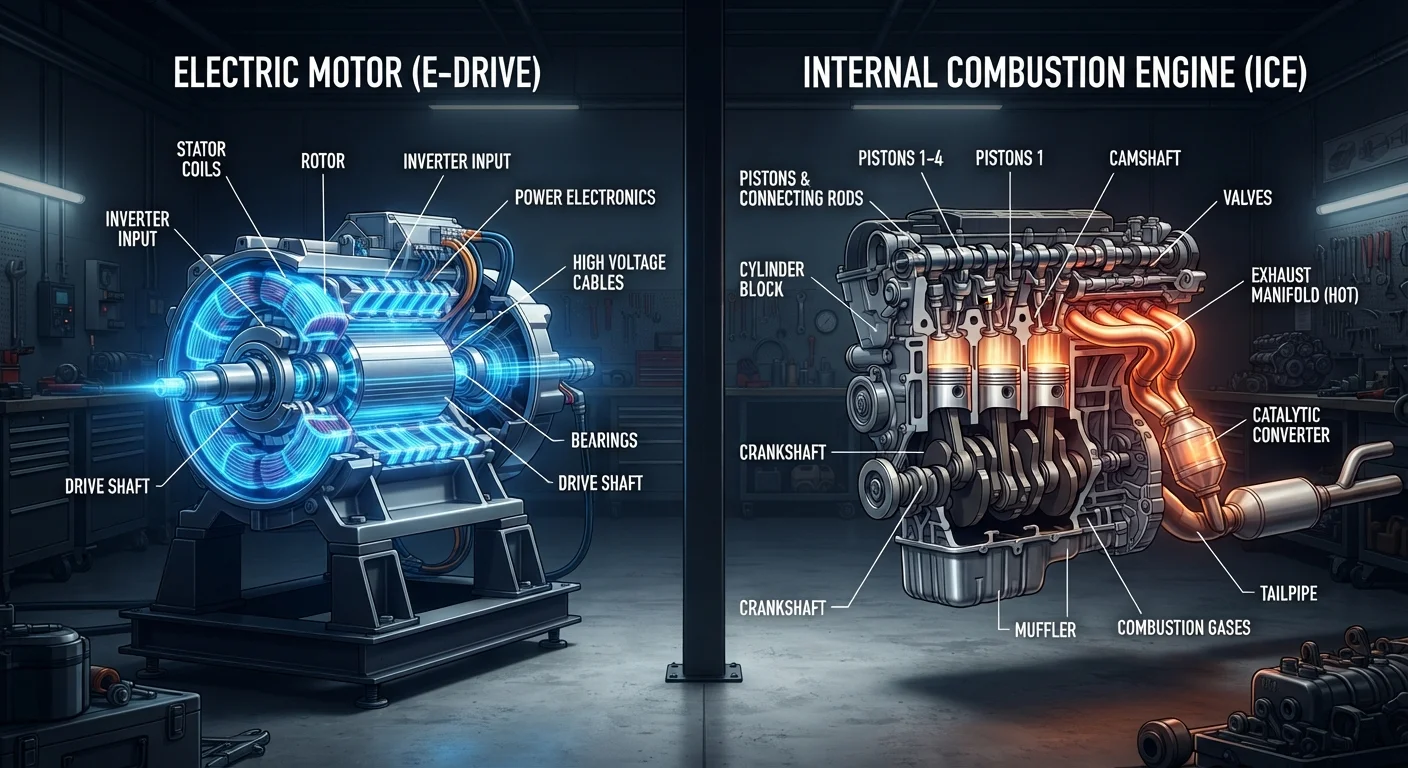
Photo credit: faqsnest.com
In this article
A side-by-side look at how electric and internal combustion engines convert energy into motion — and why that difference shapes the entire driving experience.
Key Takeaways
- Electric motors convert stored electrical energy into motion directly; combustion engines first burn fuel to create heat, then convert that heat into mechanical work.
- Electric motors deliver peak torque from zero RPM, which is why electric vehicles feel immediately responsive off the line.
- Combustion engines have hundreds of moving parts; electric motors typically have far fewer, reducing certain types of wear.
- Energy conversion efficiency strongly favors electric motors, which waste far less energy as heat compared to combustion engines.
- Neither powertrain is universally superior — range, infrastructure, climate, and use case all determine which suits a given driver better.
The Core Difference: How Each Powertrain Creates Motion
Every vehicle needs a way to convert stored energy into the rotational force that turns its wheels. An electric motor and an internal combustion engine (ICE) both accomplish that job — but through entirely different physical processes.
An electric motor works through electromagnetism. When electrical current flows through wire coils arranged around a central shaft (called the rotor), it creates a magnetic field. That field interacts with permanent magnets or an outer electromagnet housing (the stator), producing a rotational force — called torque — that spins the shaft. There is no burning, no explosion, and no intermediate step. Electrical energy becomes mechanical energy almost directly.
A combustion engine works through a series of controlled explosions. A precisely timed mixture of air and fuel ignites inside a sealed cylinder, producing hot expanding gas that pushes a piston down. That piston's linear (up-and-down) motion is converted into rotation via a crankshaft. To learn exactly how those four steps unfold — intake, compression, power, and exhaust — see our plain-language walkthrough of the four-stroke cycle.
This fundamental difference — electromagnetic conversion versus thermodynamic conversion — explains nearly every practical distinction between the two powertrains.
Torque, Power, and the Feel of Acceleration
Torque is the twisting force that gets a vehicle moving. Understanding when each powertrain produces its torque explains a lot about how they feel to drive.
An electric motor delivers its maximum torque immediately, from 0 RPM onward. There is no need to rev up, no gear hunting, and no delay. This is why electric vehicles often feel startlingly quick off the line, even in everyday models that are not high-performance machines.
A combustion engine's torque output is tied to engine speed (measured in RPM). Power builds as the engine revs, peaks within a specific RPM range, then tapers off. Automakers design transmissions specifically to keep the engine operating within that productive band — which is why multi-speed gearboxes are standard on ICE vehicles. For a breakdown of how each gearbox type manages that, see our guide to transmission types.
Electric motors in most passenger vehicles do not need a traditional multi-speed gearbox. A single fixed-ratio drive unit handles the full speed range, contributing to the smooth, linear acceleration that EV drivers often describe.
| Criterion | Electric Motor | Internal Combustion Engine |
|---|---|---|
| Energy source | Electricity (battery or grid) | Gasoline, diesel, or alternative fuel |
| Conversion process | Electromagnetic (direct) | Thermodynamic (burn → heat → motion) |
| Torque delivery | Maximum torque from 0 RPM | Builds with RPM; peaks in a band |
| Typical energy efficiency | ~85–90%+ to the wheels | ~20–40% to the wheels |
| Moving parts (drivetrain) | Very few (rotor, bearings) | Hundreds of precisely machined parts |
| Transmission required | Usually single fixed-ratio drive | Multi-speed gearbox typically needed |
| Routine maintenance | No oil changes; fewer brake services | Oil, plugs, belts, coolant, filters |
| Refueling / recharging time | Tens of minutes to hours | Minutes at a pump |
| Infrastructure availability | Growing but still limited | Widespread nationally |
Efficiency: Where Does the Energy Actually Go?
Energy efficiency — the share of stored energy that actually reaches the wheels — is one of the starkest contrasts between the two powertrains.
A conventional gasoline combustion engine converts roughly 20–40% of the energy in fuel into useful mechanical work under typical driving conditions. The remainder is lost primarily as heat through the exhaust system, the cooling system, and engine friction. This is an inherent consequence of thermodynamic conversion: you cannot fully sidestep heat loss when burning fuel.
Electric motors convert electrical energy to mechanical energy at efficiencies commonly cited above 85–90%, depending on design and operating conditions. Losses exist — primarily as heat in the motor windings and inverter electronics — but they are far smaller in proportion. Additionally, most electric vehicles recover energy during braking through regenerative braking, where the motor acts as a generator and returns energy to the battery rather than dissipating it as heat through brake pads.
For a deeper look at how driving behavior, load, and conditions affect real-world energy use in combustion vehicles, our fuel economy variables explainer covers the factors that move the numbers.
~20–40%
Typical ICE energy conversion efficiency
The U.S. Department of Energy notes that conventional gasoline engines lose the majority of fuel energy as heat, not useful motion.
85–90%+
Typical electric motor efficiency
The U.S. Department of Energy estimates electric motors convert over 85% of electrical energy into mechanical output under normal operating conditions.
~100
Years of ICE refinement in passenger cars
Combustion engines have powered passenger vehicles for roughly a century, resulting in highly developed service networks and manufacturing processes.
Complexity, Maintenance, and Durability
The mechanical complexity of a powertrain determines both its maintenance requirements and its potential failure points.
A modern combustion engine contains hundreds of precisely machined moving parts: pistons, rings, valves, camshafts, timing chains or belts, a water pump, an oil pump, and more. Each requires lubrication, periodic replacement, or careful calibration. Oil and filter changes, coolant flushes, spark plug replacement, and timing component service are standard ICE maintenance items. Our overview of motor oil types explains one of the most frequent of those tasks.
An electric motor's moving parts are minimal — primarily the rotor and its bearings. There is no oil to change in the motor itself, no spark plugs, no timing belt, and no exhaust system to maintain. Battery pack health and thermal management become the primary long-term concerns instead. Brake components also tend to last longer in EVs, because regenerative braking handles a significant portion of the deceleration that would otherwise wear down brake pads.
Neither powertrain is maintenance-free. High-voltage battery systems in EVs require qualified technicians for any internal service. Combustion engines, despite their complexity, benefit from a century of refined service procedures and a vast network of trained mechanics.
What This Means for Everyday Drivers
The powertrain under the hood shapes every aspect of the ownership experience — from how the vehicle responds in traffic to what you do on a long road trip.
Electric motors deliver a quieter, smoother driving experience at low and moderate speeds, with strong immediate response. They suit drivers with predictable daily driving patterns, reliable home or workplace charging, and shorter typical trip distances. Cold climates can reduce battery range, which is a practical factor worth researching for specific models and regions.
Combustion engines continue to offer fueling flexibility that electric infrastructure has not yet matched in most of the country. They also carry a long track record of performance across a wide range of temperatures, payloads, and towing demands. Their complexity does mean more scheduled maintenance, but that maintenance is well understood and widely serviceable.
For drivers curious about vehicles that blend both systems, our comparison of hybrid architectures breaks down how full, mild, and plug-in hybrids each manage the relationship between the two powertrains.
Understanding these fundamental differences — rather than marketing claims — puts you in a better position to evaluate any vehicle on its actual merits for your specific situation.
A Note on Performance Comparisons
Published efficiency and performance figures for both electric and combustion vehicles vary considerably by design, load, speed, temperature, and driving style. The ranges cited in this article reflect broadly reported general characteristics, not guarantees for any specific vehicle. Always consult vehicle-specific data from manufacturers or independent testing organizations when evaluating a particular model.

Author
Cars & Driving Editorial Team
Cars & Driving Editorial Team is the collective byline for our editorial team and contributor network. Articles published under this byline or an editorial pen name are researched, written, and reviewed according to our editorial standards for clarity, consistency, and independence before publication.
View all articles →