
What Actually Happens Inside a Car Engine
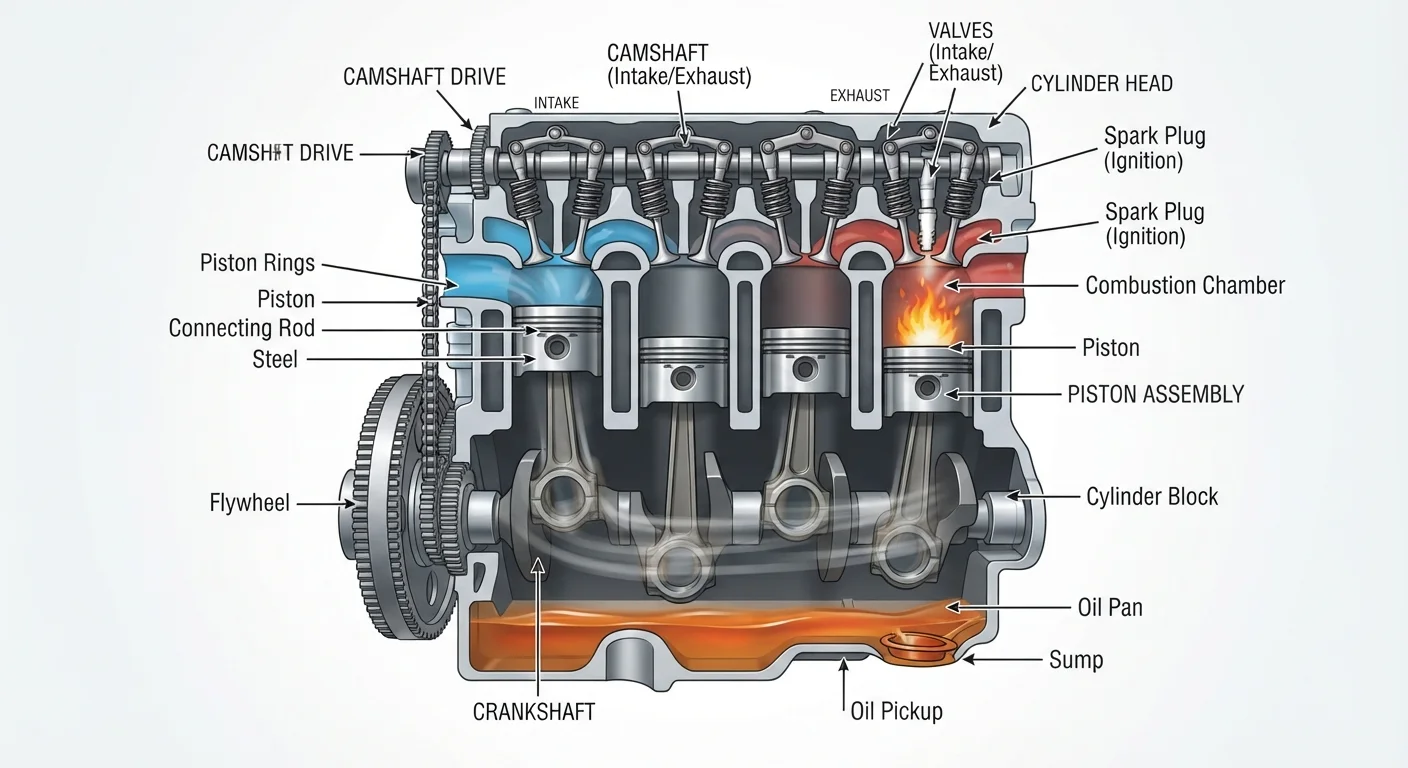
Photo credit: faqsnest.com
In this article
From fuel ignition to crankshaft rotation, here's a plain-language walkthrough of the four-stroke combustion cycle every driver should understand.
Key Takeaways
- Most car engines use a repeating four-stroke cycle: intake, compression, combustion, and exhaust.
- Pistons convert the energy from burning fuel into rotational motion via the crankshaft.
- The crankshaft connects to the transmission, which sends that rotation to the drive wheels.
- Engine displacement and cylinder count affect power output and fuel consumption.
- Understanding these basics helps you interpret warning signs and have better conversations with mechanics.
The Big Picture: What an Engine Actually Does
Strip away all the complexity, and a car engine has one job: turn fuel into motion. It does this by burning a precisely measured mixture of gasoline and air inside sealed chambers called cylinders, then capturing the force of that explosion to spin a shaft. That spinning shaft — the crankshaft — is what ultimately drives your wheels.
Most gasoline engines in passenger cars follow the same basic design: multiple cylinders arranged in a row or a V-shape, each containing a piston that moves up and down. The pistons are connected to the crankshaft via connecting rods, so as the pistons pump, the crankshaft rotates. It's a straightforward mechanical conversion of linear movement into rotational movement.
For a broader look at how this fits alongside other vehicle systems, see our guide to eight key systems under the hood.
The Four Strokes, Step by Step
The engine's cycle is called a "four-stroke" cycle because each piston makes four distinct movements — two down, two up — to complete one full power cycle. Here's what happens during each stroke:
- Intake stroke: The piston moves downward, drawing a mixture of air and fuel (delivered by the fuel injector) into the cylinder through an open intake valve. Think of it like a syringe pulling back to draw in liquid.
- Compression stroke: Both valves close. The piston moves back up, compressing that air-fuel mixture into a much smaller space. Compression makes the subsequent ignition far more powerful — typically the mixture is squeezed to about one-tenth of its original volume.
- Combustion (power) stroke: At the top of compression, the spark plug fires, igniting the compressed mixture. The resulting explosion forces the piston sharply downward. This is the only stroke that actually produces power; the other three are preparation and cleanup.
- Exhaust stroke: The exhaust valve opens, and the piston rises again to push the spent gases out of the cylinder and into the exhaust system, which eventually routes them out through the tailpipe.
Then the cycle repeats, thousands of times per minute, in every cylinder. In a four-cylinder engine, the cylinders are timed to fire in a sequence so at least one is always on a power stroke, keeping the output smooth.
Why Cylinder Count Matters to You
A four-cylinder engine is lighter and typically more fuel-efficient, making it well-suited for everyday commuting. A six- or eight-cylinder engine produces more power and torque, which is useful for towing or merging at highway speeds. If you're evaluating vehicles, matching the cylinder count to how you actually drive can meaningfully affect your fuel costs and driving experience.
From Crankshaft to Wheels
The crankshaft is the engine's output shaft. As each piston completes its power stroke and pushes down, the connecting rod converts that linear push into rotation at the crankshaft — the same principle as how your legs turning the pedals on a bicycle make the wheel spin.
Crankshaft speed is measured in revolutions per minute, or RPM. When you press the accelerator, you're allowing more air and fuel into the cylinders, creating stronger combustion and making the crankshaft spin faster. Your tachometer displays this RPM reading in real time.
The crankshaft feeds its rotation into the transmission, which uses a set of gears to multiply torque (turning force) at low speeds or allow higher speeds at lower force. Understanding that link between the engine and the transmission is key to grasping how your car accelerates. Transmission types and how they work is worth reading once you have the engine basics down.
4,000–7,000
Typical RPM range for a gasoline passenger car engine
At 3,000 RPM, each cylinder in a four-cylinder engine completes roughly 1,500 full four-stroke cycles every minute.
~30%
Thermal efficiency of a typical gasoline engine
Most conventional gasoline engines convert only around 20–40% of fuel's energy into motion; the remainder is lost as heat, according to the U.S. Department of Energy.
2,000°F+
Peak combustion temperature inside a cylinder
Combustion temperatures can exceed 2,000°F (1,093°C), which is why the cooling and lubrication systems are critical to engine survival.
Supporting Systems That Keep It All Running
The four-stroke cycle doesn't run on its own. Several supporting systems work in the background to keep combustion happening reliably and safely:
- Fuel system: Injectors spray a precise amount of fuel into each cylinder at exactly the right moment. Modern engines use electronic fuel injection, which is far more accurate and efficient than older carburetors.
- Ignition system: The ignition coil steps up the battery voltage to the thousands of volts needed to create a spark at the plug. Spark plug timing — when exactly the plug fires — is managed electronically for optimal combustion.
- Cooling system: Combustion generates intense heat. Coolant circulates through passages in the engine block and cylinder head to absorb that heat and carry it to the radiator, where it dissipates into the air.
- Lubrication system: The oil pump forces engine oil under pressure to bearings, the crankshaft, camshafts, and other moving parts. Without it, friction would destroy the engine in minutes.
- Exhaust and emissions system: Beyond routing spent gases away, the catalytic converter chemically converts harmful pollutants — carbon monoxide, hydrocarbons, nitrogen oxides — into less harmful compounds before they exit the tailpipe.
If you're new to owning a vehicle, this first-time driver's maintenance grounding explains how to keep these systems in good shape from day one.
It's also worth noting that electric vehicles work on an entirely different principle — no combustion cycle, no pistons, no crankshaft. How electric motors and combustion engines differ at a fundamental level puts that contrast in clear terms if you're curious.
Frequently Asked Questions

Author
Cars & Driving Editorial Team
Cars & Driving Editorial Team is the collective byline for our editorial team and contributor network. Articles published under this byline or an editorial pen name are researched, written, and reviewed according to our editorial standards for clarity, consistency, and independence before publication.
View all articles →