
The Language of Music Genres: A Plain-English Reference Guide
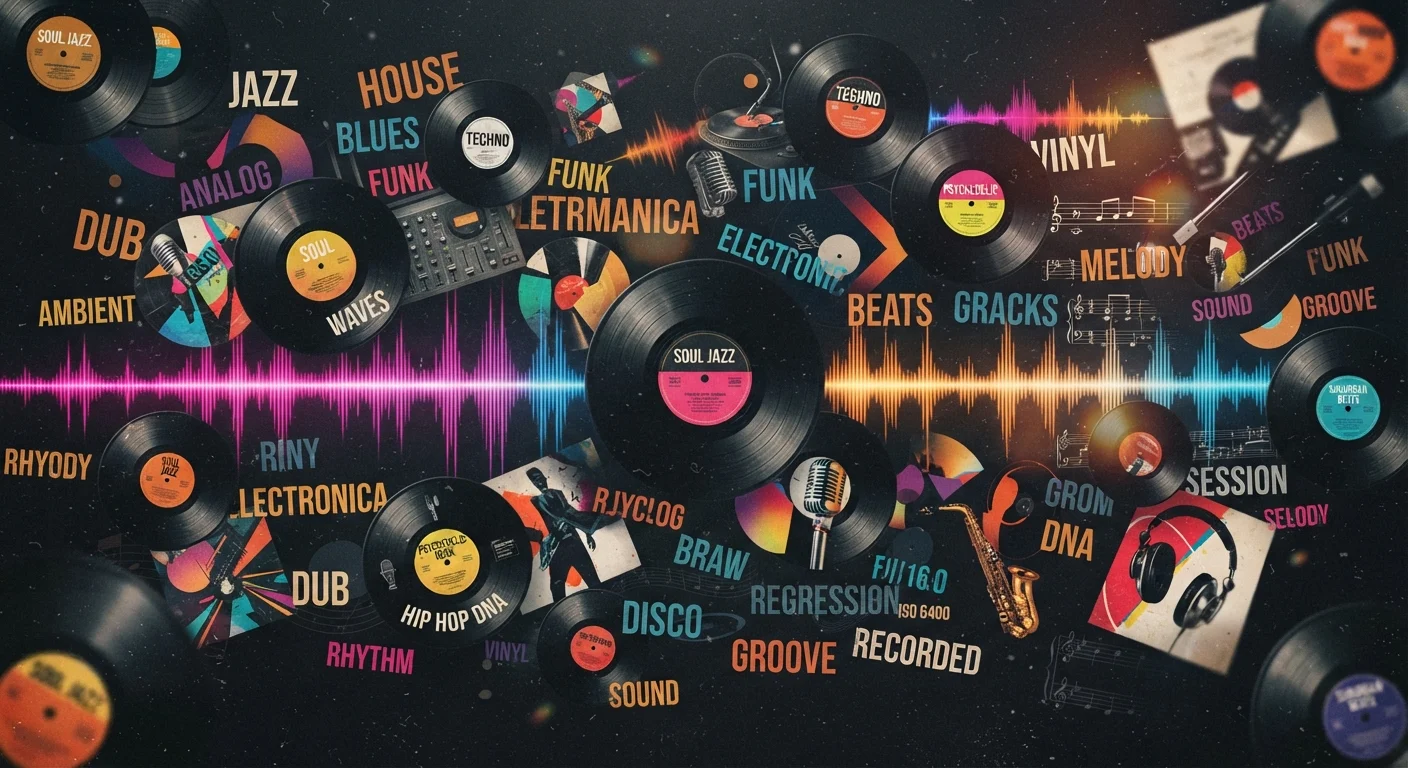
Photo credit: faqsnest.com
In this article
Ambient, hyperpop, shoegaze, cumbia — demystify genre labels with clear, concise definitions and context for curious listeners.
Why Genre Labels Matter — and Where They Fall Short
Music genres exist to make the listening world navigable. Without them, describing why a Miles Davis record and a Kendrick Lamar album feel entirely different would require an essay every time. Genre shorthand compresses cultural history, sonic conventions, and emotional registers into a single word — jazz, rap, country — so listeners can orient themselves quickly.
But genre labels are imperfect maps. They are shaped by commercial interests (record labels grouping music for marketing), critical conventions (journalists coining terms for movements they observe), and audience communities (fans identifying shared values in the music they love). The same song might appear under different genre tags across streaming platforms, music databases, and print criticism.
What genre terminology gives us, at its best, is a shared vocabulary for conversation. If you want to explore that vocabulary further, reading about music without getting lost in the jargon is a useful companion to this guide — it tackles terms critics use to describe sound itself, such as timbre, texture, and dynamics.
Genre Labels Are Tools, Not Rules
No artist is obligated to fit a single genre, and most labels are applied retroactively by critics, fans, or industry categorizers — not by the musicians themselves. Many landmark albums deliberately crossed genre boundaries, making them difficult to classify and all the more influential. Treat genre terms as useful shorthand for navigating listening, not as definitive judgments about where music belongs.
Core Genre Families: A Reference Overview
Most genre trees branch from a handful of broad families. Understanding their roots helps decode the hundreds of subgenres that spiral outward from each.
Electronic Music
Electronic music is unified not by a single sound but by a shared reliance on synthesizers, drum machines, and digital audio workstations (DAWs) as primary instruments. Within it, house music is generally dance-oriented with a four-on-the-floor kick pattern; techno emphasizes repetitive, industrial textures at higher BPMs; and ambient — as defined above — strips rhythm away entirely in favor of texture.
Rock and Its Offshoots
Rock began as a fusion of blues, country, and rhythm and blues in the 1950s. By the 1990s it had fragmented into dozens of distinct subgenres: grunge, Britpop, post-rock, math rock, emo, and shoegaze among them. Each subgenre represents a different set of priorities — emotional rawness in emo, rhythmic complexity in math rock, sonic density in shoegaze.
Latin Genres and Global Traditions
Latin music encompasses an enormous range of traditions — cumbia, salsa, reggaeton, bossa nova, norteño, and more — each with specific geographic origins and distinct rhythmic signatures. Cumbia's Afro-Colombian roots, for instance, produce a highly syncopated pattern that distinguishes it clearly from the synthesizer-driven beat of reggaeton.
Internet-Native and Microgenres: The Digital Frontier
Streaming platforms and social media have accelerated genre formation dramatically. Where it once took years for a sonic movement to gain a name, online communities now coin and spread genre labels in months. The result is a proliferating landscape of microgenres — many of them tongue-in-cheek, others genuinely descriptive.
Vaporwave, for example, emerged around 2010–2012 as a distinctly online aesthetic: slowed, pitch-shifted samples of 1980s and 1990s corporate music, layered with internet nostalgia imagery. It existed almost entirely as a digital artifact. Hyperpop, similarly, was born on streaming platforms rather than in clubs or concert venues.
This internet-driven fragmentation is worth understanding alongside the broader question of why certain sounds define particular cultural moments. Decade-defining songs and what makes a track feel like its era offers useful context for how sonic identity becomes culturally embedded over time.
| Number of Spotify genre tags | Over 6,000 micro-genres catalogued (Spotify data via Every Noise at Once project) |
| Oldest documented genre convention | Classical — formalized terminology from the 17th century (Music history scholarship, general consensus) |
| Origin of 'rock and roll' as a genre label | Popularized by US disc jockeys in the early 1950s (Encyclopedia Britannica) |
| Cumbia's geographic reach | Active variants across 10+ Latin American countries (Cultural musicology research) |
| Hyperpop's commercial breakout period | Approximately 2018–2022 (Music press documentation) |
Microgenres also reflect listener identity as much as sound. A playlist tagged "dark academia" or "cottagecore" is as much a mood and aesthetic community as a musical description — genre functioning as lifestyle signifier rather than purely sonic category.
For a deep-dive into one of the most richly documented genre families, Getting Into Jazz: A Map Through the Genre's Many Worlds provides a structured entry point to a tradition with more than a century of documented subgenres.

Author
Entertainment & Media Editorial Team
Entertainment & Media Editorial Team is the collective byline for our editorial team and contributor network. Articles published under this byline or an editorial pen name are researched, written, and reviewed according to our editorial standards for clarity, consistency, and independence before publication.
View all articles →