
Organic Compost vs. Synthetic Fertiliser: Understanding the Difference
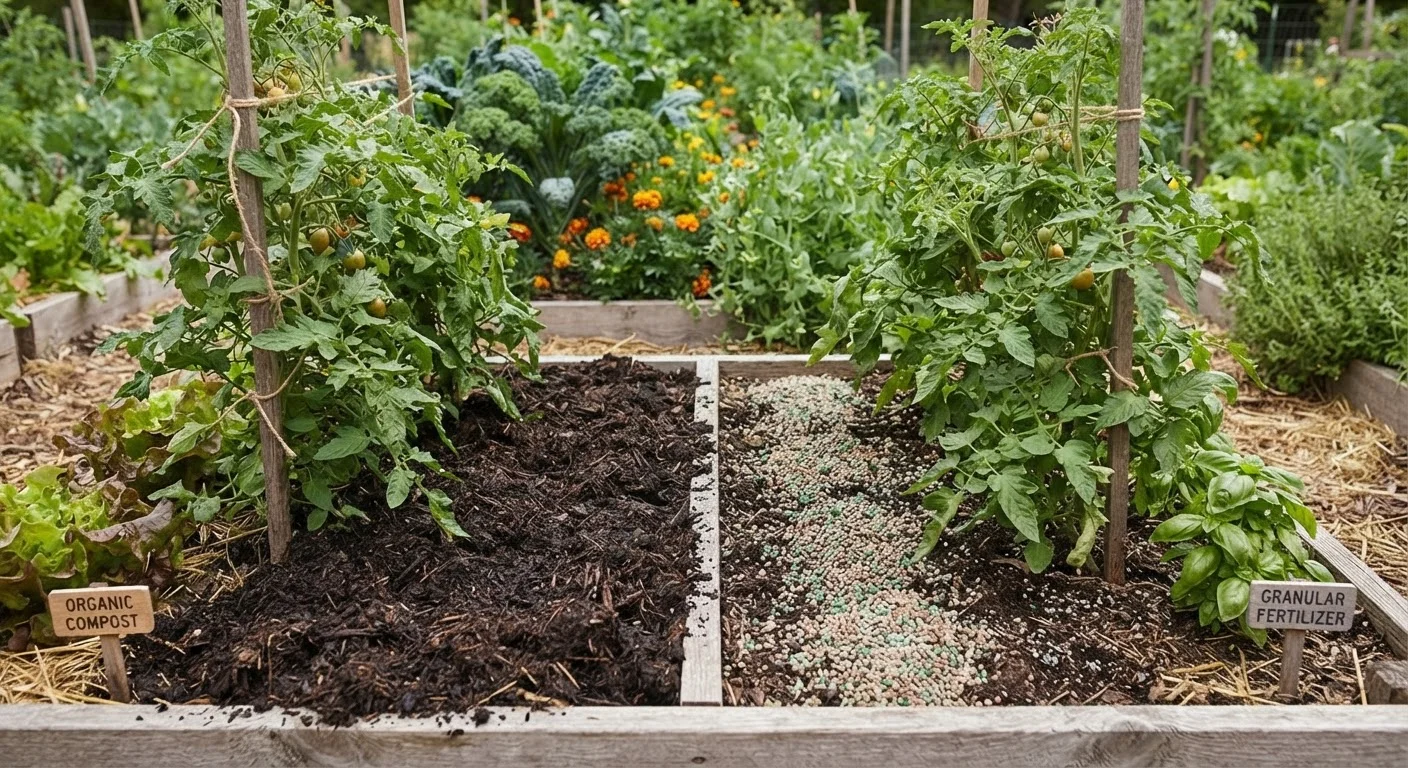
Photo credit: faqsnest.com
In this article
Compost and synthetic fertilisers feed plants differently. Explore how each works, their long-term effects on soil, and key trade-offs.
Key Takeaways
- Organic compost feeds soil biology first, releasing nutrients slowly over weeks and months.
- Synthetic fertilisers deliver targeted nutrients quickly but do not meaningfully improve soil structure.
- Long-term compost use builds water retention, microbial life, and reduced erosion risk.
- Synthetic fertilisers carry a higher risk of nutrient runoff if over-applied.
- Many experienced gardeners combine both approaches depending on the crop and the season.
How Each One Works
The core difference between organic compost and synthetic fertiliser lies not in what they contain, but in how they deliver nutrients to plants.
Organic compost is decomposed plant and animal matter. It doesn't feed plants directly — instead, it feeds the billions of bacteria, fungi, and other organisms in your soil. Those microbes break down organic material over time, releasing nutrients in forms that plant roots can absorb. The process is gradual and self-regulating: nutrient release generally tracks with microbial activity, which rises when conditions are warm and moist — exactly when plants are actively growing.
Synthetic fertilisers are manufactured compounds — typically derived from mined minerals or industrial chemical processes — that contain specific, immediately plant-available nutrients, most commonly nitrogen (N), phosphorus (P), and potassium (K). Because the nutrients are already in a form roots can take up, there's no waiting on microbial activity. A water-soluble synthetic fertiliser can show results within days.
Neither approach is inherently superior — they operate on different timescales and serve different functions in the garden ecosystem.
Effects on Soil Over Time
This is where the two approaches diverge most significantly.
Regular compost applications gradually improve soil structure — the way particles clump together to create pore spaces for air and water. Well-structured soil drains better during heavy rain, retains moisture during dry spells, and allows roots to penetrate more easily. Compost also sustains microbial communities that suppress some soil-borne diseases and help cycle nutrients naturally. Over several growing seasons, compost-amended soil typically requires fewer inputs because its capacity to support plant growth improves year over year.
Synthetic fertilisers, by contrast, have little to no effect on soil structure. Repeated heavy use — particularly of high-nitrogen formulas — can, over many years, acidify soil pH and reduce microbial diversity in some conditions. More immediately, synthetic nutrients that aren't absorbed by plants can leach through the soil and into waterways, contributing to nutrient pollution. This isn't an argument against their use, but it underscores why application rates and timing matter.
Layering compost alongside mulch is one strategy experienced gardeners use to compound soil benefits — see our guide to mulching for how these two practices work together.
| Organic Compost | Synthetic Fertiliser | |
|---|---|---|
| How nutrients are delivered | Via soil microbes over weeks/months | Directly to roots, often within days |
| Effect on soil structure | Significant improvement over time | Little to none |
| Microbial life support | Feeds and sustains soil biology | Minimal or neutral impact |
| Risk of nutrient runoff | Low with normal use | Higher if over-applied or timed poorly |
| Precision of nutrient control | Low — broad, variable profile | High — specific N-P-K ratios |
| Cost to produce at home | Minimal if made from scraps | Cannot be made at home |
| Best use case | Long-term soil building | Correcting specific deficiencies quickly |
Practical Trade-Offs to Weigh
Choosing between compost and synthetic fertiliser — or deciding how to combine them — depends on what you're trying to accomplish and the constraints you're working within.
Speed vs. Patience
If a plant shows clear signs of nitrogen deficiency mid-season (yellowing lower leaves, stunted growth), a targeted synthetic fertiliser can act much faster than compost. Compost is a poor emergency tool. Conversely, applying compost in autumn builds soil biology for the following spring — a patient, compounding investment that synthetic fertiliser doesn't replicate.
Cost and Availability
Compost can be made at home from garden and kitchen scraps at minimal cost. If space is limited, that's still achievable — our article on building a compost heap in a small garden walks through practical setups. Purchased bagged compost or well-rotted manure is also widely available. Synthetic fertilisers vary in price by formulation but are generally accessible at garden centres.
Precision vs. Broad Nourishment
Synthetic fertilisers allow you to target a specific nutrient in a specific ratio. This is useful when a soil test reveals a clear deficiency. Compost provides a broader, more variable nutritional profile — which is usually sufficient for general gardening but doesn't allow the same degree of fine-tuning.
Environmental Considerations
Home composting diverts organic waste from landfill and closes a natural nutrient loop. Synthetic fertiliser production is energy-intensive. On the application side, compost is relatively forgiving of moderate over-application; synthetic fertilisers can cause fertiliser burn on plants or runoff into local waterways if applied too heavily or before heavy rain.
Get a Soil Test Before You Add Anything
Before reaching for compost or fertiliser, consider testing your soil's pH and nutrient levels. Many cooperative extension services and garden centres offer affordable soil testing. The results tell you what your soil actually needs — which can save money, prevent over-application, and lead to noticeably better plant performance.
When to Use Each — or Both
In practice, compost and synthetic fertiliser aren't mutually exclusive. Many gardeners use compost as a foundation — incorporated into beds each season — and reach for a targeted synthetic product only when a specific plant shows signs of a deficiency confirmed by observation or a soil test.
A few useful decision points:
- New beds or poor soil: Prioritise compost. Building soil biology first creates a more stable growing environment than relying on repeated synthetic inputs.
- Established vegetable gardens: Regular compost applications reduce the need for supplemental fertiliser. If yields drop or plants underperform, a soil test can clarify whether a targeted synthetic product is warranted.
- Lawns: Both approaches are used, but lawns with heavy use often benefit from the slow-release nitrogen in composted materials combined with selective synthetic applications during peak growing periods.
- Container plants: Containers lack the soil ecosystem that compost relies on. A balanced liquid fertiliser is often more effective, supplemented with a compost-based potting mix where possible.
No single formula applies to every garden. Paying attention to your plants, testing your soil periodically, and adjusting inputs based on results is a more reliable strategy than defaulting to either approach exclusively.

Author
Home & Garden Editorial Team
Home & Garden Editorial Team is the collective byline for our editorial team and contributor network. Articles published under this byline or an editorial pen name are researched, written, and reviewed according to our editorial standards for clarity, consistency, and independence before publication.
View all articles →