
How Food Became America's Most Contested Cultural Battlefield
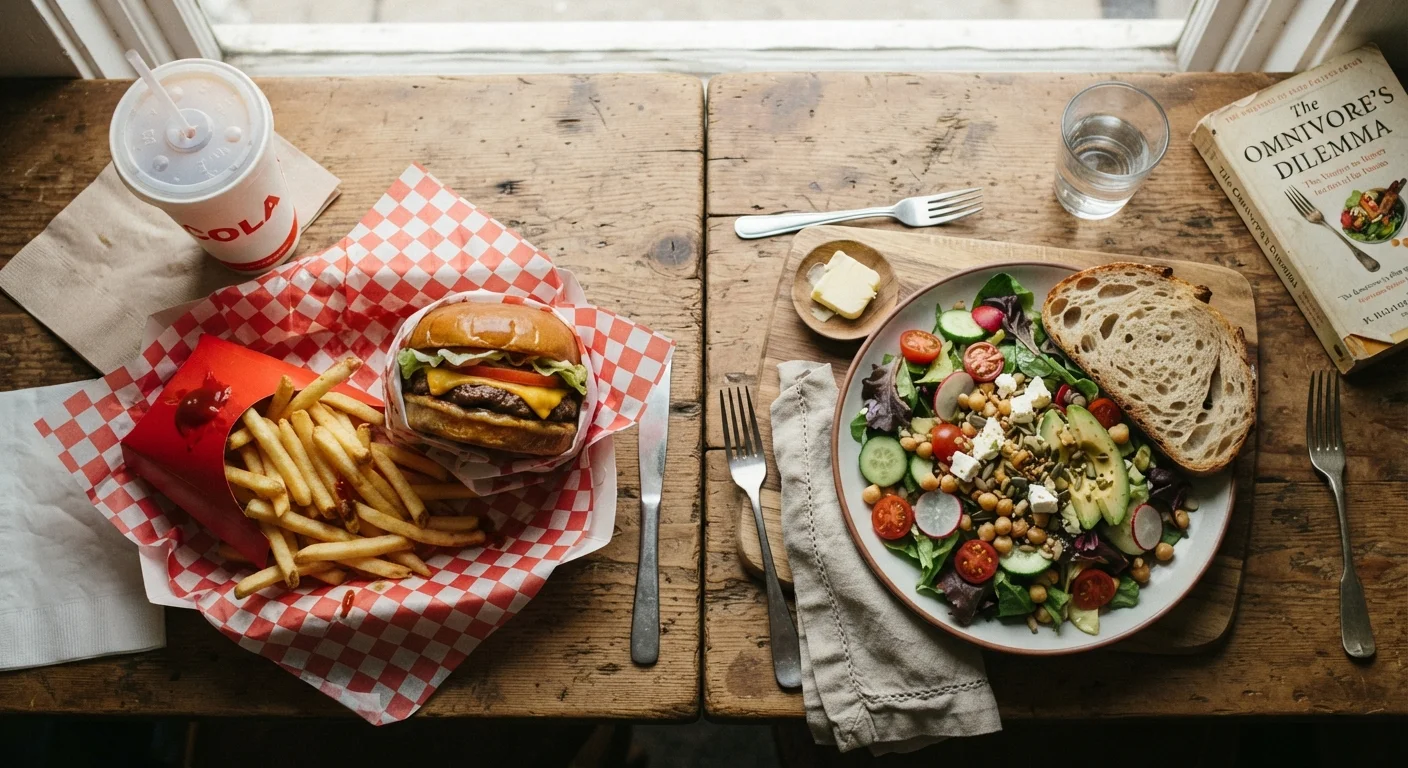
Photo credit: faqsnest.com
In this article
Diet choices, farm-to-table movements, and fast-food debates now carry heavy cultural weight. Explore how eating became tied to identity, politics, and belonging.
Key Takeaways
- Food choices in America now carry strong signals about class, politics, and cultural identity.
- The farm-to-table and fast-food debates map closely onto urban-rural and economic divides.
- Immigration has continuously expanded — and complicated — what counts as 'American' food.
- Moralization of diet has increased social friction, making eating a source of judgment and exclusion.
- Understanding food culture requires examining the structural forces behind individual choices.
From Sustenance to Statement
For most of human history, the central question about food was pragmatic: Is there enough? In contemporary America, that question has been eclipsed by a more fraught one: What does what you eat say about you?
The shift has been decades in the making. Beginning in the 1970s and accelerating through the 1980s and 1990s, Americans absorbed a cascade of messages — from public health agencies, food industry marketing, environmental advocates, and celebrity culture — that tied eating to identity and moral worth. Organic became virtuous. Fast food became shorthand for poor choices, poor values, or poverty itself. The table, long a site of community, became a site of judgment.
This isn't merely a matter of personal preference hardening into ideology. It reflects genuine structural forces: a food system shaped by agricultural policy, corporate consolidation, and stark geographic inequality. The result is that America's relationship with food now encodes its deepest tensions — around class, race, health, the environment, and what it means to live a good life.
Class, Access, and the Myth of Pure Choice
One of the most persistent distortions in American food culture is the premise that what people eat is primarily a matter of individual will. In reality, access to food — its cost, availability, and variety — is profoundly shaped by income, geography, and race.
Food deserts, defined as low-income areas with limited access to affordable fresh food, remain a documented reality across many American cities and rural regions. When critics label fast food or processed food as moral failures, they often ignore that for millions of Americans these options represent genuine economic or logistical constraints, not lifestyle preferences.
19%
Americans living in food-insecure households
According to USDA Economic Research Service data, food insecurity remains a persistent structural reality affecting tens of millions of Americans.
3x
Price premium for organic vs. conventional produce
Consumer Reports and USDA data have documented that organic fresh produce commonly costs 20–100% more than conventional equivalents, with some categories exceeding three times the price.
45%
Adults who say diet is tied to their personal identity
A Pew Research Center survey on food attitudes found that nearly half of American adults link their dietary choices to a sense of personal or cultural identity.
At the same time, the farm-to-table and clean-eating movements — whatever their genuine merits — have become legible class signals. The ability to pay premium prices for locally sourced produce, to subscribe to a CSA box, or to shop exclusively at specialty grocery stores marks a kind of cultural capital that is not equally distributed. As the sociologist Pierre Bourdieu argued, taste is never purely aesthetic — it is always also social, a mechanism through which class distinctions are reproduced and naturalized.
This dynamic is explored further in our analysis of how individualism and collectivism shape American life, where personal responsibility narratives consistently obscure the structural conditions that constrain individual choice.
Immigration, Authenticity, and the Expanding American Table
Any serious account of American food culture must grapple with immigration. The United States has no single culinary tradition precisely because it has absorbed the culinary traditions of the world — unevenly, selectively, and often with little acknowledgment of origin.
The pattern repeats across generations: an immigrant community introduces a food culture that faces initial suspicion or ridicule, only to be absorbed into the mainstream decades later, sometimes stripped of context and sometimes enriched by hybridization. Italian food, Chinese food, Mexican food, and now Korean, Ethiopian, and Vietnamese cuisines have all traveled this arc in American life.
What makes this process contested is the question of authenticity and credit. When a cuisine becomes profitable and fashionable, debates arise about who gets to profit from it, whether adaptations honor or erase the source culture, and which communities benefit. These debates are not merely academic — they touch on real questions of economic equity and cultural recognition. Our deeper look at how immigration has continuously reshaped American cultural identity provides essential context for understanding this ongoing negotiation.
The Political Sorting of the American Plate
In an era of intense polarization, food has become one more domain where Americans signal tribal affiliation. Research has documented meaningful correlations between dietary patterns and political identity — not because political parties formally dictate diet, but because the values underlying food choices (environmentalism, traditionalism, skepticism of corporate power, nostalgia for self-sufficiency) align with broader ideological clusters.
The fast-food debate is illustrative. When a politician is photographed eating at a fast-food chain, it reads to some audiences as authentic relatability and to others as a symbol of cultural regression. The farm-to-table movement, conversely, is celebrated in progressive urban circles and mocked in conservative rural ones — not primarily because of disagreement about nutrition science, but because it has come to represent a set of urban, coastal, elite-coded values.
This sorting mirrors the urban-rural divide examined in our piece on urban vs. rural America, where geography increasingly predicts not just what people eat but what they believe, how they vote, and who they trust.
What the Moralization of Eating Costs Us
When food becomes a moral category — when eating a burger is coded as lazy or uninformed and eating a grain bowl is coded as enlightened — the social costs are significant. Shame is a poor instrument of change. Behavioral science research consistently shows that moralizing dietary messages tend to provoke defensiveness and backlash rather than reflection and adjustment.
More substantively, framing food choices as individual moral decisions obscures the systemic levers that actually shape what Americans eat: farm subsidies that favor commodity crops over fresh produce, food marketing regulations, school lunch funding, and the distribution of grocery infrastructure. Lasting change in American food culture will require engaging those structural realities — not just adjudicating the virtue of individual plates.
Food's power to divide is real, but so is its power to build connection. Shared meals remain one of the most reliable sites of cross-cultural understanding in American life. The question is whether the cultural conversation around food will continue to harden into faction — or find its way back to the table as common ground. See also why shared cultural touchstones are harder to sustain now.
Frequently Asked Questions

Author
People & Culture Editorial Team
People & Culture Editorial Team is the collective byline for our editorial team and contributor network. Articles published under this byline or an editorial pen name are researched, written, and reviewed according to our editorial standards for clarity, consistency, and independence before publication.
View all articles →