
Urban vs. Rural America: More Than a Geography Gap
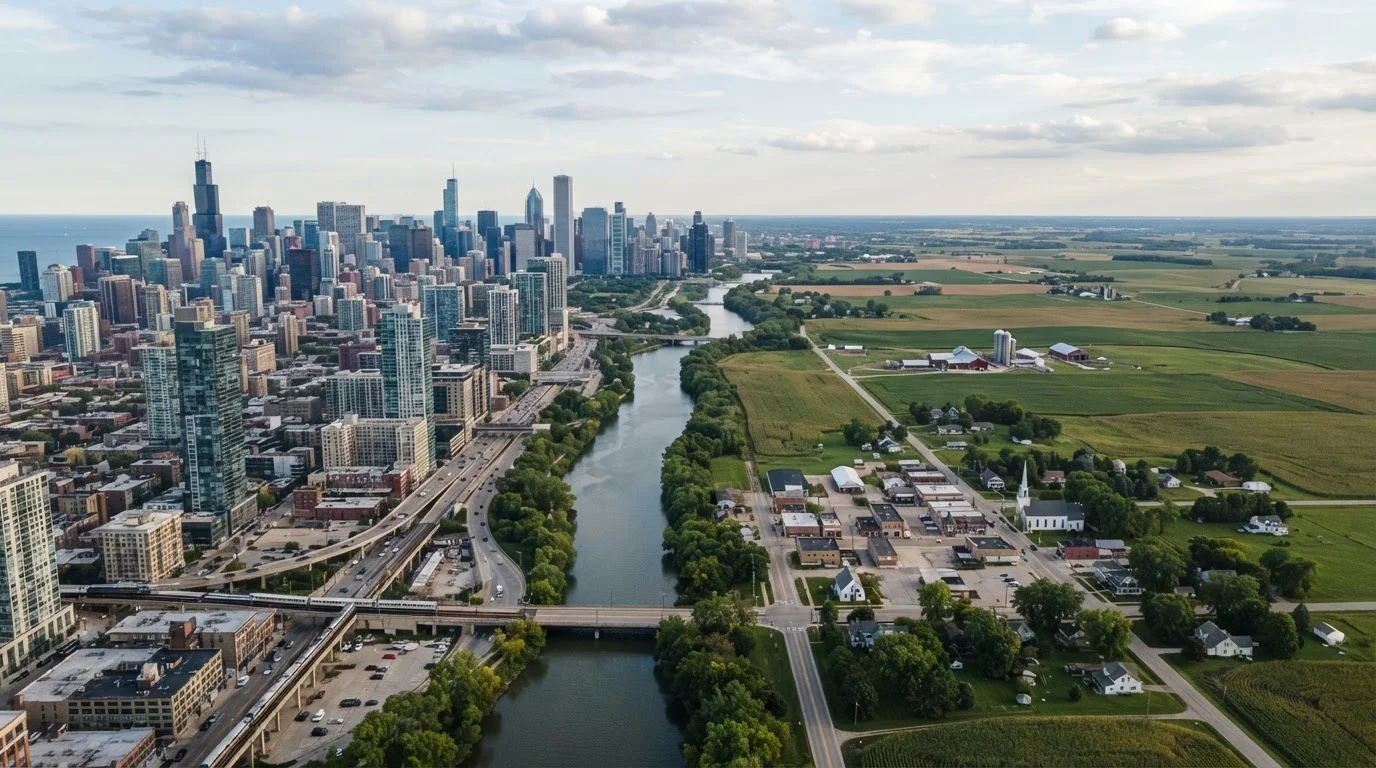
Photo credit: faqsnest.com
In this article
The divide between city and country life in America runs deeper than zip codes. Examine the differing values, media diets, and daily experiences that shape each world.
Key Takeaways
- The urban-rural divide reflects deep differences in social trust, institutional relationships, and daily life structure.
- Media consumption patterns differ significantly between city and rural residents, shaping how each group interprets the same national events.
- Economic anxiety takes different forms in each setting — urban cost pressure versus rural disinvestment — but both drive cultural resentment.
- Rural and urban Americans often share more values in common than political narratives suggest, particularly around family and community.
- Place-based identity functions as a powerful cultural lens, influencing everything from food habits to social trust and civic participation.
Two Americas, One Country: The Cultural Fault Lines
The urban-rural divide in the United States is frequently framed as a political story — red counties and blue cities, competing voting blocs. But beneath the electoral map lies something more textured: a genuine divergence in how Americans experience everyday life, form social bonds, and relate to institutions. Geography, in this sense, is less a backdrop than a formative force.
Sociologists have long noted that place shapes identity in ways that rival class, education, or even religion. Where you grow up influences your sense of social trust, your relationship to strangers, and what you expect from public life. A person navigating a major metro and a person managing a small agricultural community are not simply living in different landscapes — they are, in many meaningful respects, operating inside different social contracts.
For a deeper look at how geographic context shapes social bonds specifically, see the social architecture of American friendship.
| Criterion | Urban America | Rural America |
|---|---|---|
| Population density | High — thousands per square mile | Low — often under 100 per square mile |
| Institutional trust | Moderate, variable by group | Generally lower, declining over decades |
| Economic pressure type | Cost of living, housing affordability | Disinvestment, service loss, out-migration |
| Social connectivity style | Broad, weak-tie networks | Narrow, strong-tie community bonds |
| Media representation | Overrepresented in national coverage | Underrepresented or crisis-framed |
| Cultural identity anchor | Profession, subculture, neighborhood | Place, family legacy, local heritage |
| Access to services | Generally higher (healthcare, transit) | Significantly limited, widening gap |
Economic Anxiety Wears Different Faces
Both urban and rural Americans carry significant economic anxiety, but the structural sources differ in ways that matter culturally. In cities, the dominant pressure is cost: housing affordability, commute time, and the psychological weight of proximity to extreme wealth alongside persistent poverty. Urban residents often feel economically squeezed even when employment rates are relatively strong.
In rural America, the anxiety tends to be about absence. Hospitals have closed — more than 140 rural hospitals have shut down since 2010, according to the Chartis Center for Rural Health. Broadband access remains uneven. Young people leave, and the social infrastructure built around stable populations starts to hollow out. This pattern of disinvestment creates a specific kind of grievance: the sense that the institutions of national life were built for somewhere else.
These different economic textures produce different cultural postures. Urban economic pressure tends to fuel debates around redistribution, housing policy, and corporate accountability. Rural economic distress often expresses itself as distrust of distant institutions — government agencies, media organizations, universities — perceived as indifferent or actively hostile to rural ways of life.
140+
Rural hospital closures since 2010
According to the Chartis Center for Rural Health, more than 140 rural hospitals have shut down since 2010, intensifying healthcare access disparities.
~20%
Share of Americans living in rural areas
The U.S. Census Bureau estimates roughly one in five Americans lives in a rural area, though they occupy approximately 97% of the nation's land area.
~35%
Rural Americans lacking broadband access
The FCC and independent researchers have documented that roughly a third of rural Americans lack access to high-speed broadband, limiting economic and social participation.
Media Diets and the Perception Gap
One of the most consequential and least-discussed dimensions of the divide is how differently urban and rural Americans consume information. This is not simply about partisan media choices — it runs deeper into what kinds of stories get told, whose concerns become visible, and which experiences are treated as the default American experience.
National news organizations are predominantly headquartered in major coastal cities. The framing of stories — which crises get sustained coverage, which communities are treated as representative of broader trends — inevitably reflects the institutional geography of journalism. Rural Americans have expressed, in survey research from organizations like the American Press Institute, a sense that the news doesn't speak to them or reflect their realities.
Meanwhile, urban residents often receive little sustained exposure to the economic and social realities of rural life beyond crisis framing — opioid epidemics, farm foreclosures, population decline. The nuance of what rural communities actually value, celebrate, and struggle to preserve rarely penetrates national coverage. This asymmetric visibility fuels mutual misunderstanding in ways that political messaging alone cannot explain.
It's worth noting that these information gaps extend into practical daily life as well. Even something as seemingly neutral as driving culture reflects deep geographic divergence — highway rural driving and city stop-and-go navigation require genuinely different habits and mental models, as explored in this comparison of highway and city driving habits.
What the Divide Gets Wrong — and What It Gets Right
The urban-rural binary, for all its analytic usefulness, conceals as much as it reveals. Rural America is not monolithic: a ranching community in Wyoming, a historically Black farming region in Alabama, and a tourist-dependent mountain town in Vermont have sharply different cultural profiles. Likewise, urban America contains neighborhoods that function more like small towns in their social density, and vast stretches of urban poverty that have more in common with rural disinvestment than with the cosmopolitan city of popular imagination.
Research from scholars like Robert Wuthnow, who has studied rural America extensively, suggests that rural residents are primarily motivated not by resentment but by a fierce attachment to community and a desire for that community to be treated with respect. Similarly, urban residents who appear radically different on cultural surveys often share core values around family stability, fairness, and hard work.
The divide is real — but it is also partially constructed and actively maintained by media, political incentives, and the cultural industries that profit from conflict narratives. For a broader reckoning with how national narratives distort American self-understanding, this examination of American exceptionalism myths offers useful context. And for those interested in how food has become one of the sharpest markers of urban-rural cultural identity, this analysis of food as cultural battlefield is worth exploring.
Understanding urban and rural America as two genuinely different lived realities — without collapsing either into caricature — is not just an intellectual exercise. It is a prerequisite for any serious conversation about shared national life.

Author
People & Culture Editorial Team
People & Culture Editorial Team is the collective byline for our editorial team and contributor network. Articles published under this byline or an editorial pen name are researched, written, and reviewed according to our editorial standards for clarity, consistency, and independence before publication.
View all articles →