
Highway Driving vs. City Driving: How Your Habits Need to Shift
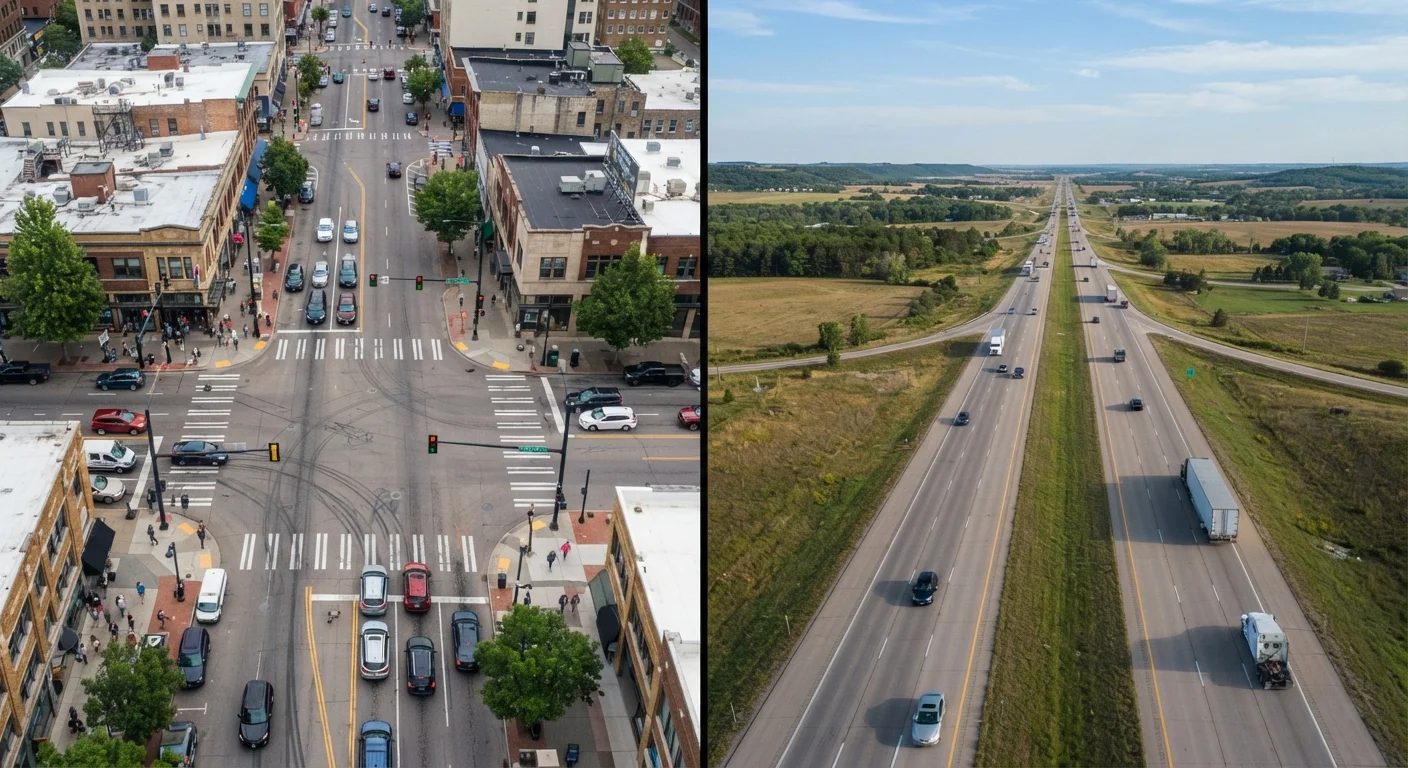
Photo credit: faqsnest.com
In this article
Merging at speed, managing stop-and-go traffic, and reading road signs all work differently. Here's how to mentally switch between the two.
Key Takeaways
- Highway driving demands sustained attention over longer distances, while city driving requires constant, rapid decision-making.
- Merging at speed on a highway is fundamentally different from yielding at a city intersection — both require specific habits.
- Your following distance, scan range, and speed management all need to adjust when you switch between environments.
- Fatigue builds differently in each context — highway monotony and city stress are distinct challenges.
- Defensive driving principles apply to both environments but play out in noticeably different ways.
Two Environments, Two Mental Modes
Most American drivers switch between highway and city driving regularly, often without consciously changing their approach. That's where problems start. These two environments don't just look different — they demand fundamentally different forms of attention, timing, and physical habit.
On the highway, the challenge is sustained focus over distance. Traffic moves in one general direction, speeds are relatively consistent, and the biggest hazards tend to be complacency, following too closely, and misjudging merges. On city streets, the challenge is rapid sequential decision-making. You're managing traffic signals, cyclists, pedestrians stepping off curbs, double-parked vehicles, and short visibility windows around every block.
Neither environment is inherently more dangerous, but they each expose different weaknesses in drivers who haven't consciously adapted their habits. The core principles of defensive driving apply to both — but the way those principles express themselves looks very different depending on where you are.
| Criterion | Highway Driving | City Driving |
|---|---|---|
| Typical speed range | 55–80 mph | 15–45 mph |
| Primary attention demand | Sustained focus, distance scanning | Rapid, multi-directional awareness |
| Following distance needed | 3+ seconds (longer at speed) | 2–3 seconds, managed for stop-and-go |
| Main hazard type | Merging, fatigue, tailgating | Pedestrians, signals, blind-spot conflicts |
| Fatigue profile | Monotony-induced inattention | Cognitive overload and stress |
| Sign complexity | Exit signs, mile markers, speed limits | Traffic signals, turn restrictions, parking rules |
| Speed perception risk | Lower (speed is consistent) | Higher after highway transition |
What Changes on the Highway
Highway driving rewards patience and planning. The most common errors aren't reckless — they're the result of drivers doing too little rather than too much.
Following Distance
At 65 mph, your vehicle travels roughly 95 feet per second. A three-second following gap — the minimum most safety guidance recommends — gives you about 285 feet of stopping buffer. Many drivers maintain far less, especially in light traffic when it feels unnecessary. It rarely does until it suddenly does.
Merging
Merging onto a highway is one of the most misunderstood maneuvers in everyday driving. The goal is to match the speed of traffic on the main roadway before entering it — not to reach the end of the on-ramp and then accelerate. Use the full length of the ramp, signal early, and find a gap rather than forcing one. For a deeper look at right-of-way during merges, see this breakdown of merging and yielding rules.
Fatigue and Monotony
Highway monotony is real. Extended stretches of straight, similar-looking road can produce a state sometimes called highway hypnosis — where your eyes are open but your brain is less engaged than it should be. Plan rest stops on trips over two hours, and don't rely on caffeine alone to substitute for actual rest.
What Changes in the City
City driving compresses everything — space, time, and margin for error. The pace feels slower in terms of speed, but cognitively it's far more demanding per mile.
Scan Range and Attention Width
On the highway, your eyes scan far ahead — hundreds of yards down the road. In the city, your scan range tightens because threats can emerge from any direction within just a few car lengths. You need to track traffic signals, scan crosswalks, watch for cyclists in your blind spot, and still catch the car ahead braking suddenly. That's a lot of simultaneous inputs.
Speed Perception After Highway Travel
One of the most reliable hazards when transitioning from highway to city driving is distorted speed perception. After 45 minutes at 70 mph, 35 mph can genuinely feel like you're crawling — even when you're still moving faster than you think. Check your speedometer consciously when you first enter city limits after a long highway run. This effect is well-documented and is one reason posted speed limits in transition zones matter more than they might appear to.
Stop-and-Go Management
Brake smoothly and early. Harsh, late braking in stop-and-go traffic not only wears your brakes faster but telegraphs poor attention to drivers behind you. Leave enough room to coast toward stopped traffic rather than stopping abruptly — it's easier on the vehicle and reduces rear-end risk.
If you're curious how some widely held city and highway driving beliefs hold up to scrutiny, several common driving myths are worth revisiting.
Making the Transition Consciously
The moment you exit the highway and enter surface streets — or vice versa — treat it as an intentional mental reset, not just a physical one. A few habits help:
- Check your speed actively within the first minute of transitioning. Don't rely on feel.
- Adjust your scan distance — pull your gaze in when entering city environments, push it out when entering highway flow.
- Rebuild your following distance to match the new speed context. Highway gaps don't translate to city conditions.
- Turn off cruise control well before you reach city limits — not at the first stoplight.
For those planning longer highway journeys, especially with family, the transition challenge becomes more complex. Long-distance driving with kids adds another layer of cognitive load worth planning around. And if your route takes you into unfamiliar terrain beyond typical highway or city driving, mountain, desert, and coastal roads require their own set of adjusted habits entirely.
The bottom line: your car doesn't need to shift gears when you move between environments — but your driving mindset does.

Author
Cars & Driving Editorial Team
Cars & Driving Editorial Team is the collective byline for our editorial team and contributor network. Articles published under this byline or an editorial pen name are researched, written, and reviewed according to our editorial standards for clarity, consistency, and independence before publication.
View all articles →