
The Shifting Meaning of the American Dream Across Decades
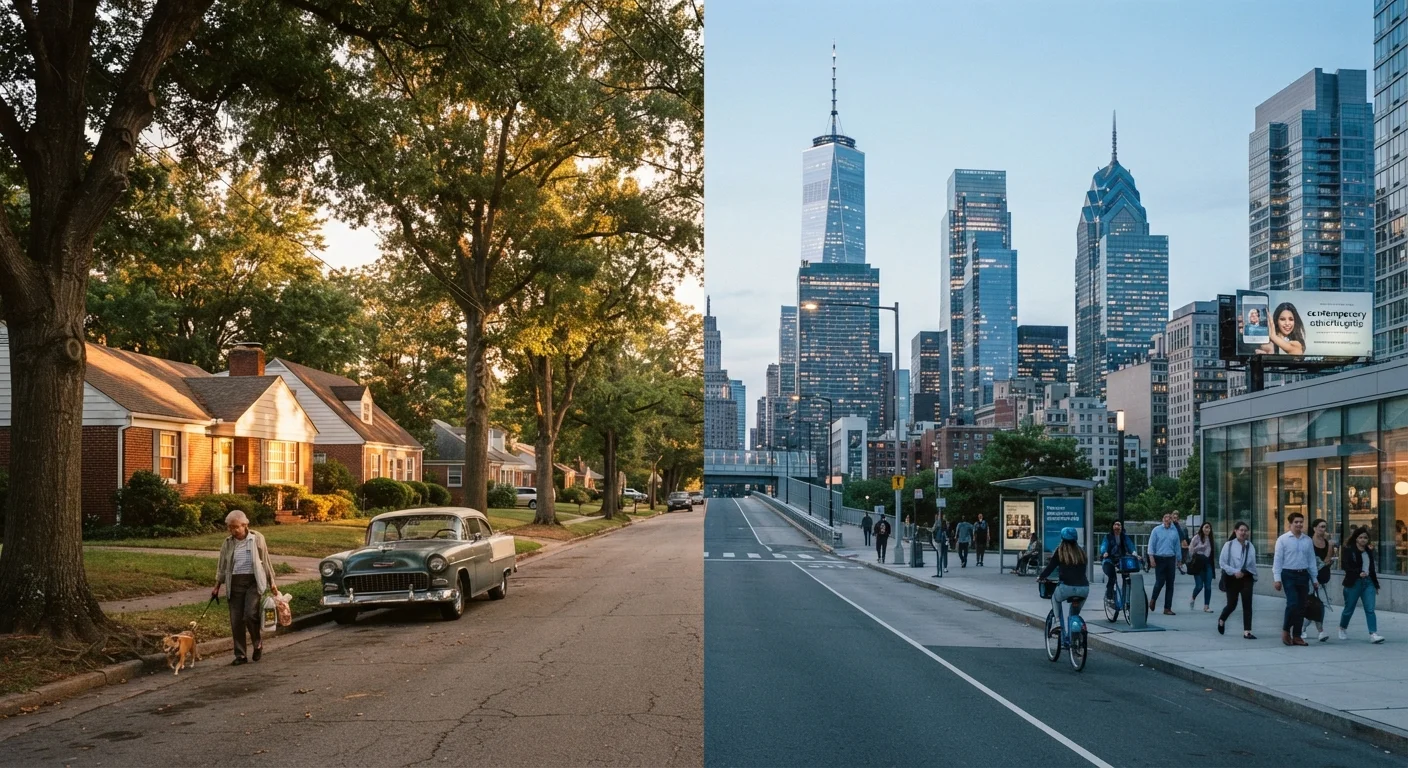
Photo credit: faqsnest.com
In this article
Homeownership, upward mobility, personal freedom — the American Dream has meant different things in different eras. Trace how the concept has evolved since the mid-20th century.
What the Phrase Has Always Carried
Historian James Truslow Adams introduced the phrase "American Dream" in his 1931 book The Epic of America, describing it not as material wealth but as a social order in which every individual could reach their fullest potential regardless of birth circumstances. That foundational ambiguity — the dream as both aspiration and ideology — has fueled its remarkable longevity and its equally remarkable elasticity.
The concept sits at the intersection of promise and pressure. It has served as a beacon for immigrants, a yardstick for the middle class, and, periodically, a mirror that reflects uncomfortable truths about inequality. Understanding how its meaning has shifted decade by decade reveals as much about American social structure as it does about individual aspiration.
| Phrase coined | 1931, by historian James Truslow Adams (Adams, The Epic of America, 1931) |
| U.S. homeownership peak | Approximately 69% (2004) (U.S. Census Bureau, Housing Vacancy Survey) |
| Top priority for younger Americans | Personal freedom and work-life balance over homeownership (Gallup and Pew Research surveys, 2010s–2020s) |
| Decades covered by the concept | 9+ decades of continuous cultural reference (Documented from 1931 through present day) |
| Key structural enabler (postwar era) | GI Bill and FHA mortgage programs (Federal Housing Administration historical records) |
The Postwar Blueprint: 1945–1969
The postwar era produced what most Americans still picture first when they hear the phrase: a single-family home in the suburbs, a steady manufacturing or corporate job, a car in the driveway, and children who would surpass their parents' educational attainment. Federal policies — from the GI Bill to federally backed mortgages — made this version structurally accessible to a broad white middle class in ways that were systematically denied to Black Americans and other minorities through redlining and discriminatory lending.
This version of the dream was explicitly material and explicitly collective in structure: the nuclear family was the unit of success. Sociologists describe this period as one of unusually compressed income distribution, where a factory worker's wage could sustain a household at a recognizable middle-class standard. The dream, in short, felt achievable to a historically wide slice of the population — though never as universally as its mythology suggested.
For a broader look at how cultural markers tracked alongside these shifts, see this decade-by-decade cultural reference.
Fracture and Redefinition: 1970s–1990s
The 1970s introduced deindustrialization, stagflation, and the first sustained erosion of the wage-growth gains that had defined the postwar compact. The dream began to bifurcate. For the emerging professional class, the 1980s reframed ambition around individual enterprise — entrepreneurship, financial self-sufficiency, and conspicuous achievement. Reagan-era rhetoric elevated self-reliance as the core mechanism of mobility, subtly shifting blame for economic immobility from structural barriers to individual effort.
This tension between individualist and collectivist framings of success is a recurring fault line in American values — one explored in depth in this analysis of individualism versus collectivism in American life.
Meanwhile, homeownership rates, often used as a proxy for dream attainment, peaked around 1980 and then became increasingly dependent on dual-income households. The dream's material benchmarks had not changed; the resources required to reach them had grown substantially harder to assemble.
American Dream
A national ethos, first formally articulated by historian James Truslow Adams in 1931, holding that every American can achieve success and upward mobility through effort and determination, regardless of their origins. The specific content of that success has been defined differently across generations.
Redlining
A discriminatory practice, common in the mid-20th century, in which financial institutions and government agencies systematically denied mortgages and financial services to residents of certain neighborhoods — predominantly Black communities — effectively barring them from wealth-building through homeownership.
Deindustrialization
The large-scale decline of manufacturing employment in an economy, typically as production moves overseas or becomes automated. Beginning in the 1970s in the U.S., deindustrialization eroded working-class wages and the material stability they had supported.
Upward Mobility
The ability of individuals or families to move to a higher socioeconomic position over time — typically measured by income, education, or occupational status compared to one's parents. It is a central premise of the American Dream's promise.
GI Bill
Formally the Servicemen's Readjustment Act of 1944, this legislation provided returning World War II veterans with access to low-cost mortgages, college tuition benefits, and job training. It significantly expanded homeownership and higher education for white veterans but was implemented in ways that largely excluded Black veterans.
The Contemporary Renegotiation: 2000s to the Present
The 2008 financial crisis was a structural turning point. Millions of households lost homes they had been encouraged to treat as guaranteed wealth-building vehicles. For younger millennials and Gen Z, the experience of watching that collapse — combined with rising student debt loads and housing costs that have substantially outpaced wage growth — has produced a measurable shift in what "success" means.
Survey research consistently shows that younger Americans are more likely to define the American Dream in terms of personal freedom, meaningful work, and work-life balance than in terms of homeownership or income targets. The aspiration has shifted inward and is increasingly individualized. Some researchers frame this as a healthier, more realistic orientation; others see it as an adaptive response to foreclosed material possibilities.
Immigration remains a persistent renewal engine for the dream's classic form. First-generation immigrants frequently describe their aspirations in terms strikingly similar to the postwar blueprint — stability, upward mobility, homeownership — even as native-born Americans revise those benchmarks. How immigration continuously reshapes American cultural identity is directly relevant here: new arrivals often reinvigorate ideals that existing residents have begun to question.
There is also the question of whether the dream's mythology has ever matched its mechanics. Scrutinizing the myths of American exceptionalism offers a useful counterweight — examining which beliefs about American mobility and opportunity hold up against comparative data and which do not. And when material futures feel uncertain, the pull of an idealized past intensifies — a dynamic examined through the lens of nostalgia as a cultural force.
What persists across every era is the dream's function as a shared reference point — a language Americans use to debate fairness, measure progress, and argue about what the country owes its people. That the meaning keeps shifting is not a sign of the concept's failure. It may be evidence of its most durable feature: adaptability.

Author
People & Culture Editorial Team
People & Culture Editorial Team is the collective byline for our editorial team and contributor network. Articles published under this byline or an editorial pen name are researched, written, and reviewed according to our editorial standards for clarity, consistency, and independence before publication.
View all articles →