
Markers of American Cultural Shifts Since 1970: A Timeline Reference
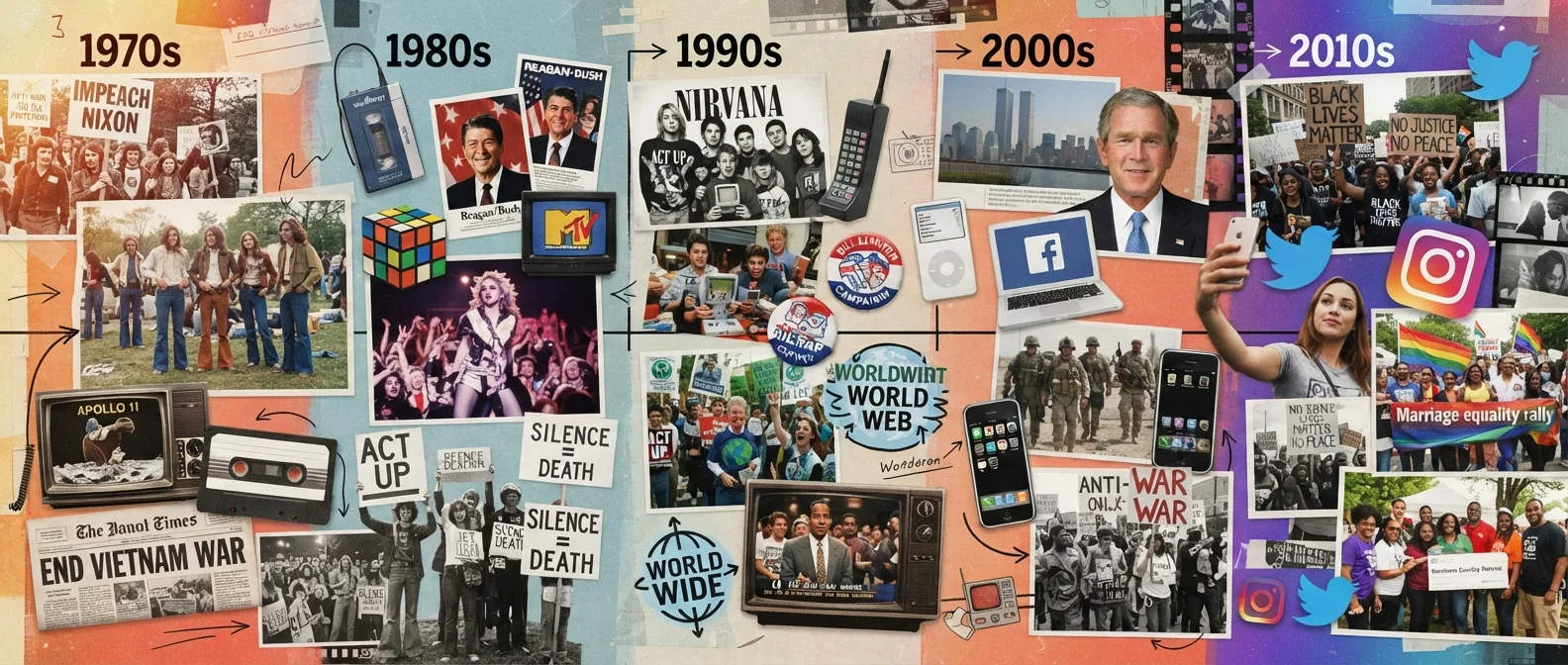
Photo credit: faqsnest.com
In this article
A decade-by-decade reference to the social, technological, and behavioral changes that have measurably altered American everyday life over the past half-century.
How to Use This Timeline Reference
Cultural change rarely announces itself. It accumulates across years and decades, visible only in retrospect through shifts in behavior, language, technology adoption, and social norms. This reference documents measurable markers — demographic data, legislative milestones, consumption patterns, and behavioral indicators — that collectively define how American everyday life has transformed since 1970.
The goal is analytical, not nostalgic. Each decade is organized around the structural forces most clearly supported by social science research and census data. Where consensus is incomplete, that uncertainty is noted. For readers interested in how shared cultural moments form and dissolve, our piece on the rise and fall of monoculture offers a complementary lens.
| U.S. suburban population majority | First recorded in the 1970 Census (U.S. Census Bureau) |
| Internet household penetration by 2000 | ~50% of U.S. households (U.S. Census Bureau, Current Population Survey) |
| Smartphone ownership among U.S. adults (2021) | Over 85% (Pew Research Center) |
| Peak U.S. union membership rate | ~35% of workforce (mid-1950s); declined to ~10% by 2020s (Bureau of Labor Statistics) |
| Workforce shift to services | Service sector surpassed manufacturing as primary employer by the 1980s (Bureau of Labor Statistics historical data) |
| Facebook founding year | 2004 |
The 1970s: Institutional Distrust and Identity Politics Take Root
The 1970s opened against a backdrop of Watergate, stagflation, and the end of the Vietnam War — a convergence that measurably eroded public confidence in federal institutions. Gallup data from the period shows trust in the federal government declining sharply from late-1960s highs, a trend that has never fully reversed.
Structurally, the decade marked the rise of identity-based political organizing. The women's liberation movement shifted from advocacy into legislation with the Equal Rights Amendment's 1972 congressional passage. Title IX (also 1972) fundamentally reorganized gender participation in education and athletics. The 1973 Roe v. Wade ruling made reproductive rights a permanent axis of political identity. Meanwhile, the 1970 Census revealed that for the first time more Americans lived in suburbs than in cities or rural areas — a spatial reorganization with lasting consequences for community structure, commuting, and racial segregation patterns.
Culturally, the decade produced a fragmentation of mass media taste, laying groundwork for what would later become niche-audience culture. Scholars of popular music trace this era's genre proliferation — punk, disco, country rock, soul — as an early indicator of the fracturing monoculture that fully dissolved by the streaming era. For more on how music encodes cultural moments, see what makes a track feel like its era.
The 1980s–1990s: Market Logic, Technology, and the Reshaping of Work
The 1980s initiated a decisive shift toward market-oriented policy frameworks — deregulation, tax restructuring, reduced union density — whose effects on income distribution are well-documented. The share of income held by the top 1% of earners began a multi-decade rise during this period, according to research using IRS and Census data.
The decade also produced the first mass-market personal computers, beginning a technology adoption curve whose social implications would fully unfold in the following decade. By the mid-1990s, the World Wide Web had transitioned from academic infrastructure to commercial platform. Internet access grew from near-zero in 1993 to roughly 50% of U.S. households by 2000, a diffusion rate with few historical precedents.
Labor markets shifted structurally. The service sector — defined broadly as work producing intangible outputs — surpassed manufacturing as the primary employment category. Real wages for non-supervisory workers remained largely stagnant across both decades even as productivity increased, a divergence that economists have linked to declining union representation and deregulation. The concept of the American Dream was itself being renegotiated during these years — a process traced in detail in our analysis of how the American Dream has evolved across decades.
Immigration patterns also shifted significantly. The 1990 Immigration Act expanded legal entry pathways and diversified origin countries, accelerating demographic change that would reshape urban cultural life. How immigration continuously reshapes American cultural identity examines this process across its full historical arc.
The 2000s–2010s: Digital Networks, Polarization, and the Attention Economy
The early 2000s introduced broadband internet at scale. By 2004, Facebook had launched; by 2007, the iPhone had redefined mobile computing. These weren't merely consumer products — they restructured how Americans form opinions, consume news, and maintain social relationships. Research published in peer-reviewed journals on political communication has consistently linked algorithmic content distribution to increased ideological sorting, though the precise causal mechanisms remain actively debated among scholars.
The 2008 financial crisis produced lasting behavioral shifts. Household debt deleveraging, delayed homeownership among younger adults, and increased skepticism toward financial institutions all measurably followed. The homeownership rate for Americans under 35 declined sharply and, by most measures, has not recovered to pre-crisis levels.
The 2010s cemented what researchers call the attention economy — a framework in which platforms monetize user engagement, with behavioral and psychological effects still being studied. Social media use became normative: Pew Research Center data shows smartphone ownership among U.S. adults rising from 35% in 2011 to over 85% by 2021. This period also saw the mainstreaming of identity-affirmative language, shifting norms around gender and sexuality, and a renewed reckoning with racial justice that mobilized significant public participation. For a guide to interpreting these kinds of shifts critically, reading cultural trends without getting misled is a useful next step.
Identity politics
Political organizing and advocacy centered on the shared experiences or interests of particular social groups — such as race, gender, or sexuality — rather than on broad ideological platforms. Became a structuring feature of U.S. political life from the 1970s onward.
Monoculture
A condition in which a single, dominant cultural product, institution, or norm shapes the tastes and experiences of a large, diverse population simultaneously. U.S. broadcast television and major record labels once sustained monoculture; digital fragmentation has largely dissolved it.
Attention economy
An economic model in which platforms and media companies compete for human attention as a scarce resource, then monetize that attention through advertising or behavioral data. The term was popularized by economist Herbert Simon and gained mainstream relevance with the rise of social media.
Ideological sorting
The process by which individuals increasingly align their social identity, media consumption, and residential choices with a single political party or ideological position. Research suggests algorithmic media has accelerated this trend in the United States.
Service sector
The segment of the economy producing intangible goods — including retail, healthcare, finance, education, and technology services — as opposed to manufacturing or agriculture. It became the dominant U.S. employment category during the 1980s.

Author
People & Culture Editorial Team
People & Culture Editorial Team is the collective byline for our editorial team and contributor network. Articles published under this byline or an editorial pen name are researched, written, and reviewed according to our editorial standards for clarity, consistency, and independence before publication.
View all articles →