
Turbocharging and Supercharging: Forced Induction Without the Confusion
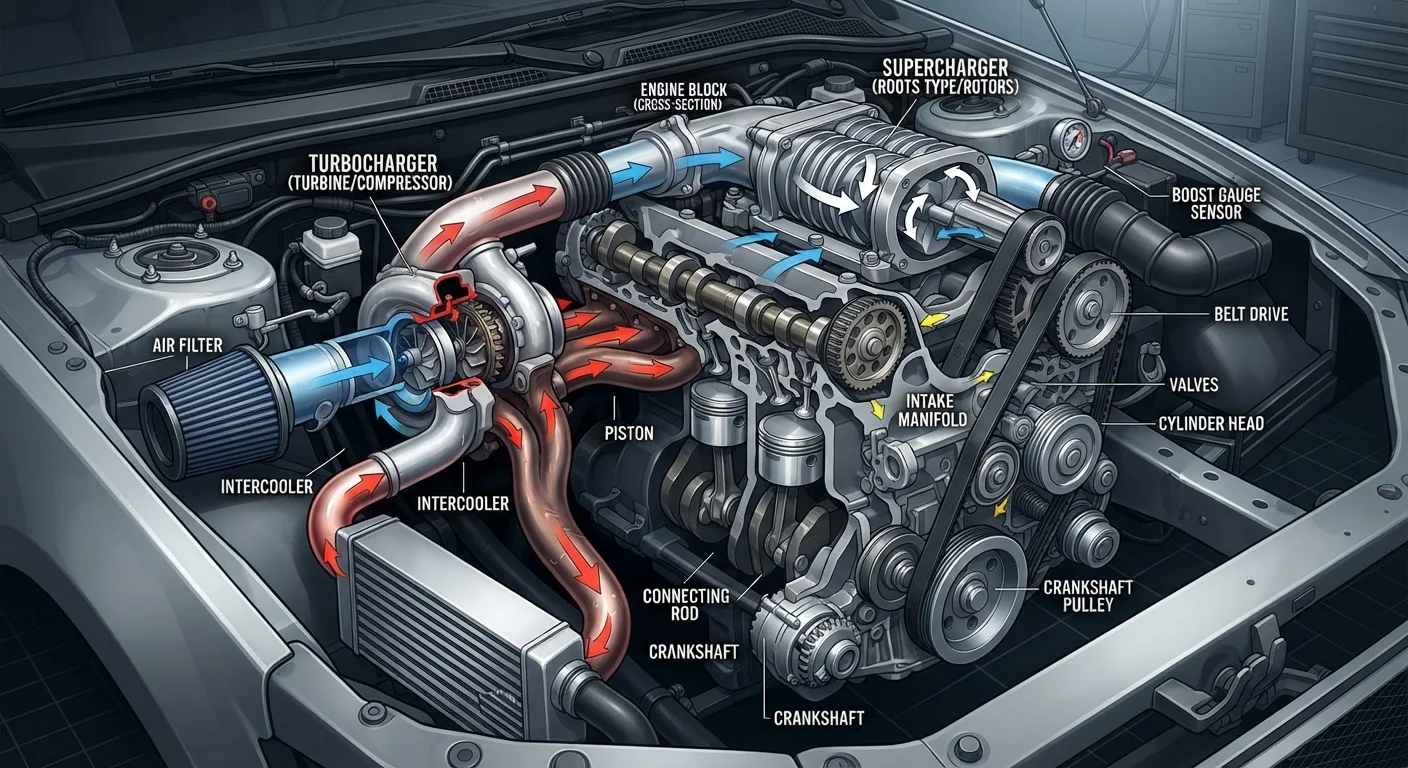
Photo credit: faqsnest.com
In this article
Both systems push more air into an engine — but they work differently and suit different driving needs. Here's what distinguishes them.
Key Takeaways
- Both systems force more air into the engine to produce more power from the same displacement.
- Turbochargers are driven by exhaust gases; superchargers are driven directly by the engine's crankshaft.
- Turbochargers can feel slow to respond at low RPM — a characteristic known as turbo lag.
- Superchargers deliver power more immediately but consume engine energy to do so.
- Many modern vehicles use turbocharging to improve fuel economy without sacrificing output.
- Some performance engines combine both systems for broad power delivery across all RPM ranges.
What Both Systems Are Actually Doing
Internal combustion engines make power by burning a mixture of air and fuel. The more air an engine can pack into its cylinders per combustion cycle, the more fuel it can burn — and the more power it produces. Forced induction is simply the practice of using a mechanical device to compress that intake air before it enters the cylinders, pushing in more than atmospheric pressure alone would deliver.
Without forced induction, an engine relies on natural air pressure to fill its cylinders — a process called naturally aspirated operation. Forced induction bypasses that limitation. It effectively lets a smaller engine punch above its displacement, or allows a larger engine to produce significantly more output than its size would otherwise suggest.
Both turbochargers and superchargers accomplish this compression goal. Where they differ is entirely in how they get their energy to spin the compressor. That single difference cascades into distinct power characteristics, efficiency profiles, and installation trade-offs. For a broader look at how this fits into the engine system as a whole, see our guide to eight key systems under the hood.
How a Turbocharger Works
A turbocharger consists of two turbine wheels connected by a shared shaft, housed in a split casing. One wheel sits in the exhaust stream and is spun by hot exhaust gases leaving the engine. That spinning motion transfers through the shaft to the second wheel — the compressor — which pulls in fresh intake air, compresses it, and pushes it into the engine.
Because turbochargers are powered by exhaust energy that would otherwise be wasted, they're considered relatively efficient. They don't place a direct mechanical load on the crankshaft the way a supercharger does.
The trade-off is turbo lag: at low engine speeds, exhaust flow isn't strong enough to spin the turbine quickly, so boost pressure builds slowly. There's a brief delay between pressing the accelerator and feeling the full surge of power. Modern engineering has narrowed this gap considerably — variable geometry turbines, twin-scroll housings, and smaller turbine wheels all help — but some lag typically remains, especially at very low RPM.
| Criterion | Turbocharger | Supercharger |
|---|---|---|
| Power source | Exhaust gas energy | Engine crankshaft (belt-driven) |
| Throttle response | Delayed at low RPM (turbo lag) | Immediate across RPM range |
| Fuel efficiency impact | Generally more favorable | Parasitic load reduces efficiency |
| Packaging complexity | Requires exhaust plumbing and intercooler | Mounts directly to engine intake |
| Heat generated | Very high (exhaust-driven) | Moderate by comparison |
| Common applications | Mainstream cars, diesel trucks, performance vehicles | High-output performance and muscle car engines |
| Oil sensitivity | High — clean oil critical for longevity | Lower — primarily belt and bearing maintenance |
How a Supercharger Works
A supercharger is a compressor driven directly by the engine's crankshaft, typically through a belt-and-pulley system. Because it's mechanically connected, boost pressure rises in direct proportion to engine speed — the moment the engine spins faster, so does the supercharger.
This produces a key advantage: immediate, linear power delivery. There's no lag waiting for exhaust gases to build up. Press the accelerator and the engine responds right away across the RPM range. This quality makes superchargers particularly popular in applications where low-speed torque and predictable throttle feel matter.
The cost is mechanical efficiency. Because the supercharger is belt-driven off the crankshaft, it consumes some of the engine's output just to run. This parasitic load is always present, whether or not you're pressing hard on the accelerator. In return, you get consistent, immediate boost — a trade-off that suits certain performance applications well.
30–40%
Typical power increase from forced induction
Engineering literature generally indicates forced induction can raise engine output by 30–40% or more compared to the same displacement naturally aspirated, depending on boost pressure and tune.
150,000+ RPM
Turbocharger turbine spin speed
Turbocharger turbines commonly spin well over 100,000 RPM under boost, which is why oil quality and cool-down periods after hard driving matter for longevity.
3–5%
Estimated parasitic loss from a supercharger
Estimates in automotive engineering literature suggest belt-driven superchargers can consume roughly 3–5% of engine output just to operate the compressor itself.
Real-World Implications for Drivers
For everyday driving, the distinction mostly shows up in how a vehicle feels at different speeds. A turbocharged engine may feel a bit hesitant pulling away from a stop or at low throttle, then deliver a noticeable surge as RPM climbs and boost builds. A supercharged engine tends to feel more responsive from the moment you accelerate, with power available on demand.
From a maintenance perspective, both systems add mechanical complexity relative to a naturally aspirated engine. Turbochargers run at extremely high temperatures and require clean, high-quality engine oil to lubricate properly — oil change discipline matters more on a turbocharged vehicle. Superchargers generally run cooler but introduce their own belt, bearing, and seal maintenance considerations over time.
It's also worth noting that forced induction is one approach to extracting more performance from combustion engines — a technology that exists alongside the broader shift toward electrification. If you're curious about how combustion-based power delivery compares to electric drivetrains at a fundamental level, our electric vs combustion engine comparison covers the core differences. And for drivers exploring hybrid technology, which sometimes pairs turbocharged engines with electric assist, our hybrid architecture breakdown is worth a read.
Neither system is universally superior. Each reflects a deliberate engineering choice about where to prioritize: efficiency and packaging, or immediacy and simplicity of power delivery.

Author
Cars & Driving Editorial Team
Cars & Driving Editorial Team is the collective byline for our editorial team and contributor network. Articles published under this byline or an editorial pen name are researched, written, and reviewed according to our editorial standards for clarity, consistency, and independence before publication.
View all articles →