
What Suspension Actually Does — and the Trade-Offs in Every Design
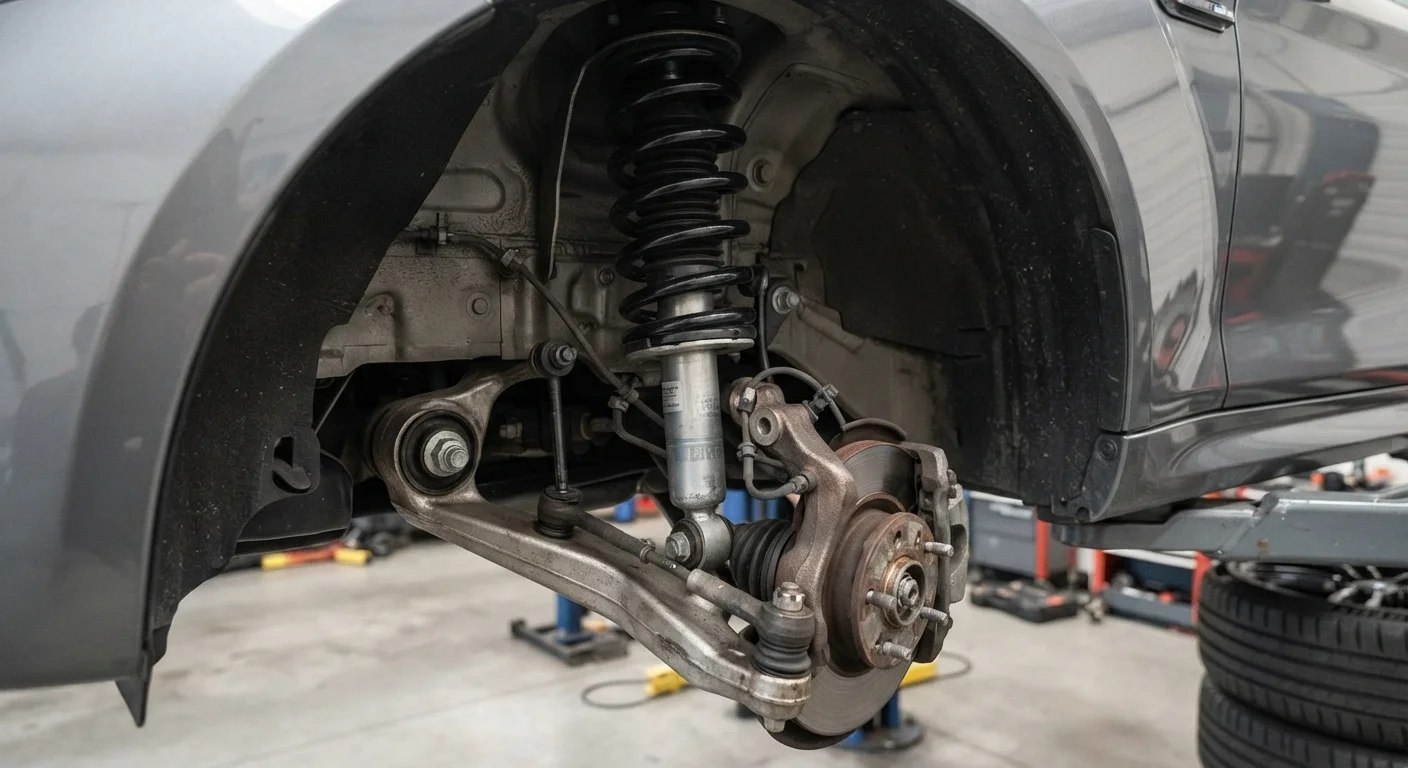
Photo credit: faqsnest.com
In this article
Suspension balances ride comfort against handling precision. Understanding its basic principles helps explain why cars feel so different from one another.
Key Takeaways
- Suspension serves two jobs simultaneously: absorbing road shock and keeping tires planted on the pavement.
- Every suspension design is a compromise — engineers trade ride comfort against handling precision.
- Independent suspension improves ride quality per wheel; solid axles are simpler and more durable under heavy loads.
- Adaptive dampers can shift between comfort and sport modes, but add cost and complexity.
- Understanding suspension basics helps drivers interpret how a car will behave before they buy or modify it.
Independent suspension greatly improves ride comfort
Each wheel responds to its own road inputs, so a bump on one side doesn't disturb the other. This makes a meaningful difference on irregular road surfaces.
Softer tuning reduces cabin fatigue on long drives
Lower spring rates and compliant dampers absorb more road texture, keeping occupants comfortable over hours of highway driving.
Solid axles offer proven durability under load
Simpler geometry and fewer pivot points mean less to break or wear out, which is why trucks and off-road vehicles continue to use them for rear axles.
Adaptive systems can serve multiple purposes
Electronically adjustable dampers let a single vehicle switch between comfort-focused and handling-focused modes, reducing the need for a compromise in either direction.
Well-designed suspension extends tire life
Proper wheel geometry and consistent tire contact distribute wear more evenly, which can meaningfully extend how long a set of tires lasts.
Stiffer tuning transmits more road noise and vibration
The same firmness that limits body roll in corners also sends more road texture into the cabin, which some drivers find fatiguing on rough pavement.
Independent suspension adds mechanical complexity
More pivot points, bushings, and joints mean more components that can wear. Repair costs are generally higher than equivalent solid-axle setups.
Soft suspension can compromise handling predictability
Excessive body roll changes wheel camber (the angle of the tire relative to vertical), which can reduce cornering grip in a way that catches an unprepared driver off guard.
Adaptive damper repairs can be expensive
Electronic damping systems require specialized diagnosis. A failed adaptive damper on an out-of-warranty vehicle can cost significantly more than a conventional shock absorber replacement.
Lowered springs without matched dampers accelerate wear
Fitting aftermarket lowering springs without upgrading the dampers forces the shock absorbers to operate outside their designed range, shortening their service life.
The Two Jobs Suspension Has to Do at Once
Suspension exists to solve a tension that can't be fully resolved — only managed. On one side, you want the cabin to feel smooth and isolated from the road. On the other, you need the tires to stay in contact with the pavement so steering, braking, and acceleration actually work. These two goals pull against each other constantly.
Every bump the road sends into a tire creates energy. Suspension components — primarily springs and dampers (commonly called shock absorbers) — absorb and dissipate that energy before it reaches the passengers. Springs compress to take the hit; dampers control how quickly the spring rebounds, preventing the car from bouncing repeatedly like a pogo stick.
At the same time, the suspension must keep each tire's contact patch pressed against the road surface. A tire that's bouncing or lifting slightly can't transmit braking or cornering forces effectively. That's why suspension tuning matters well beyond ride comfort — it's directly tied to safety. For a broader look at how this system fits alongside others under the vehicle, see our guide to key vehicle systems.
Independent vs. Solid Axle: The Fundamental Split
The most significant design choice in suspension engineering is whether each wheel moves independently or whether two wheels on the same axle are linked.
Independent suspension allows each wheel to rise and fall on its own. When the left front wheel hits a pothole, the right front wheel is unaffected. This dramatically improves ride quality and handling, especially on uneven roads. Double-wishbone and MacPherson strut setups are the most common forms on passenger cars.
Solid axle (or live axle) designs connect two wheels with a rigid beam. When one wheel moves, the other is influenced. This sounds like a drawback — and for ride quality, it often is — but solid axles are mechanically simpler, more durable under heavy loads, and maintain consistent wheel geometry under significant stress. They remain common on trucks, heavy-duty SUVs, and off-road vehicles for exactly those reasons.
Independent suspension greatly improves ride comfort
Each wheel responds to its own road inputs, so a bump on one side doesn't disturb the other. This makes a meaningful difference on irregular road surfaces.
Softer tuning reduces cabin fatigue on long drives
Lower spring rates and compliant dampers absorb more road texture, keeping occupants comfortable over hours of highway driving.
Solid axles offer proven durability under load
Simpler geometry and fewer pivot points mean less to break or wear out, which is why trucks and off-road vehicles continue to use them for rear axles.
Adaptive systems can serve multiple purposes
Electronically adjustable dampers let a single vehicle switch between comfort-focused and handling-focused modes, reducing the need for a compromise in either direction.
Well-designed suspension extends tire life
Proper wheel geometry and consistent tire contact distribute wear more evenly, which can meaningfully extend how long a set of tires lasts.
Stiffer tuning transmits more road noise and vibration
The same firmness that limits body roll in corners also sends more road texture into the cabin, which some drivers find fatiguing on rough pavement.
Independent suspension adds mechanical complexity
More pivot points, bushings, and joints mean more components that can wear. Repair costs are generally higher than equivalent solid-axle setups.
Soft suspension can compromise handling predictability
Excessive body roll changes wheel camber (the angle of the tire relative to vertical), which can reduce cornering grip in a way that catches an unprepared driver off guard.
Adaptive damper repairs can be expensive
Electronic damping systems require specialized diagnosis. A failed adaptive damper on an out-of-warranty vehicle can cost significantly more than a conventional shock absorber replacement.
Lowered springs without matched dampers accelerate wear
Fitting aftermarket lowering springs without upgrading the dampers forces the shock absorbers to operate outside their designed range, shortening their service life.
Spring Rate and Damping: Where the Real Trade-Offs Live
Once you understand the architecture, the next layer is tuning — specifically, spring rate and damping force.
Spring rate describes how stiff the spring is. A higher spring rate resists compression more, keeping the car flatter in corners but transmitting more road texture into the cabin. A lower spring rate gives a plush ride but allows more body roll when cornering.
Damping force controls rebound speed. Firm dampers keep body motion crisp and predictable, which experienced drivers often prefer. Soft dampers feel more forgiving on rough surfaces but can allow the car to wallow through direction changes.
What 'Unsprung Weight' Actually Means
Unsprung weight refers to components not supported by the springs — wheels, tires, brake rotors, and in solid-axle designs, the axle housing itself. Lower unsprung weight allows the tire to follow road contours more quickly, improving both ride quality and grip. This is one reason engineers work to keep wheel and brake components as light as practical, and why large, heavy wheels on an otherwise standard suspension can subtly degrade ride quality even when the springs and dampers are unchanged.
Adaptive damper systems — found on many modern vehicles — use electronically controlled valves to adjust damping in real time. In practice, this lets a car feel compliant on a highway cruise and firm during spirited driving. The technology works well, but it adds mechanical and electronic complexity that can be expensive to diagnose or repair outside the warranty period.
Similar engineering trade-offs appear throughout a vehicle's drivetrain. Our transmission types explainer covers comparable compromises between driver engagement and mechanical simplicity.
Why Electric and Hybrid Vehicles Complicate the Equation
Battery-electric and hybrid vehicles add another variable: mass distribution. Large battery packs mounted low in the floor lower the center of gravity, which can actually benefit handling by reducing body roll. However, the added weight increases the forces that suspension components must manage, which often pushes engineers toward stiffer springs to compensate.
Heavier vehicles also demand more from dampers during braking — regenerative or otherwise — because the system has more kinetic energy to control when the nose dives under deceleration. Engineers working on electric platforms frequently redesign suspension geometry from the ground up rather than adapting existing setups.
If you want to understand how different hybrid architectures influence vehicle weight and energy management, our hybrid architecture comparison covers that in detail.
~30%
Typical unsprung weight reduction with independent rear suspension
Automotive engineers generally cite meaningful reductions in unsprung mass when switching from solid to independent rear setups, which directly affects how quickly tires respond to road inputs.
2–3x
Cost difference between adaptive and conventional damper replacement
Industry repair data consistently shows electronically controlled dampers cost substantially more to replace than conventional units, a factor worth weighing when evaluating optional adaptive suspension packages.

Author
Cars & Driving Editorial Team
Cars & Driving Editorial Team is the collective byline for our editorial team and contributor network. Articles published under this byline or an editorial pen name are researched, written, and reviewed according to our editorial standards for clarity, consistency, and independence before publication.
View all articles →