
The Sound Design Elements Most Viewers Never Consciously Notice
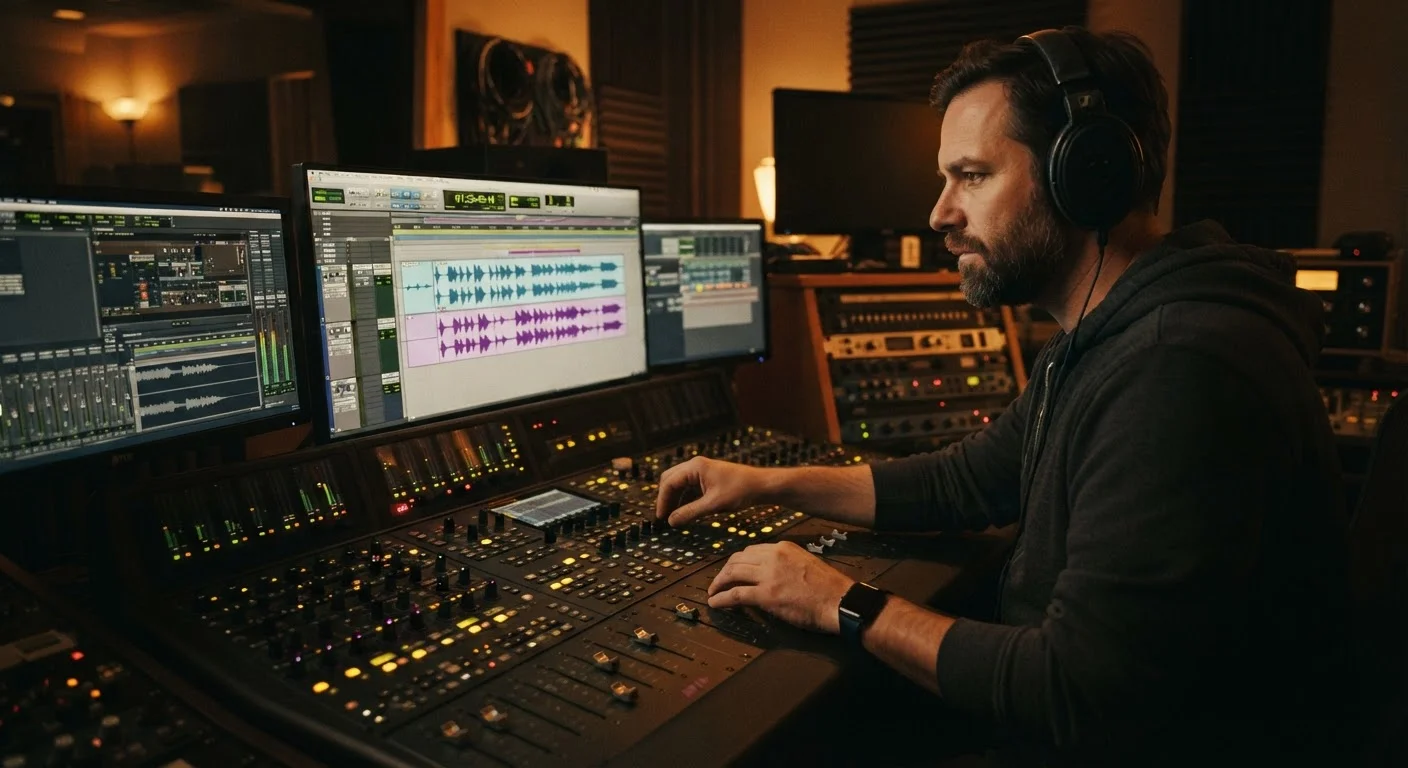
Photo credit: faqsnest.com
In this article
Foley, room tone, silence as emphasis — discover the invisible audio craft that shapes emotional response in film and television.
Key Takeaways
- Most of the sound in a finished film is constructed in post-production, not recorded on set.
- Foley artists recreate everyday sounds — footsteps, rustling fabric, object handling — in a dedicated studio.
- Room tone, a nearly silent ambient recording, prevents jarring cuts between dialogue lines.
- Strategic silence is a powerful narrative tool, not simply the absence of sound.
- Sound perspective — how audio shifts with camera distance — reinforces spatial realism subconsciously.
- Effective sound design is invisible; when it works, audiences feel the effect without identifying the cause.
The Invisible Architecture of Audio
When a film moves an audience to tears or makes them grip their armrests, credit typically goes to the performances, the script, or the cinematography. Rarely does anyone walk out of a theater thinking about the sound of footsteps on gravel, the low electrical hum in a hospital corridor, or the precise moment a scene goes completely silent. Yet those elements are doing profound emotional work, operating just beneath conscious awareness.
Sound design is a discipline that constructs the entire audio world of a production — everything that isn't dialogue or score. It is one of filmmaking's most technically demanding and least publicly discussed crafts. Understanding how it functions transforms the viewing experience. As part of a broader framework for active film analysis — explored in watching a film critically — sound design deserves the same analytical attention given to cinematography or mise-en-scène.
Foley: The Sounds You Think Are Real
The footsteps you hear in a scene were almost certainly not recorded when the actor walked across the set. On a working production, microphones capture dialogue with boom mics positioned close to performers, which means ambient environmental sounds are inconsistent, contaminated by equipment noise, or simply absent. Enter Foley.
Named after Universal Studios sound pioneer Jack Foley, this practice involves trained artists performing sounds on a specialized stage in sync with the projected image. A Foley artist might crunch a bag of cornstarch to replicate footsteps in snow, slap a leather glove against a surface for a punch impact, or rattle a metal sheet to simulate thunder. The results feel authentic because they are physically performed rather than digitally generated.
~200–400
Foley cues in a typical feature film
Industry estimates from sound post-production professionals suggest a standard dramatic feature requires hundreds of individually performed Foley sounds to complete its audio track.
5–10%
Usable on-set audio in major productions
Sound editors working on major studio productions have noted that only a fraction of location-recorded sound typically survives into the final mix without extensive replacement or augmentation.
3–6 months
Post-production sound timeline for a feature film
The sound post-production phase of a major feature film — covering editing, Foley, effects, score integration, and final mixing — commonly spans several months for a theatrical release.
What distinguishes skilled Foley from merely functional work is specificity. The way a character handles a coffee cup — the ceramic weight, the slight scrape on a table — communicates subtext. A nervous character's movements produce different sonic textures than a confident one's. Sound designers and Foley artists make those choices deliberately, reinforcing character psychology through audio detail that viewers absorb without analysis.
Room Tone, Presence, and the Sound of Nothing
After principal photography wraps on any location, a standard practice is to record approximately one minute of silence — everyone still, no one speaking, no movement. This is called room tone or presence. Every space has a unique ambient fingerprint: the faint resonance of its dimensions, the hum of climate systems, the pressure of outdoor noise bleeding through walls.
Dialogue editors use room tone as a kind of sonic glue. When assembling a scene from multiple takes, cuts between lines would otherwise produce audible jumps — a subtle but disorienting audio hiccup that signals an edit. Filling those gaps with the location's own ambient sound preserves the illusion of continuity. The viewer never notices the technique; they only notice its absence when it's missing.
This granular attention to acoustic space connects directly to how sound communicates environment. Just as mise-en-scène encodes meaning in visual composition, the acoustic texture of a space tells audiences where they are and how to feel about it before any plot information arrives.
Silence as Narrative Emphasis
Cinema trains audiences to expect a continuous audio environment. Scores swell, effects punctuate action, ambient layers fill every pause. This conditioning makes deliberate silence one of the most potent tools in a sound designer's kit.
When sound abruptly withdraws — a battle scene suddenly going muffled and distant as a character loses hearing, or a crowded room falling silent the moment devastating news lands — the contrast itself becomes the message. The brain registers the void as significant. Physiologically, sudden quiet can produce an alertness response similar to a loud noise, because the sensory expectation has been violated.
Directors deploy this technique at moments of maximum emotional weight: a character's death, a traumatic revelation, a moment of profound solitude. The strategic use of silence is closely related to how unreliable narrative tools manipulate audience perception — much like the techniques examined in the unreliable narrator in film. Both exploit the gap between what audiences expect and what they receive.
How to Actively Listen to Sound Design
On your next viewing, watch one scene with your eyes closed and focus entirely on the audio layers — identify what you can hear beyond dialogue. Then watch a quiet scene a second time and notice what the ambient environment communicates about mood or setting. This practice rapidly builds awareness of sound design as a narrative system rather than background texture.
Sound Perspective and Spatial Realism
A fundamental principle of sound design is that audio should reflect a camera's relationship to its subject — what practitioners call sound perspective. A wide exterior shot of a city should carry a broad, reverberant soundscape. A tight close-up in a confined space should feel acoustically intimate, the ambient layers narrowing with the frame.
When sound perspective is properly executed, it reinforces spatial realism without drawing attention to itself. When it's wrong — when a close-up carries the acoustic profile of a large room, or an outdoor scene sounds like a studio — viewers register discomfort without being able to articulate why. The disconnect between visual and audio information creates a subtle but persistent sense that something is off.
This kind of invisible technical craft is analogous to understanding how language works in music criticism — the terminology is specialized but the underlying principle is about how meaning is constructed layer by layer. Exploring music criticism's vocabulary reveals similar dynamics: craft becomes transparent when it succeeds and conspicuous when it fails.
Effective sound design, at its best, disappears entirely into the experience it creates — which is precisely what makes it so worth paying attention to.
Frequently Asked Questions

Author
Entertainment & Media Editorial Team
Entertainment & Media Editorial Team is the collective byline for our editorial team and contributor network. Articles published under this byline or an editorial pen name are researched, written, and reviewed according to our editorial standards for clarity, consistency, and independence before publication.
View all articles →