
Tyre Maintenance from the Ground Up
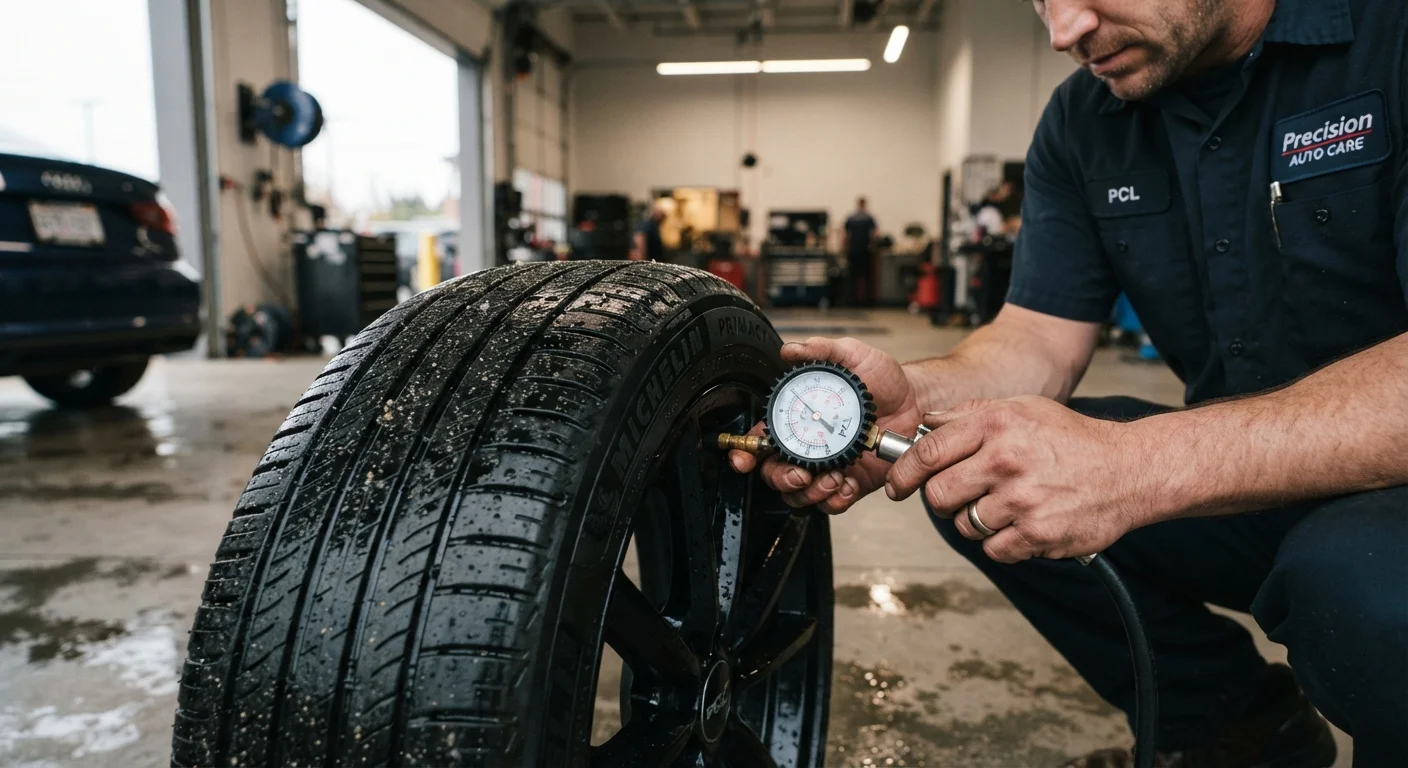
Photo credit: faqsnest.com
In this article
Pressure, tread depth, rotation, and alignment — everything a non-specialist driver needs to understand about keeping tyres road-ready.
Key Takeaways
- Check tyre pressure at least once a month and always before long trips.
- U.S. law sets a minimum tread depth of 2/32 inch, but 4/32 inch is a safer real-world threshold.
- Rotating tyres every 5,000–7,500 miles evens out wear and extends tyre life.
- Misaligned wheels cause uneven wear and can affect handling and fuel economy.
- Visual checks take two minutes and can catch damage before it becomes a roadside emergency.
Why Tyres Deserve Your Attention
Your tyres are the only parts of the vehicle that actually contact the road. Every braking decision, every corner, every lane change depends entirely on four patches of rubber — each roughly the size of a hand. Yet tyres are among the most neglected components a driver owns.
Poorly maintained tyres shorten stopping distances, reduce handling precision, and increase the risk of a blowout. They also quietly drain your fuel economy. The good news is that tyre care doesn't require specialist knowledge or tools. A pressure gauge, a tread depth checker (or a coin in a pinch), and a basic inspection routine go a long way.
This guide covers everything a non-specialist driver needs to know — pressure, tread, rotation, alignment, and when to call it time on a set of tyres. For a broader look at what else needs attention over the year, see the seasonal car maintenance checklist that covers the major checkpoints across all seasons.
Tyre Pressure: The One Check Everyone Should Do
Tyre pressure is measured in PSI (pounds per square inch). The correct figure for your vehicle is on a sticker inside the driver's door jamb — not on the tyre sidewall, which shows the maximum pressure the tyre can handle, not the recommended operating pressure.
Most passenger cars run between 32 and 36 PSI. SUVs and trucks often require higher figures. Check your owner's manual if you can't find the door sticker.
1 in 4
Vehicles on the road with at least one underinflated tyre
The National Highway Traffic Safety Administration (NHTSA) has consistently found significant rates of tyre underinflation in roadway surveys.
~3%
Fuel economy lost per 1 PSI drop in tyre pressure
The U.S. Department of Energy estimates fuel economy improves by roughly 0.5% for every 1 PSI gain across all four tyres — making proper inflation a meaningful efficiency factor.
4/32"
Recommended tread replacement threshold for wet roads
Testing by tyre safety organizations has shown braking distances increase substantially below 4/32 inch on wet pavement, even though the legal minimum is 2/32 inch.
How to Check Pressure Correctly
- Check when the tyres are cold — meaning the car hasn't been driven for at least three hours, or less than a mile at low speed. Heat from driving expands the air inside and gives a false high reading.
- Remove the valve cap (the small rubber or metal cap on the wheel rim), press the gauge firmly onto the valve stem, and read the result.
- Add or release air to reach the target PSI. Many gas stations have air pumps; a portable 12V compressor is a worthwhile investment for home use.
- Don't forget the spare — a flat spare at the moment you need it is a real problem.
Check pressure at least once a month and before any road trip. Temperatures affect pressure: for roughly every 10°F drop in ambient temperature, tyres lose about 1 PSI. This is why pressure warnings spike in autumn and winter.
Keep a small digital tyre gauge in your glove box — they're inexpensive and far more accurate than the stick gauges built into many gas station air pumps.
Accuracy matters when the difference between correct and incorrect pressure can be just a few PSI. An unreliable gauge gives false confidence.
If your TPMS (Tyre Pressure Monitoring System) warning light comes on, don't assume a small underinflation is harmless — pull over safely and check all four tyres as soon as possible.
TPMS lights typically activate when a tyre is 25% below recommended pressure, which is already a meaningful safety deficit, not a minor inconvenience.
Tread Depth: Understanding the Legal Minimum and Safe Practice
Tread channels water away from the contact patch. As tread wears down, wet-weather grip drops significantly, and stopping distances increase. In the U.S., the legal minimum tread depth is 2/32 of an inch. Most tyre manufacturers and safety organizations recommend replacing tyres before you reach that threshold — around 4/32 of an inch is a more prudent practical limit, particularly in wet or wintry conditions.
How to Measure Tread
Tyre depth gauges cost a few dollars and give an accurate reading. Alternatively, use the penny test as a rough check: insert a penny into the tread groove with Lincoln's head pointing down. If you can see all of Lincoln's head, the tread is at or below 2/32 inch — time to replace. A quarter used the same way reveals 4/32 inch; if you can see the top of Washington's head, you're getting close to the replacement window.
New tyres typically start at 10/32 to 11/32 inch. Tread wear indicator bars — small raised sections molded into the grooves — become flush with the surrounding tread at 2/32 inch, giving you a visual signal that you've hit the legal limit.
If you're new to reading tyre markings and want to understand what the numbers on your sidewall actually mean, the tyre markings decoded guide explains each element clearly.
Tyre Rotation: Making Your Set Last Longer
Tyres don't wear evenly. Front tyres on a front-wheel-drive vehicle carry the load of steering and power delivery, so they wear faster than the rears. Rear-wheel-drive vehicles have the opposite pattern on the driven axle. All-wheel-drive vehicles can develop complex uneven wear patterns across all four corners.
Rotating tyres — moving them to different positions on the vehicle — evens out that wear and extends the usable life of the full set. A general guideline is to rotate every 5,000 to 7,500 miles, though your owner's manual may specify a different interval. Many drivers simply rotate at every other oil change as an easy way to remember.
Rotation Patterns
The most common pattern for non-directional tyres (tyres that can be mounted in either direction) on a front-wheel-drive car moves the fronts straight back and crosses the rears to the front. Directional tyres — which have a tread pattern designed to rotate in one specific direction — can only be swapped front to rear on the same side. A qualified mechanic can confirm which pattern suits your vehicle and tyre type.
Rotation is an easy place to save money while extending a significant investment. The guide to car maintenance on a budget covers how to prioritize tasks like this when you're watching costs.
Wheel Alignment and Balancing
Alignment and balancing are related but distinct services that often get confused.
Alignment
Wheel alignment refers to the angle at which your tyres meet the road. When alignment is off — caused by hitting a pothole, curb, or through general suspension wear — your tyres scrub against the pavement at a slight angle. You may notice the car pulling to one side, or a steering wheel that sits crooked on a straight road. Uneven tyre wear (one edge wearing faster than the other) is a classic symptom. Alignment should be checked annually or any time you notice those symptoms, and always after a significant impact.
Balancing
Wheel balancing corrects small weight imbalances in a tyre-and-wheel assembly. An out-of-balance wheel causes vibration — typically felt through the steering wheel at highway speeds. Technicians add small weights to the rim to correct this. Balancing is typically done whenever new tyres are mounted and can be rechecked during rotation if vibration develops.
Both services require a shop with the right equipment. They are not DIY tasks for a home driveway. If you're interested in understanding more about the interconnected systems that affect your driving experience, the under the bonnet systems guide is a useful companion read.
Visual Inspections and When to Replace
A two-minute walk-around before you drive — or at minimum weekly — can catch problems that could become dangerous on the road. Here's what to look for:
- Sidewall bulges or bubbles: A bulge indicates internal damage to the tyre's structure, often from a hard impact. A tyre in this condition can fail without warning and should not be driven on.
- Cuts, cracks, or embedded objects: Small nails or screws may cause a slow leak rather than immediate deflation. A tyre shop can assess whether a puncture is repairable — generally it must be in the central tread area and not too large.
- Cracking in the sidewall: Rubber degrades over time even without heavy use. Visible cracking (sometimes called dry rot) suggests age-related deterioration. Many manufacturers recommend replacing tyres older than six years regardless of remaining tread depth, with ten years considered an absolute maximum.
When any of these signs appear, or when tread reaches 4/32 inch, it's time to schedule a replacement. Don't wait until you're at the 2/32 inch legal minimum.
For first-time owners building their overall maintenance knowledge, the first-time driver's grounding guide offers a solid starting point across all the key areas. Pairing tyre care with the rest of your vehicle's needs — fluids, filters, and seasonal checks — keeps you ahead of problems rather than reacting to them.
This article provides general educational information about tyre maintenance. Always consult your vehicle's owner's manual and a qualified mechanic for guidance specific to your vehicle. Do not perform tyre or wheel work beyond your skill level — incorrect fitting or repair can create serious safety hazards.

Author
Cars & Driving Editorial Team
Cars & Driving Editorial Team is the collective byline for our editorial team and contributor network. Articles published under this byline or an editorial pen name are researched, written, and reviewed according to our editorial standards for clarity, consistency, and independence before publication.
View all articles →